
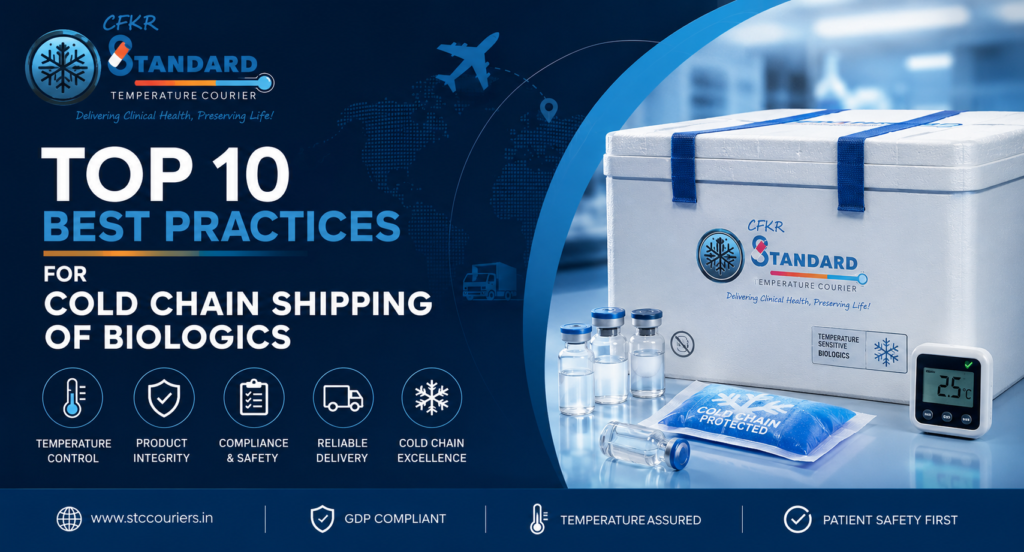
STC Couriers delivers reliable cold chain shipping for biologics with validated packaging, temperature monitoring, and GDP-compliant logistics to ensure product safety and integrity throughout transit.
Biologics are some of the most valuable and most fragile products in the pharmaceutical world. A single temperature excursion during transit can destroy a vaccine batch worth lakhs of rupees or, worse, put a patient at risk. Unlike small molecule drugs, biologics such as vaccines, insulin, and monoclonal antibodies are made from living cells or proteins, which means even a short deviation outside the approved temperature range can permanently break down their structure and make them ineffective or unsafe. This guide walks through ten proven practices that keep biologics stable from the manufacturing floor to the patient, and explains how the right cold chain packaging solutions make that possible.
What Is Cold Chain Shipping of Biologics
Cold chain shipping of biologics is the process of transporting temperature sensitive biological products, such as vaccines, insulin, monoclonal antibodies, and gene therapies, within a controlled temperature range from origin to destination. The goal is to prevent degradation caused by heat, cold, or fluctuation. This process depends on validated packaging, continuous monitoring, and a chain of custody where every handler follows the same temperature protocol. Cold storage pharmaceutical operations and cold chain transportation in India have grown rapidly in the last decade, driven by rising vaccine production and expanding biologics manufacturing.
1. Choose the Right Cold Chain Packaging Solution for the Product
Not every biologic needs the same packaging. A vaccine that must stay between 2 and 8 degrees Celsius has very different requirements from a gene therapy product that needs deep frozen storage at minus 70 degrees. Before selecting packaging, teams should map the exact temperature range, the shipping duration, and the external climate the shipment will pass through. Many shippers make the mistake of using one packaging format for every product, which leads to unnecessary cost or, in the worst case, a failed shipment. Working with experienced cold chain packaging companies helps because they can recommend validated systems tested for specific payload sizes and routes rather than generic boxes.
2. Validate Packaging Under Real World Conditions
Packaging that looks good on paper can still fail in the field. Every packaging configuration should go through thermal validation testing that simulates the actual journey, including summer heat, monsoon humidity, and handling delays at airports or customs. This testing should cover the full expected duration plus a safety buffer, usually an extra twelve to twenty four hours, to account for unexpected delays. Validation reports should be kept on file because regulators and auditors often ask for proof that packaging was tested under conditions similar to the real shipping lane.
3. Use Data Loggers on Every Shipment
A temperature excursion that is not recorded is a risk that goes unnoticed until it is too late. Every biologics shipment should carry a calibrated data logger that records temperature at regular intervals throughout the journey. Modern loggers offer real time alerts through cellular or Bluetooth connections, which means a warehouse team can respond to a temperature deviation before the product is compromised rather than discovering the problem after delivery. This single practice has probably saved more biologics batches than any other tool in cold chain transportation in India.
4. Train Every Handler in the Chain
A cold chain is only as strong as its weakest link, and that link is usually a person, not a piece of equipment. Warehouse staff, delivery drivers, and even the person accepting the shipment at a hospital or clinic need clear training on how to store, handle, and log temperature sensitive products. Simple mistakes, like leaving a shipment on a loading dock in direct sunlight for twenty minutes, can cause damage that no packaging can fully prevent. Regular refresher training and clear standard operating procedures reduce this human risk significantly.
5. Build Redundancy Into the Cold Chain Network
Relying on a single refrigerated vehicle or a single storage facility is risky because equipment failures and power cuts happen more often than most teams expect. A resilient cold chain management India strategy includes backup generators at storage sites, alternate vehicle routes, and secondary storage locations that can absorb a shipment if the primary site fails. Companies that build this redundancy into their network recover faster from disruptions and avoid the total loss of a batch when something goes wrong.
6. Plan for the Last Mile Separately
The last mile, meaning the final leg of delivery to a clinic, hospital, or pharmacy, is often the weakest part of the entire journey. Vehicles used for last mile delivery are smaller, trips are shorter but more frequent, and handling is less controlled than at a central warehouse. Planning last mile logistics as its own workstream, with its own packaging format and its own monitoring plan, prevents the common failure pattern where a shipment stays perfectly stable for thousands of kilometers only to fail in the final twenty.
7. Work With Specialized Cold Chain Logistics Partners
General logistics companies can move a lot of freight, but biologics need partners who understand pharmaceutical regulations, temperature validation, and emergency response protocols. Specialized cold chain logistics India providers usually hold certifications such as Good Distribution Practice compliance and maintain dedicated refrigerated fleets rather than shared cold storage. Choosing a partner based on price alone is a common and costly mistake, because the cheapest option rarely has the infrastructure needed to guarantee product integrity across a full shipping lane.
8. Keep Documentation Complete and Audit Ready
Regulators such as the Central Drugs Standard Control Organisation and international bodies expect complete documentation for every biologics shipment. This includes temperature logs, packaging validation reports, chain of custody records, and proof of corrective action if an excursion occurred. Missing documentation can delay customs clearance or, in serious cases, lead to a batch being rejected even if the product itself was never actually compromised. Digital record keeping systems make this process faster and reduce the chance of lost paperwork.
9. Design for Climate and Route Specific Risks
India spans several climate zones, from the humid coast to the dry heat of the northern plains, and each route brings its own risk profile. A shipment moving through Chennai in May faces very different heat exposure than one moving through Shimla in December. Route specific risk assessment, including expected ground handling time, customs delays, and seasonal temperature data, should feed directly into packaging and monitoring decisions rather than being an afterthought.
10. Review and Improve After Every Excursion
Every temperature excursion, even a minor one that did not damage the product, is useful data. Teams that conduct a root cause review after each incident, and actually change their process based on that review, see excursion rates drop significantly over time. Teams that skip this step tend to repeat the same failure on the same route again and again. Building a simple feedback loop between the quality team and the logistics team closes this gap.
Comparing Cold Chain Packaging Solutions
| Packaging Type | Temperature Range | Typical Duration | Best For |
|---|---|---|---|
| Passive insulated boxes with gel packs | 2°C to 8°C | Up to 96 hours | Vaccines, insulin, small parcel shipments |
| Vacuum insulated panels | 2°C to 8°C or -20°C | Up to 120 hours | High value biologics, long haul air freight |
| Active refrigerated containers | -20°C to 25°C, adjustable | Multiple days to weeks | Bulk shipments, ocean and rail freight |
| Dry ice packaging | -70°C and below | 48 to 96 hours | Gene therapies, deep frozen samples |
| Cryogenic dewars | Below -150°C | Weeks to months | Cell and gene therapy, biobanking |
Comparing Cold Chain Transportation Options in India
| Mode | Speed | Cost | Reliability for Biologics |
|---|---|---|---|
| Air freight | Fastest, one to two days domestic | Highest | High, if ground handling is well managed |
| Refrigerated road transport | Moderate, depends on distance | Moderate | High for regional and last mile delivery |
| Rail with refrigerated containers | Slower, but steady | Lower for bulk volumes | Good for planned, high volume shipments |
| Sea freight in refrigerated containers | Slowest | Lowest per unit | Suitable for stable, long shelf life biologics only |
Conclusion
Cold chain shipping of biologics succeeds or fails on the details, from the packaging material chosen on day one to the training given to the delivery driver on the last mile. Companies that invest in validated cold chain packaging solutions, build redundancy into their network, and treat every excursion as a learning opportunity consistently protect product quality better than those relying on outdated methods. Cutting corners on any single step, whether it is skipping thermal validation or using an untrained courier for the last mile, tends to show up eventually as a spoiled batch or a rejected shipment, so the cost of doing it right upfront is almost always lower than the cost of a failure later. As cold chain logistics in India continues to expand alongside the country’s growing pharmaceutical and biologics manufacturing base, these ten practices offer a practical starting point for any team looking to strengthen its cold chain management.
Frequently Asked Questions
What is the biggest risk in cold chain shipping of biologics?
The biggest risk is a temperature excursion that goes undetected, usually caused by equipment failure, poor packaging choice, or a gap in handling during transfer between vehicles or facilities.
How long can a passive packaging system keep biologics stable?
Most passive insulated systems with gel packs can maintain a stable 2°C to 8°C range for up to 96 hours, though this depends heavily on the outside temperature and how well the box was packed.
What temperature is required for most vaccines?
Most standard vaccines require storage and transport between 2°C and 8°C, though some newer vaccines and gene therapies require deep frozen conditions as low as -70°C.
Is air freight always the best option for biologics?
Air freight is usually the most reliable option for time sensitive biologics, but it is also the most expensive, so many companies use it only for high value or highly perishable shipments while using road or rail for less time sensitive cargo.
How do cold chain packaging companies test their solutions?
Reputable cold chain packaging companies run thermal simulation tests that mimic real shipping conditions, including extreme heat, extended transit delays, and repeated handling, to confirm the packaging holds the required temperature range for longer than the expected shipping duration.