
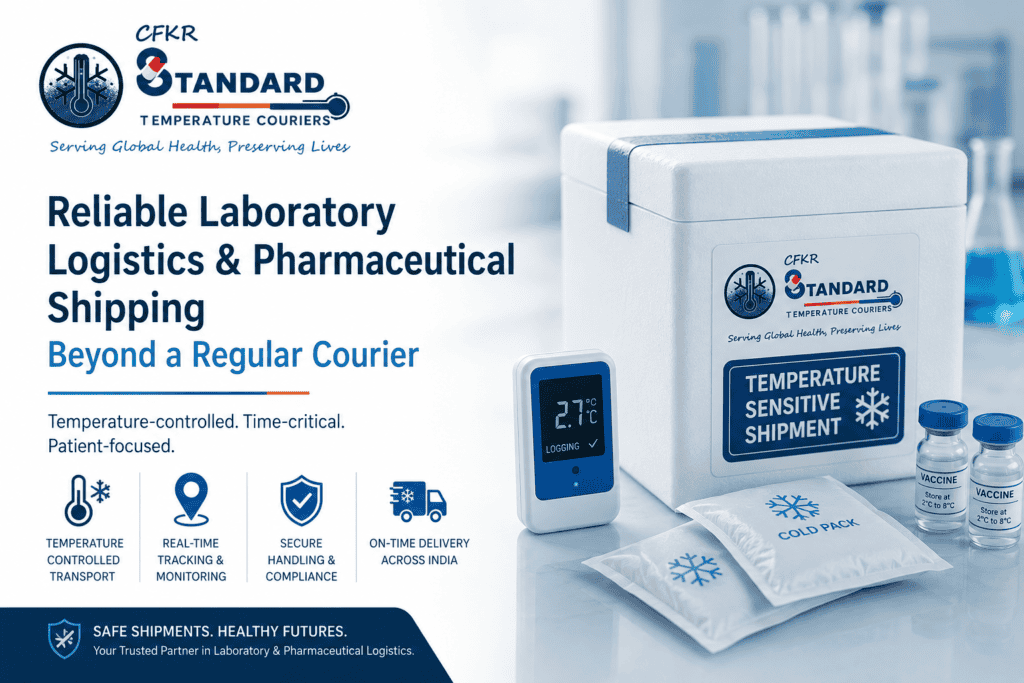
Safe Temperature-Controlled Healthcare Logistics
If you have ever wondered why hospitals and diagnostic labs do not just use regular courier services for their shipments, this blog will answer that question clearly. Moving a blood sample from one city to another is not the same as shipping a pair of shoes. The moment something goes wrong with temperature, timing, or packaging, the shipment is not just late. It is destroyed. And in healthcare, a destroyed shipment can mean a delayed diagnosis or a wasted dose of vaccine that a patient was waiting for.
This blog covers how temperature controlled transport works, what separates professional laboratory logistics providers from regular shipping companies, and what you should look for when choosing a pharmaceutical shipping partner in India.
What Makes Healthcare Shipments Different
Most products can tolerate a few hours in a hot delivery van. Medical products cannot. Blood samples, vaccines, biological medicines, clinical trial kits, diagnostic reagents, and tissue samples all have strict temperature requirements that must be maintained from the moment of pickup to the moment of delivery.
The World Health Organization has repeatedly stated that maintaining correct storage and transportation temperatures is essential for medical products. Even a few hours outside the required range can reduce the effectiveness of a vaccine or make a diagnostic sample completely unusable for testing.
Here is a simple breakdown of temperature ranges used in pharmaceutical and laboratory logistics:
Temperature Range | Products That Require It |
2°C to 8°C (Refrigerated) | Vaccines, blood samples, insulin, some biologics |
-20°C (Frozen) | Plasma, some diagnostic kits, frozen biologics |
Below -70°C (Deep Frozen) | Certain research samples, advanced biologics |
15°C to 25°C (Controlled Room Temperature) | Some oral medicines, diagnostic reagents |
Understanding which temperature range your product needs is the first step. The second step is finding a logistics provider that can actually maintain those conditions across the entire journey, not just at the pickup point.
The Real Problems in Pharmaceutical Logistics
Most discussions about logistics focus on delivery speed. While speed matters in healthcare, there are deeper problems that pharmaceutical and laboratory shipments face every day.
A temperature excursion happens when a shipment goes outside its required temperature window during transit. This can occur because of poor packaging, a delayed flight, a truck breakdown, or simply poor handling at a transfer point. The shipment might look perfectly fine on the outside, but the product inside is no longer effective or safe to use.
Transit delays are another serious issue. Unlike a delayed online shopping order, a delayed blood sample can mean inaccurate test results. A delayed vaccine shipment during a public health campaign can disrupt immunization coverage for thousands of people. According to the Centers for Disease Control and Prevention, cold chain failures in vaccine distribution are one of the key reasons for reduced vaccine effectiveness in certain regions.
Packaging failures are often underestimated. Validated thermal packaging systems are not cheap, and some logistics providers cut costs here. A properly designed pharmaceutical shipment uses insulated containers, gel packs at specific temperatures, dry ice where needed, and inner packaging that isolates the product from external temperature changes. A standard foam box from a general-purpose courier does not qualify.
What a Professional Laboratory Logistics Company Actually Provides
The difference between a regular courier and a pharmaceutical logistics company is not just about having refrigerated vehicles. It is about the entire system that surrounds the shipment from preparation to delivery.
Here is how the two compare across the key factors that matter in healthcare shipping:
Feature | Standard Courier | Pharmaceutical Logistics Company |
Temperature Control | Basic, no validation | Validated packaging across multiple temperature ranges |
Real-Time Monitoring | Usually not available | GPS and temperature data loggers throughout transit |
Handling Training | General parcel handling | Trained for biological and medical shipments |
Documentation | Basic waybill | Regulatory compliance documents, chain of custody records |
Emergency Response | Not available | Backup plans for transit failures and temperature deviations |
Delivery Timelines | Standard windows | Priority and same-day options for urgent samples |
Regulatory Knowledge | None | Follows IATA, WHO, and local healthcare guidelines |
When you look at this comparison, it becomes clear that pharmaceutical and laboratory shipments require a completely different level of service. Any company that offers cold chain logistics should be able to explain exactly how it handles each of these points before you hand over your first shipment.
Cold Chain Monitoring: The Technology Behind Safe Shipments
Modern pharmaceutical logistics providers do not rely on guesswork. They use technology to track and monitor shipments from the moment the package leaves the lab or warehouse to the moment it is delivered. This is where cold chain monitoring becomes the backbone of every reliable healthcare shipment.
Temperature data loggers are small devices placed inside the shipment packaging. They record temperature readings at regular intervals throughout transit. If a temperature excursion occurs, the log captures it with a timestamp and the exact temperature at that moment. This creates an accurate record that helps both the logistics provider and the client understand what happened and when.
GPS tracking allows the healthcare organization sending the shipment to know exactly where it is at any point during transit. This is important for time-sensitive samples and for planning lab operations around expected delivery windows.
Alert systems send notifications to both the logistics team and the client if the temperature moves outside acceptable limits. A trained response team can then take corrective action before the entire shipment is compromised.
The United States Pharmacopeia provides guidelines around pharmaceutical storage and transportation that recommend monitoring throughout the supply chain, not just at fixed storage points. This is the standard that serious pharmaceutical logistics companies follow.
Vaccine Distribution: Where Cold Chain Failures Have the Biggest Consequences
Vaccines are among the most temperature-sensitive products in healthcare logistics. Most vaccines lose their effectiveness when exposed to temperatures above 8°C or when frozen unintentionally (in the case of certain liquid formulations). Once a vaccine loses potency, there is no way to restore it. The entire batch must be discarded. This makes vaccine distribution logistics one of the highest-risk areas in the entire cold chain.
In India, the cold chain network for vaccine distribution has improved significantly over the past decade, but gaps still exist, especially in smaller towns and rural areas. Pharmaceutical shipping companies that serve these regions need to plan routes carefully, use appropriate packaging for longer transit times, and have contingency plans ready when the primary route faces disruption.
The logistics provider’s ability to handle last-mile delivery in non-metro locations is often what separates adequate service from genuinely reliable service.
Clinical Trial Logistics: A High-Stakes Specialty
Clinical trials represent one of the most demanding areas within pharmaceutical logistics. Investigational medicines, biological samples from trial participants, and research materials all travel between multiple sites, sometimes across cities or even countries. Providers that specialize in clinical trial logistics understand that every missed temperature log or late delivery can set back an entire research program.
Every shipment in a clinical trial must be documented precisely. The chain of custody must be unbroken. Temperature conditions must be logged and verifiable. Any failure in transit can mean that a sample cannot be used for research, which wastes months of work and significant investment.
Here is how clinical trial logistics compares to standard pharmaceutical delivery in terms of complexity:
Factor | Standard Pharmaceutical Delivery | Clinical Trial Logistics |
Documentation Requirement | Standard compliance documents | Detailed chain of custody, protocol-specific records |
Temperature Monitoring | Standard cold chain | Protocol-defined temperature ranges, continuous logging |
Shipment Urgency | Scheduled deliveries | Often urgent, time-point sensitive |
Number of Sites | Usually one-to-one | Multi-site, multi-city coordination |
Regulatory Oversight | General healthcare guidelines | Trial-specific regulatory requirements |
Logistics providers that work in clinical trials need dedicated teams and established protocols for this kind of complexity. It is not a service that a general pharmaceutical courier can offer without specialized training and infrastructure.
India's Growing Demand for Cold Chain Logistics
India’s pharmaceutical sector is one of the largest in the world. According to the Indian Brand Equity Foundation, India produces a significant share of the world’s generic medicines and is a major supplier of vaccines globally. This scale creates enormous demand for reliable cold chain logistics, both within the country and for export shipments.
Domestic demand is also rising. More diagnostic labs are setting up operations in tier-two and tier-three cities. Biotechnology research is expanding. Online pharmacy platforms are delivering prescription medicines, including refrigerated products, to patients at home. All of these trends require a stronger, more widespread cold chain infrastructure.
Healthcare organizations looking for logistics partners in India should prioritize companies with nationwide coverage that includes not just metro cities but also smaller towns, because that is where the most difficult deliveries happen and where the risk of cold chain failure is highest.
How to Choose the Right Pharmaceutical Logistics Partner
The selection process for a pharmaceutical logistics partner should not be rushed. Here are the factors that should drive your evaluation, explained simply.
Industry experience matters more than company size. A logistics provider that has spent years specifically in healthcare and pharmaceutical transport will handle problems better than a large general courier that added cold chain as an afterside service.
Ask about packaging validation. Any provider claiming to offer temperature-controlled transport should be able to show you documentation on how their packaging systems are validated for the temperature ranges you need.
Check their tracking and monitoring capabilities. Real-time tracking and temperature monitoring should be standard, not an add-on feature.
Finally, check their compliance knowledge. Pharmaceutical shipments, especially those involving biological materials or international routes, fall under specific regulations from bodies like IATA. Your logistics partner should understand these requirements without needing to be taught by you.
Conclusion
Temperature controlled transport is not a premium add-on for healthcare logistics. It is the baseline requirement. Diagnostic samples, vaccines, clinical trial materials, and specialty medicines cannot be entrusted to logistics providers that treat them like regular parcels.
As India’s healthcare and pharmaceutical sectors continue to grow, the demand for professional laboratory logistics and pharmaceutical shipping services will grow with them. Organizations that take the time to choose the right logistics partner, one that invests in monitoring technology, trained staff, validated packaging, and real emergency response capacity, will protect their products, their operations, and ultimately the patients who depend on them.