
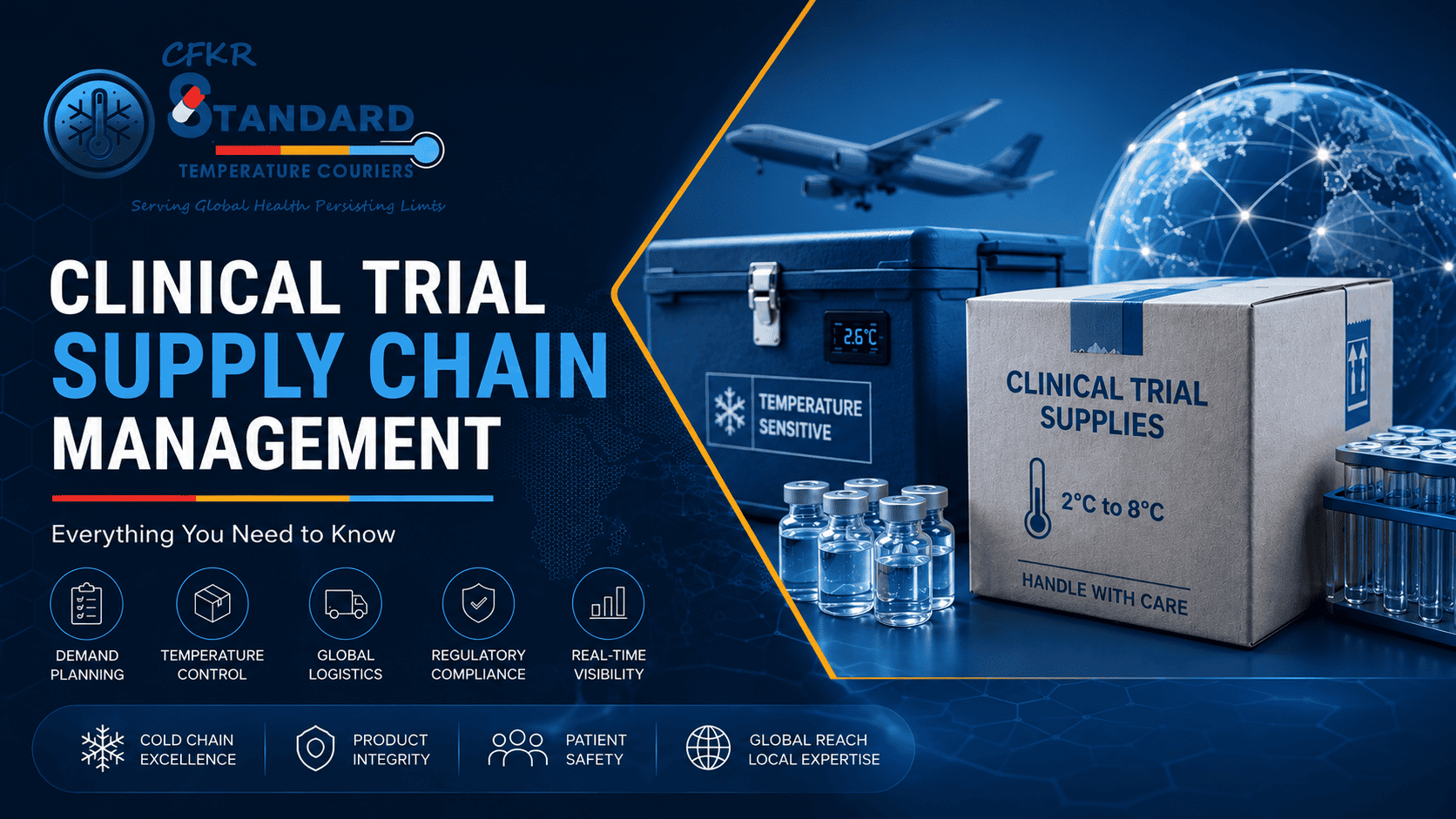
CFKR STC Couriers provides reliable clinical trial supply chain management with temperature-controlled logistics, ensuring safe, compliant, and timely delivery of pharmaceutical products across global healthcare networks.
Running a clinical trial is not just about the science. Behind every successful trial, there is a carefully managed system of sourcing, storing, packing, and delivering the right drugs or devices to the right places at the right time. That system is called clinical trial supply chain management, and it is one of the most underappreciated parts of bringing a new medicine to patients.
If something goes wrong in the supply chain, even a well-designed study can fall apart. Shipments get delayed. Temperature requirements get missed. Sites run out of drug. Patients miss doses. The data becomes unreliable. All of that costs time, money, and in some cases, patient safety.
This guide covers everything you need to know about clinical trial supply chain management, from what it actually involves to how clinical trial logistics companies operate and what to look for when choosing clinical trial supply services.
What Is Clinical Trial Supply Chain Management?
Clinical trial supply chain management refers to the end-to-end process of planning, sourcing, manufacturing, packaging, labeling, storing, and distributing investigational medicinal products (IMPs) across all the sites and countries involved in a clinical trial.
Unlike commercial drug distribution, clinical trial supply chains are far more complex. The drug may be experimental, which means it has unique handling requirements. Trials often run across multiple countries with different regulatory rules. Patients are enrolled at different rates, making demand unpredictable. And the stakes are extremely high because any supply failure directly impacts clinical outcomes and timelines.
At its core, clinical trial supply and logistics involves four major areas: demand forecasting, inventory management, distribution logistics, and regulatory compliance. Each of these has to work together perfectly for the trial to succeed.
Why Clinical Trial Supply Chain Management Is Difficult
Most people outside the industry assume that getting a drug to a clinical site is similar to getting a product to a retail store. It is not. There are several reasons why clinical trial supply chain management is uniquely challenging.
First, the patient population is unpredictable. You may plan for 500 patients but only enroll 300, or enrollment may happen faster than expected in one country and slower in another. Over-supplying wastes expensive drug and creates waste management problems. Under-supplying delays patient treatment and can compromise data integrity.
Second, the product itself is often complex. Many investigational drugs require strict cold chain management, meaning they must be kept at controlled temperatures from the moment they are manufactured to the moment they are administered to the patient. Even brief temperature excursions can render the product unusable.
Third, regulatory requirements differ by country. A label that is compliant in Germany may not meet the requirements in Japan. Import permits, customs documentation, and local storage requirements all add layers of complexity to clinical trial logistics.
Fourth, blinding and randomization add another dimension. In double-blind trials, neither the patient nor the investigator knows whether the patient is receiving the active drug or a placebo. This requires sophisticated packaging and labeling systems that maintain the blind while still ensuring the right patient gets the right kit.
Key Components of Clinical Trial Supply and Logistics
Demand Planning and Forecasting
Before the first patient is enrolled, supply chain teams build a forecasting model based on the protocol. They look at how many sites will be active, how quickly patients are likely to be enrolled, how much drug each patient needs per visit, and what waste factor to build in for returns, breakage, and protocol deviations. This forecast is updated continuously throughout the trial as actual enrollment data comes in.
Manufacturing and Packaging
Once the drug is manufactured, it needs to be packaged and labeled for the trial. Clinical trial packaging is different from commercial packaging. Kits are often numbered to support randomization. Labels must include trial-specific information in multiple languages. Many trials use Interactive Response Technology (IRT) systems to assign specific numbered kits to specific patients, which means packaging has to be done to very precise specifications.
Storage and Cold Chain Management
Clinical trial depots, operated by clinical trial supply services providers, store drug at the correct temperature, track inventory in real time, and manage expiry dates. Many investigational drugs require refrigeration between 2 and 8 degrees Celsius, and some require ultra-low temperature storage. Maintaining the cold chain from the depot to the clinical site, and then within the site itself, requires validated equipment, trained staff, and robust monitoring systems.
Distribution and Last-Mile Logistics
Getting the drug from the depot to the clinical site is where many supply chains face their greatest challenges. Clinical trial logistics companies coordinate with couriers, customs brokers, local agents, and site coordinators to ensure shipments arrive on time and in good condition. Cross-border shipments require import licenses, customs clearance documents, and sometimes named patient authorizations, all of which must be managed in parallel.
Returns and Reconciliation
Unused drug must be returned to the depot or destroyed at the site, depending on country regulations. All drug accountability records must be reconciled at the end of the trial to show exactly how much drug was shipped, how much was dispensed, how much was returned, and how much was destroyed. Regulators inspect these records closely, and discrepancies can delay trial closure or trigger audits.
Comparison: In-House Supply Chain vs. Outsourced Clinical Trial Supply Services
Many sponsors face a choice early in trial planning: manage the supply chain themselves or outsource it to a specialist provider. Here is how the two approaches compare across key dimensions.
Factor | In-House Management | Outsourced Supply Services |
Cost at low volume | Lower (no markup) | Higher (service fees) |
Cost at high volume | Higher (fixed overhead) | Lower (economies of scale) |
Regulatory expertise | Depends on internal team | Strong (dedicated experts) |
Geographic reach | Limited | Global networks |
Technology (IRT, tracking) | Requires investment | Usually included |
Flexibility | Low (fixed resources) | High (scalable) |
Speed to set up | Slow | Faster |
Risk of errors | Higher for smaller teams | Lower due to specialization |
For small to mid-sized sponsors running their first global trial, outsourcing to experienced clinical trial logistics companies is usually the more practical choice. For large pharma companies running multiple programs in parallel, a hybrid model often works best, keeping strategic oversight in-house while outsourcing depot operations and distribution.
Comparison: Clinical Trial Logistics Models
Clinical trial logistics companies operate through different models depending on the geography and complexity of the trial. Here is a look at the most common approaches.
Logistics Model | How It Works | Best For |
Central depot model | All drug stored at one central location, shipped directly to sites globally | Smaller trials, limited geographies |
Regional depot model | Drug stored at regional hubs (e.g., EU, US, APAC) and distributed locally | Larger trials spanning multiple continents |
Local depot model | Drug stored in-country, managed by local clinical trial supply services provider | Countries with complex import regulations |
Direct-to-patient (DtP) | Drug shipped directly to patients at home | Decentralized or hybrid trials |
Site-to-patient (StP) | Site manages local distribution to patients | Hybrid decentralized models |
Direct-to-patient logistics has grown significantly since 2020 as decentralized clinical trials have become more common. This model requires a whole new layer of planning around home nursing, patient consent, last-mile cold chain, and local regulatory requirements for home delivery of IMPs.
How Clinical Trial Logistics Companies Work
Clinical trial logistics companies, often called CMOs (Contract Manufacturing Organizations) with packaging capabilities, or CROs (Contract Research Organizations) with supply chain arms, or standalone CTL (Clinical Trial Logistics) providers, offer a range of services under one roof.
A typical engagement starts at the protocol stage. The logistics provider reviews the protocol, understands the drug and its handling requirements, maps out the countries and sites, and builds a supply strategy. This includes selecting depot locations, estimating quantities, designing the packaging configuration, and setting up IRT integration.
Once the trial starts, the logistics provider manages day-to-day operations: receiving drug from the manufacturer, performing incoming quality checks, storing it under the correct conditions, picking and packing site orders, arranging courier bookings, handling customs documentation, and tracking shipments in real time. They also manage resupply, expiry extensions, and protocol amendments that affect supply quantities.
Throughout the trial, they provide data back to the sponsor on stock levels, shipment status, expiry risks, and any temperature excursions or logistics incidents. At the end of the trial, they manage drug returns, destruction, and supply reconciliation.
What to Look for in Clinical Trial Supply Services
Not all clinical trial supply services providers are the same. Choosing the right one can make the difference between a smooth trial and a logistical nightmare. Here are the key things to evaluate.
Geographic coverage matters most for global trials. A provider with depots in North America, Europe, and Asia Pacific can manage regional storage and reduce cross-border shipments, which lowers cost and risk. Always ask about their in-country capabilities in your specific trial countries, not just their global headquarters.
Cold chain expertise is non-negotiable if your drug requires temperature control. Ask to see their temperature mapping data, their Standard Operating Procedures (SOPs) for temperature excursions, and their track record with cold chain shipments. Mistakes here are expensive and can compromise your entire supply.
IRT integration capabilities are important because most modern trials use IRT systems for randomization and supply management. Your logistics provider should have experience integrating with the major IRT platforms and should be able to work within your randomization schema without errors.
Regulatory knowledge is critical for multi-country trials. Your provider should have regulatory affairs staff who understand the import and export requirements for your specific countries, and who can manage documentation proactively rather than reactively.
Track record in your therapeutic area and trial phase matters. A provider with experience in oncology supply chains for Phase I trials brings very different expertise than one who primarily handles Phase III cardiovascular programs. Ask for relevant case studies.
Common Mistakes in Clinical Trial Supply Chain Management
Even experienced teams make mistakes in supply chain planning. These are the most common ones.
Underestimating lead times is one of the biggest. Import permits in some countries can take three to six months. If you have not factored that into your timeline, your sites may open with no drug available.
Over-relying on a single depot model for a global trial is another frequent problem. Shipping from a single central location works in theory but creates long transit times, higher customs risk, and temperature exposure issues in practice.
Not building protocol amendment risk into supply forecasts means that when the protocol changes, and it often does, supply teams are scrambling to reforecast, repackage, and redistribute on tight timelines.
Failing to monitor expiry dates closely leads to expired drug at sites, which requires emergency resupply and can delay patient dosing. A good inventory management system should flag expiry risks months in advance.
The Role of Technology in Clinical Trial Supply Chain Management
Technology is reshaping clinical trial supply chain management in important ways. IRT systems have transformed how randomization and drug assignment work, reducing errors and providing real-time visibility into stock levels at every site. Temperature monitoring systems now provide continuous data logging and remote alerts, catching excursions before they become critical.
Advanced analytics tools allow supply chain teams to run scenario planning models, testing different enrollment assumptions and supply strategies before committing to a plan. Some clinical trial logistics companies now offer dashboards that give sponsors a live view of their supply chain across every country and site.
Serialization and track-and-trace technologies, driven partly by commercial drug regulations, are increasingly being applied to clinical supplies, making it possible to track individual units from manufacture to patient administration.
Clinical Trial Supply Chain Management: Quick Reference Comparison
Aspect | Early Phase Trials (Phase I/II) | Late Phase Trials (Phase III) |
Drug quantities | Small, limited batches | Large, multi-batch campaigns |
Number of countries | Typically 1 to 5 | Often 20 to 50+ |
Complexity | Lower | Very high |
Forecasting difficulty | Moderate | High (long enrollment periods) |
IRT requirement | Optional | Usually mandatory |
Regulatory burden | Moderate | High |
Cost of supply failure | High (patient risk) | Very high (regulatory and commercial risk) |
Conclusion
Clinical trial supply chain management is one of the most critical yet often overlooked aspects of a successful clinical research program. Even the most promising clinical study can face delays, compliance issues, or compromised data if supply chain operations are not managed effectively.
With growing regulatory requirements, complex global studies, and increasing demand for temperature-sensitive therapies, sponsors need experienced logistics partners who understand the unique challenges of clinical trial distribution.
STC Couriers combines over 30 years of logistics expertise with specialized cold chain transportation, pharmaceutical logistics, and clinical trial supply services to support healthcare organizations across every stage of the clinical trial process. Our commitment to precision, compliance, and temperature integrity helps ensure that investigational products reach clinical sites safely, securely, and on time.
By partnering with STC Couriers, sponsors can focus on advancing medical innovation while we manage the complexities of clinical trial supply and logistics with reliability, accuracy, and care.