
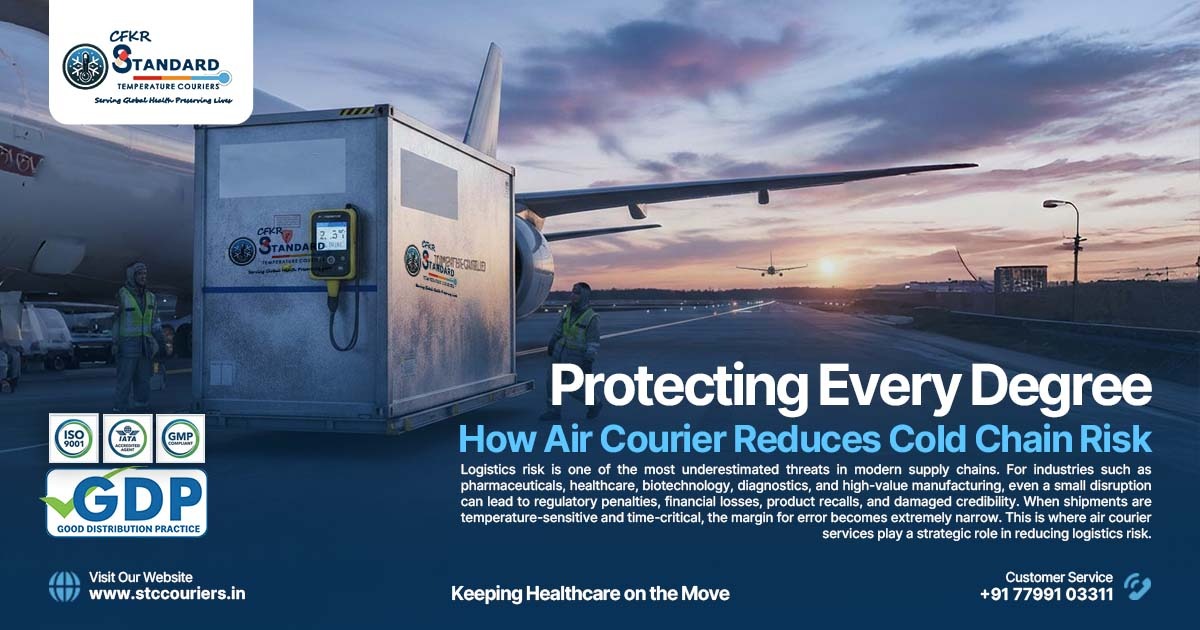
Logistics risk is one of the most underestimated threats in modern supply chains. For industries such as pharmaceuticals, healthcare, biotechnology, diagnostics, and high-value manufacturing, even a small disruption can lead to regulatory penalties, financial losses, product recalls, and damaged credibility. When shipments are temperature-sensitive and time-critical, the margin for error becomes extremely narrow. This is where air courier services play a strategic role in reducing logistics risk.
Air courier services are not simply about faster delivery. They are structured aviation-based logistics solutions designed to minimize transit exposure, reduce handling points, enhance security, and protect temperature integrity. In temperature-controlled shipments, these factors directly influence product safety and compliance outcomes.
Understanding Logistics Risk in Temperature-Controlled Supply Chains
Logistics risk in cold chain operations typically includes delays, temperature deviation, mishandling, documentation errors, theft, and operational unpredictability. Each of these risks increases when shipments remain in transit for extended periods or pass through multiple uncontrolled transfer points.
Temperature-sensitive products such as vaccines, biologics, insulin, oncology drugs, specialty injectables, and laboratory samples must remain within validated ranges such as 2–8°C, 15–25°C, or below -20°C. Any exposure outside these limits can compromise product efficacy and regulatory compliance.
The longer a shipment remains exposed to environmental fluctuations, the greater the risk. This is why transit duration and operational control become critical risk variables.
Reduced Transit Time Minimizes Exposure
One of the primary ways air courier services reduce logistics risk is by compressing delivery timelines. Road transport, especially across states or regions, may take several days and is vulnerable to traffic congestion, border checks, vehicle breakdowns, and weather disruptions.
Air transport significantly shortens transit duration. What could take two or three days by road can often be completed within hours through structured air cargo networks. Reduced transit time directly decreases exposure to temperature fluctuation, environmental instability, and operational unpredictability.
In temperature-controlled logistics, speed is not a luxury. It is a protective mechanism.
Fewer Handling Points Lower Operational Risk
Every transfer in a logistics chain introduces potential risk. Loading and unloading at multiple warehouses, cross-docking hubs, and regional distribution centers increase the probability of mishandling, packaging damage, or temperature instability.
Air courier services typically operate within centralized airport cargo terminals governed by standardized aviation protocols. While shipments are still processed, the overall chain is more streamlined and regulated compared to multi-stage ground transportation networks.
Fewer uncontrolled touchpoints reduce the chances of physical damage and operational errors. For pharmaceutical and healthcare shipments, minimizing handling exposure directly strengthens cold chain integrity.
Temperature Integrity Through Controlled Environments
Maintaining temperature stability is fundamental in cold chain logistics. Road transport relies heavily on refrigerated vehicles and insulated packaging. While modern reefer systems are effective, long-distance journeys expose shipments to prolonged environmental stress.
Air courier services reduce this stress by limiting exposure duration. Even when shipments rely on validated packaging solutions, shorter travel time reduces the likelihood of internal temperature drift. Airport cargo facilities also operate under structured operational controls that support better shipment coordination.
For highly sensitive products, reduced exposure equals reduced temperature deviation risk.
Enhanced Security and Shipment Protection
High-value and temperature-sensitive cargo often carries additional security risks. Theft, tampering, and counterfeiting can create significant financial and reputational damage. Extended road routes expose shipments to unpredictable external factors over long distances.
Airport cargo environments operate under surveillance systems, restricted access protocols, and regulated documentation procedures. Air courier services therefore provide a more secure logistics ecosystem.
For companies transporting specialty pharmaceuticals, biologics, or critical healthcare equipment, security is an integral component of logistics risk reduction.
Compliance Support and Traceability
Pharmaceutical and healthcare logistics operate under strict regulatory frameworks. Good Distribution Practice guidelines require proper documentation, traceability, and monitoring. Delays or documentation inconsistencies can trigger compliance issues and audits.
Air courier services benefit from structured aviation documentation workflows. Coordinated cargo handling systems improve traceability and reduce clearance complications. When logistics operations are aligned with compliance standards, administrative risk decreases alongside operational risk.
Businesses seeking a reliable pharmaceutical air logistics partner in India must prioritize structured risk management capabilities, not just delivery speed
Reliability in Time-Critical Operations
Time-critical shipments represent another dimension of logistics risk. Clinical trials require timely biological sample movement. Hospitals depend on urgent medication supply. Manufacturing operations rely on just-in-time component delivery.
Air courier services operate on scheduled flight networks, providing greater predictability than long-haul road transport. Even when disruptions occur, aviation networks offer alternative routing options that reduce downtime.
Predictability supports operational continuity. When shipments arrive within defined windows, business stability improves.
Financial Impact of Risk Reduction
The financial consequences of logistics failure extend beyond shipment replacement costs. Delayed deliveries may lead to contract penalties, emergency re-shipments, regulatory scrutiny, and damaged long-term relationships.
While air courier services may involve higher upfront transportation costs compared to road transport, they reduce risk-adjusted financial exposure. For high-value or highly sensitive cargo, preventing loss is significantly more cost-effective than managing failure.
Strategic logistics planning requires evaluating total risk cost, not just freight pricing.
Strategic Value of Air Courier Services in Modern Supply Chains
As global healthcare and pharmaceutical supply chains become more complex, logistics risk management becomes increasingly important. Temperature-controlled shipments are expanding due to growth in biologics, vaccine programs, and specialty treatments.
Air courier services provide structured aviation-based logistics that reduce exposure time, enhance security, streamline handling, and support compliance. These advantages collectively strengthen supply chain resilience.
At STC – Standard Temperature Couriers, aviation logistics is designed specifically for time-sensitive and temperature-controlled shipments. By focusing on operational precision, minimal handling exposure, and reliable air cargo coordination, STC supports businesses in reducing logistics risk while maintaining shipment integrity.
In modern supply chains, eliminating risk entirely may not be possible. However, reducing it strategically is achievable. Air courier services represent a proactive approach to safeguarding temperature-sensitive shipments, protecting regulatory compliance, and strengthening operational continuity.
Businesses that evaluate logistics decisions through the lens of risk reduction rather than simple cost comparison position themselves for long-term stability and trust.
Frequently Asked Questions
How do air courier services reduce logistics risk?
Air courier services reduce transit time, minimize handling points, enhance security, and operate within structured aviation environments that lower exposure to delays and temperature deviation.
Why are air courier services important for temperature-controlled shipments?
They shorten exposure duration and reduce operational unpredictability, helping maintain cold chain integrity.
Are air courier services better than road transport for sensitive cargo?
For highly temperature-sensitive or time-critical shipments, air courier services generally reduce exposure and operational risk more effectively.
What industries benefit most from air courier services?
Pharmaceuticals, healthcare, biotechnology, diagnostics, and high-value manufacturing benefit significantly from aviation-based logistics.