
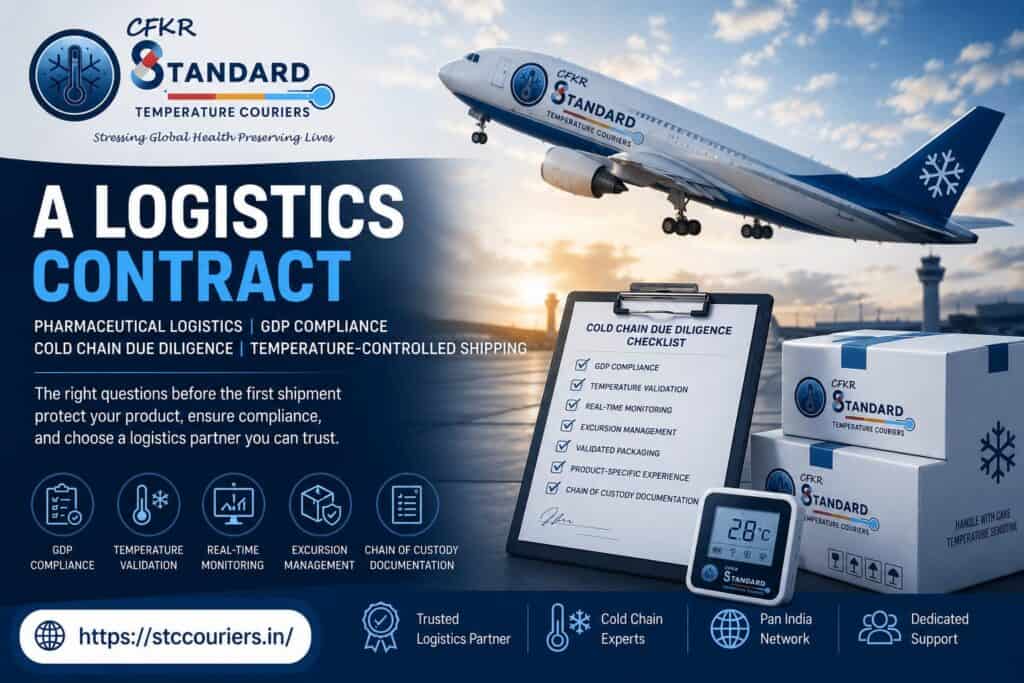
Pharmaceutical Logistics | GDP Compliance | Cold Chain Due Diligence | Temperature-Controlled Shipping
Most cold chain failures are not accidents. They are the result of a contract signed without the right questions asked.
By the time a temperature excursion hits your quality report, the damage is done. The right time to protect your product is before the first shipment, not after the first incident.
Use this checklist when evaluating any cold chain logistics provider. Each question has a direct bearing on product safety, regulatory compliance, and operational reliability. If a provider cannot answer these clearly, that is your answer.
Question 1: Are you GDP compliant, and can you show documented evidence?
Good Distribution Practice is the regulatory baseline for pharmaceutical logistics in most global markets. Compliance is not a badge a provider earns once. It requires maintained procedures, trained staff, and documented records across every shipment.
What a strong answer looks like:
- GDP SOPs available for review before contract signature
- Training records for drivers, handlers, and warehouse staff
- Temperature qualification records for vehicles and storage units
- Audit history available on request
Walk away if you hear:
- We follow industry best practices
- Our drivers are experienced
- We have never had a complaint
Question 2: What temperature ranges do you validate, and how do you validate them?
Pharmaceuticals ship under a range of temperature requirements. 2 to 8 degrees Celsius for most biologics and vaccines. 15 to 25 degrees for ambient products. Sub-zero for certain clinical trial materials and advanced therapies.
A provider who validates one range is not necessarily equipped to handle another. More importantly, validation means documented testing under real transit conditions, not manufacturer specifications taken at face value.
Ask specifically:
- Which temperature lanes have you validated?
- What is your validation protocol and how often do you re-qualify?
- Can you provide validation reports for the specific lane and season my shipment will travel?
Question 3: How do you monitor temperature during transit, and who has access to that data?
Monitoring during transit is not optional for pharmaceutical cargo. The question is not whether a provider monitors, it is how the data is recorded, who can see it in real time, and what happens when an excursion is detected.
Minimum acceptable standard:
- Continuous temperature logging from pickup to delivery
- Real-time visibility available to the shipper, not just the carrier
- Automatic alerts for excursions with defined escalation procedures
- Temperature data downloadable as part of the delivery documentation package
If monitoring is only checked at delivery, you have no visibility into what happened during the journey. That is not cold chain logistics. That is hope.
Question 4: What is your excursion management procedure?
Temperature excursions happen. The difference between a manageable incident and a full product loss depends entirely on what the logistics provider does in the first hour.
Ask for the written procedure. A credible provider has one. It should cover:
- How excursions are detected and how quickly
- Who is notified and in what order
- What corrective action is taken to recover the shipment if possible
- How the incident is documented for your quality team and regulatory records
If the answer is that someone will call you, that is not a procedure. That is an improvisation.
Question 5: What packaging solutions do you use, and are they validated for my specific lane?
Packaging failure is one of the most common causes of cold chain excursions. A thermal box validated for a two-day domestic lane at 15 degrees Celsius will not protect a vaccine shipment crossing three climate zones over five days.
Validated packaging means the system has been tested and documented for the specific transit duration, temperature range, and environmental conditions of your actual route.
Ask the provider:
- What packaging systems do you use for my product temperature range?
- Have they been validated for my specific lane, including seasonal variation?
- Who selects the packaging, and what is the selection process?
- Can I see the validation data?
Question 6: Do you have experience with my specific product type?
Biologics, vaccines, clinical trial materials, bulk drug substances, and diagnostic samples each have different handling requirements. A provider experienced in one does not automatically know how to handle another.
Product types and their considerations:
- Vaccines: Cold chain continuity from manufacturer to point of administration. Any break invalidates the product.
- Biologics: Often highly sensitive to temperature and vibration. Packaging and handling protocols must reflect that.
- Clinical trial materials: Chain of custody and documentation requirements are as important as temperature control. Regulatory filings depend on it.
- Biological samples: Time-sensitive and often irreplaceable. Loss is not just a financial problem.
Ask for references or case studies from providers who have handled your specific product type on comparable lanes.
Question 7: What does your chain of custody documentation look like?
For pharmaceutical shipments, documentation is not an admin function. It is a regulatory requirement. Chain of custody records need to capture every handover point, every person who touched the shipment, every temperature log entry, and every transit event.
If your shipment is ever questioned in a regulatory review, audit, or product recall investigation, your logistics provider’s documentation either backs you up or becomes a liability.
Documentation your provider should supply as standard:
- Proof of pickup with timestamp and handler identity
- Continuous temperature log for the full transit
- Handover records at every transfer point
- Proof of delivery with recipient confirmation
- Excursion records if applicable, with corrective action detail
Question 8: What are your contingency procedures for delays, vehicle breakdowns, or route disruptions?
Cold chain logistics does not pause for traffic, mechanical failure, or weather events. What separates a reliable provider from an unreliable one is what they have in place before a disruption happens.
Scenarios to ask about specifically:
- Vehicle breakdown mid-transit: Is there a backup vehicle protocol? What is the response time?
- Port or airport delays for international shipments: How is extended hold time managed?
- Customs clearance issues: Does the provider have in-house customs expertise or a trusted agent?
- Natural disruptions: Extreme weather, industrial action, border closures. What is the re-routing procedure?
If the provider says it rarely happens, that is not a contingency plan. Ask what happens when it does.
Question 9: Who is responsible if product is damaged in transit?
Before a shipment leaves your facility, you need to know who carries liability if it arrives compromised. This is a contractual and insurance question, not just an operational one.
Get clarity on:
- What is the provider’s liability cap per shipment?
- What insurance do they carry for pharmaceutical cargo?
- What is the claims process if a temperature excursion causes product loss?
- Who bears liability when a subcontracted carrier is involved?
Read the contract terms carefully. Liability clauses in logistics contracts are often drafted narrowly. Know what you are agreeing to before you sign.
Question 10: Do you use subcontractors, and if so, how do you manage them?
Many logistics providers outsource parts of the delivery chain, particularly last-mile or cross-border segments. That is not inherently a problem. The problem is when subcontractors operate to a lower standard than the primary provider and the primary provider has no system for managing that.
Questions to ask:
- What percentage of your shipments involve subcontractors?
- How do you qualify your subcontractors for pharmaceutical cargo?
- Are subcontractors GDP compliant? Can you evidence that?
- Who is responsible for temperature monitoring when a subcontractor is handling the shipment?
A provider who cannot answer these questions about their subcontractors cannot vouch for the full cold chain.
Question 11: Can you scale with our volume and handle international lanes?
A provider that works well for domestic shipments at low volume may not be equipped to handle international lanes, time zone complexity, multi-leg customs clearance, or significant shipment volume increases.
If your distribution network is global or is expected to grow, test the provider on both dimensions before committing to a long-term contract.
What to ask:
- Which international lanes do you currently operate on for pharmaceutical clients?
- How do you handle regulatory and customs requirements in destination countries?
- What is your current capacity, and how do you handle peak demand periods?
- What is your process for onboarding new lanes as our distribution needs expand?
Question 12: What does your track record actually look like?
Every provider can describe their capabilities. Fewer can back them up with verifiable performance data. Before you sign, ask for numbers.
Request:
- On-time delivery rate for pharmaceutical shipments over the last 12 months
- Temperature excursion rate and how excursions were managed
- Client references from companies shipping comparable products on comparable lanes
- Any regulatory actions or quality complaints in the last three years
A provider with strong performance data will share it without hesitation. Reluctance to provide specifics is a signal worth paying attention to.
How CFKR STC Couriers Answers These Questions
CFKR STC Couriers has operated in cold chain pharmaceutical logistics for over 30 years. The checklist above is not a barrier to working with CFKR. It is a standard the company is built to meet.
- GDP-compliant operations across pharmaceutical, biotech, and clinical trial shipments
- Validated temperature-controlled vehicles and packaging for multiple transit lanes
- Real-time tracking and temperature monitoring with shipper visibility from pickup to delivery
- Documented chain of custody on every shipment, ready for quality and regulatory review
- Air freight, ocean freight, and express shipping across a global distribution network
- Tailored solutions built around your product specifications, not generic freight templates
If you have specific questions about any of the twelve areas above as they apply to your shipment requirements, the CFKR team will give you straight answers.
Ready to Evaluate CFKR STC Couriers?
Contact the team with your product type, temperature requirements, and distribution lanes. You will get a clear response on capability, compliance, and commercial terms so you can make an informed decision before you commit to anything.
Call the team directly or fill in the contact form. Provide your name, mobile number, and a short description of your logistics requirement.
The right logistics partner answers the hard questions upfront. If your current provider does not, it is worth finding out what CFKR can do instead.
CFKR STC Couriers | 30+ Years in Cold Chain Pharmaceutical Logistics | Air Freight | Ocean Freight | Express Shipping | GDP Compliant