
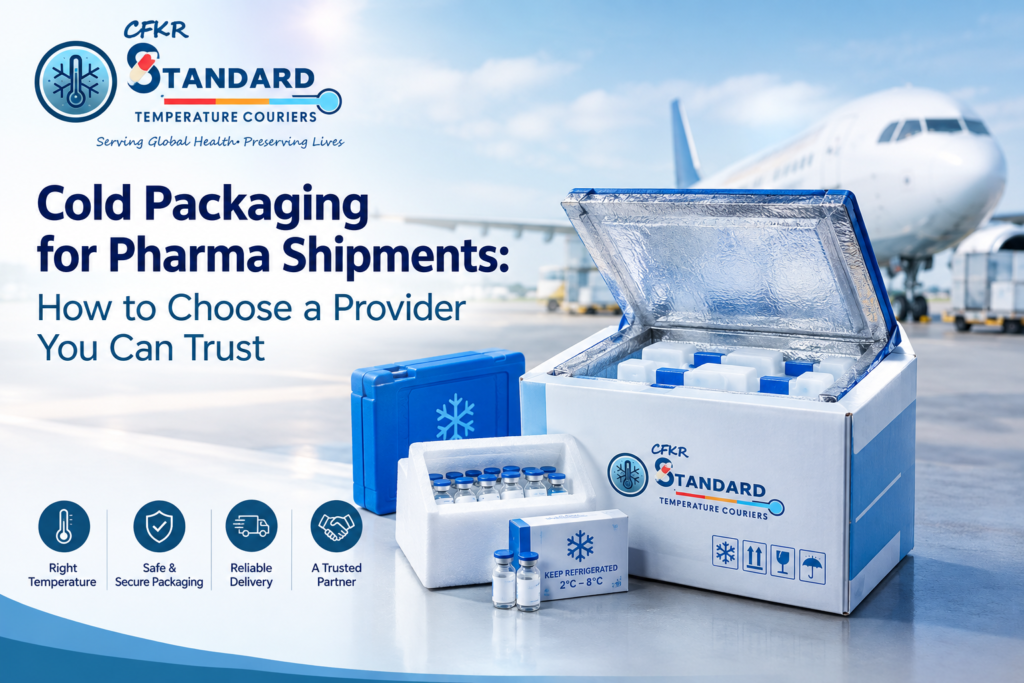
If you are searching for cold chain packaging right now, you are probably not looking for a definition. You are looking for a decision. Maybe a batch got compromised last quarter, maybe your current vendor missed a delivery window, or maybe you are scaling into a new market and your existing packaging setup will not cut it anymore. Whatever brought you here, this guide is built to help you choose, not just to help you understand.
Cold chain packaging is the physical system, insulated containers, refrigerants, phase change materials, and monitoring devices, that keeps a temperature-sensitive product within its required range from the moment it leaves a facility to the moment it reaches its destination. For pharmaceuticals, vaccines, biologics, diagnostic samples, and certain food categories, this is not a nice-to-have. It is the difference between a product that works and one that gets discarded.
By the end of this article you will know what separates reliable cold packaging from packaging that only looks reliable on paper, which standards actually matter, and what questions to ask a provider before you commit a single shipment to them.
What Cold Chain Packaging Actually Does for Your Shipment
A shipment does not fail because a box was ugly or a courier was rude. It fails because the internal temperature drifted outside a defined range for long enough to degrade the product. Cold chain packaging exists to prevent exactly that, across every leg of a journey where conditions are unpredictable: a hot tarmac, a delayed customs clearance, an unheated delivery van in winter, a warehouse dock with no climate control.
Good packaging does three things at once. It insulates against outside temperature swings. It carries enough thermal mass, through gel packs, dry ice, or phase change material, to hold the internal range for longer than the expected transit time. And it gives you a way to prove, after the fact, that the range was maintained. That third part matters as much as the first two, because in regulated industries a shipment without proof of temperature integrity is treated the same as a shipment that failed.
This is also where a lot of buyers get the wrong mental model. Cold chain packaging is not one product. It is a system that has to be matched to the product being shipped, the route, the season, and the regulatory environment on both ends. A gel-pack shipper built for a four-hour domestic hop will not survive a 36-hour international air route with a customs hold in the middle.
The Real Cost of Getting Cold Packaging Wrong
It helps to be direct about what is actually at stake, because the cost of a packaging failure rarely shows up as a single line item.
A vaccine shipment exposed to a temperature excursion does not just lose value. Depending on the product and how long it was out of range, it may need to be quarantined, tested, or destroyed entirely, and clinics further down the chain may need to notify and revaccinate patients. According to the CDC, any temperature reading outside the range recommended in the manufacturer’s package insert counts as a temperature excursion, and the standard response involves immediately labeling the affected product “do not use,” documenting the event in detail, and contacting the manufacturer for guidance before the product can be used again. That process consumes staff time, delays care, and in many cases still ends with the product being written off. thermofisher
For a clinical trial shipment, a failed cold chain can mean a lost data point, a compromised sample, or in the worst case, a protocol deviation that has to be reported to the sponsor and the ethics board. For a biologic or cell therapy shipment, it can mean a patient’s own harvested material, something that cannot simply be reordered, is lost.
None of this is theoretical, and none of it is rare enough to ignore. The global cold chain packaging market was valued at roughly USD 33.3 billion in 2025 and is projected to reach USD 75.2 billion by 2034, which tells you how much of the world’s pharmaceutical and food supply now depends on this layer of protection working correctly, every single time. imarcgroup
Types of Cold Chain Packaging Solutions and When to Use Each
Not every shipment needs the same setup. Matching the packaging type to the shipment is the first real decision point, and it is where a lot of buyers either overspend or underprotect.
Passive Insulated Packaging
Passive systems rely on insulation and a pre-conditioned thermal mass, gel packs, water packs, or phase change material, sealed inside an insulated box or pallet shipper. They need no external power, which makes them the default choice for most parcel-level pharmaceutical and biologic shipments. Their limitation is duration. A passive shipper is only as good as the hold time it was validated for, and once that window closes, protection ends whether the product has arrived or not.
Active Temperature-Controlled Containers
Active systems use powered refrigeration or heating units built into the container itself, often with a digital control panel that lets you set and monitor the exact target range in transit. These are standard for long-haul air freight, ocean freight, and any route where transit time is unpredictable or exceeds what passive packaging can safely cover. They cost more to operate and require power access at handover points, but they remove the fixed time ceiling that passive systems carry.
Hybrid Systems
Hybrid packaging combines a passive insulated core with supplemental active elements, such as a powered unit used only during the highest-risk leg of a journey, for example, a tarmac wait or a customs hold. These are increasingly common for high-value biologics and cell and gene therapy shipments, where the product cannot tolerate even a short excursion and the route includes at least one unpredictable stage. STC Couriers uses this kind of layered approach across its cryogenic transportation solutions, where ultra-low temperature ranges leave almost no margin for error.
The Regulatory Standards Your Cold Chain Packaging Must Meet
This is the section most vendors gloss over, and it is the one that should carry the most weight in your decision. Packaging that has not been tested and validated against recognized standards is a guess wearing a label.
The World Health Organization’s Performance, Quality and Safety (PQS) program sets detailed specifications for vaccine cold boxes and carriers, including exact cold-life durations under defined temperature cycles and construction requirements for insulation and monitoring. A cold box qualified under a WHO PQS specification has been tested to hold its range for a stated number of hours under realistic hot and temperate zone conditions, not just in a lab best case (WHO’s specification for large-capacity vaccine cold boxes, for example, defines short-range boxes rated for a minimum 24-hour cold life and long-range boxes rated for 48 hours). If your provider cannot point to which PQS category their packaging falls under, that is a gap worth asking about directly. who
For air shipments, the IATA Temperature Control Regulations govern how temperature-sensitive healthcare cargo must be packaged, labeled, and handled by airlines and ground handlers. Since 2012, any shipment booked as time and temperature sensitive has required a specific IATA label indicating the external transport temperature range, and since 2013 an acceptance checklist has been mandatory before airlines will take the shipment. A provider without CEIV Pharma certification or a documented process aligned to TCR is asking you to trust an unverified handoff every time your shipment touches an airport.
Within the EU and for any shipment governed by EU-aligned frameworks, the Good Distribution Practice guidelines set out specific obligations for temperature-sensitive products. The guidelines require that qualified equipment, including thermal packaging, temperature-controlled containers, or temperature-controlled vehicles, be used to maintain correct transport conditions, and that staff handling these products receive documented, specific training rather than generic handling instruction. These are not suggestions. They are audit points. gmp-compliance
On the testing side, the International Safe Transit Association’s 7 Series standards, particularly ISTA 7D and 7E, define how insulated shipping containers are thermally tested before they are ever used commercially. ISTA 7E in particular is built on real-world temperature data gathered from parcel delivery environments rather than theoretical models, and is designed specifically to evaluate how external temperature exposure affects individually packaged products moving through that system. Ask any packaging vendor for their ISTA 7E or Standard 20 certification documents before you sign anything. If they cannot produce them, you are buying an unvalidated guess. ansi
STC Couriers builds its packaging technology around these exact frameworks, and its broader regulatory compliance program is structured to keep every shipment auditable against WHO, IATA, and GDP requirements at once, not just one of them.
How to Evaluate a Cold Chain Packaging Companies Before You Sign
Once you understand the standards, evaluating a specific provider gets a lot more concrete. Four things matter more than the sales pitch.
The first is validated packaging data. Ask for the actual thermal validation reports, not a summary slide, that show hold times under both summer and winter profiles, not just a single best-case scenario. A provider that only tests under mild conditions is not testing for the situations that actually cause failures.
The second is real-time monitoring, not just temperature logging that gets reviewed after delivery. A logger that only tells you a shipment failed once it has already arrived is closer to a postmortem than a safeguard. You want visibility while the shipment is still moving, with alerts that trigger fast enough for someone to intervene.
The third is a documented compliance track record, meaning the provider can show you audit history, certifications, and how they have handled past temperature excursions, not just claim they have never had one. Every cold chain provider has had an excursion at some point. What separates a serious one is how quickly it was caught and how the response was documented.
The fourth is scalability across shipment types. A provider that only handles small parcel biologics will struggle the moment you need to move a bulk pallet shipment or a cryogenic cell therapy sample. STC Couriers structures its offering around this exact range, spanning pharmaceutical supply chain logistics, clinical trial logistics, and cell and gene therapy movement, so a single relationship covers a shipper’s needs as volume and complexity grow, rather than forcing a switch to a new vendor at every stage.
Why Pharmaceutical and Life Science Shippers Choose STC Couriers for Cold Chain Packaging Solutions
STC Couriers has spent over 30 years focused specifically on temperature-controlled pharmaceutical and biotech logistics, which means cold chain packaging is not a side offering bolted onto a general courier business. Every part of the operation, from validated packaging design through GDP-aligned handling to real-time shipment tracking, is built around the same requirement: the product has to arrive within range, every time, with the documentation to prove it.
That focus shows up in the details that matter most to a shipper choosing between providers. Packaging is matched to route and season rather than issued as a one-size-fits-all default. Monitoring runs continuously rather than only at pickup and delivery. And compliance documentation is generated as a normal part of the process, so it is ready when an auditor or a regulator asks for it, not assembled after the fact. For shippers moving vaccines, biologics, clinical trial materials, or cell and gene therapies, that combination is the actual product being bought, not the box itself.
Common Mistakes That Undermine Cold Chain Packaging Performance
A few patterns show up repeatedly in shipments that fail, and almost all of them are avoidable with the right provider relationship.
Choosing packaging based on shipment weight or cost alone, without matching it to the actual route duration and expected temperature exposure, is the most common one. A passive shipper rated for 48 hours has no margin left if a flight gets delayed by even six hours.
Skipping pre-conditioning is another. Gel packs and phase change materials need to be brought to their correct starting temperature before packing, not just placed in the box at room temperature. A packaging system that has not been properly pre-conditioned starts the journey already behind.
Relying on end-of-trip temperature checks instead of continuous monitoring is a third. By the time a receiving team notices a problem, the product has already been out of range for however long the shipment took. Continuous, in-transit monitoring is what turns a failure into a catchable event instead of a discovered one.
And treating documentation as optional paperwork rather than a core deliverable causes real problems during audits and regulatory reviews. If your provider cannot hand you a full temperature trace and chain-of-custody record for every shipment on request, you are exposed the moment a regulator asks for one.
Get Started with a Cold Chain Packaging Partner You Can Trust
If your current setup has left you managing excursions after the fact instead of preventing them, or if you are scaling into shipments your existing packaging was never built to handle, the fix is not more paperwork on your end. It is a provider whose packaging, monitoring, and compliance process are built around the standards that actually govern your product.
STC Couriers works directly with pharmaceutical, biotech, and life science teams to design cold chain packaging around the specific route, product, and regulatory requirement in front of them, backed by 30 years of temperature-controlled logistics experience. Reach out to the team to walk through your shipment profile and get a packaging solution that is actually validated for it, not just marketed as one.
Frequently Asked Questions
What is the difference between cold chain packaging and cold storage?
Cold storage refers to a fixed facility, a warehouse or refrigerator, that holds a product at a stable temperature. Cold chain packaging is the mobile system that maintains that same temperature range while the product is in transit between facilities. Both need to work together for the chain to stay intact.
How long can passive cold chain packaging maintain temperature?
It depends on the design and the validated hold time, but most passive shippers used in pharmaceutical logistics are rated between 24 and 96 hours under defined summer and winter test profiles. The exact figure should come from the provider’s ISTA or WHO PQS validation data, not a general estimate.
What temperature range do most pharmaceutical shipments require?
Refrigerated pharmaceutical products typically need to stay between 2°C and 8°C, frozen products between -25°C and -15°C, and some biologics or vaccines require ultra-cold ranges as low as -90°C to -60°C. The required range always comes from the manufacturer’s packaging insert and must be matched exactly.
Who is responsible if a shipment fails to maintain temperature?
Responsibility depends on the contract, but under GDP guidelines, the party that outsources storage or transport still retains oversight responsibility even when a third-party logistics provider handles the physical shipment. That is why documented handoffs and monitoring records matter as much as the packaging itself.
How do I know if a cold chain packaging provider is actually compliant?
Ask for their WHO PQS classification, IATA CEIV Pharma certification status, ISTA 7E or Standard 20 test reports, and evidence of GDP-aligned processes. A provider that cannot produce these documents on request is not operating to a verifiable standard, regardless of what their marketing claims.