
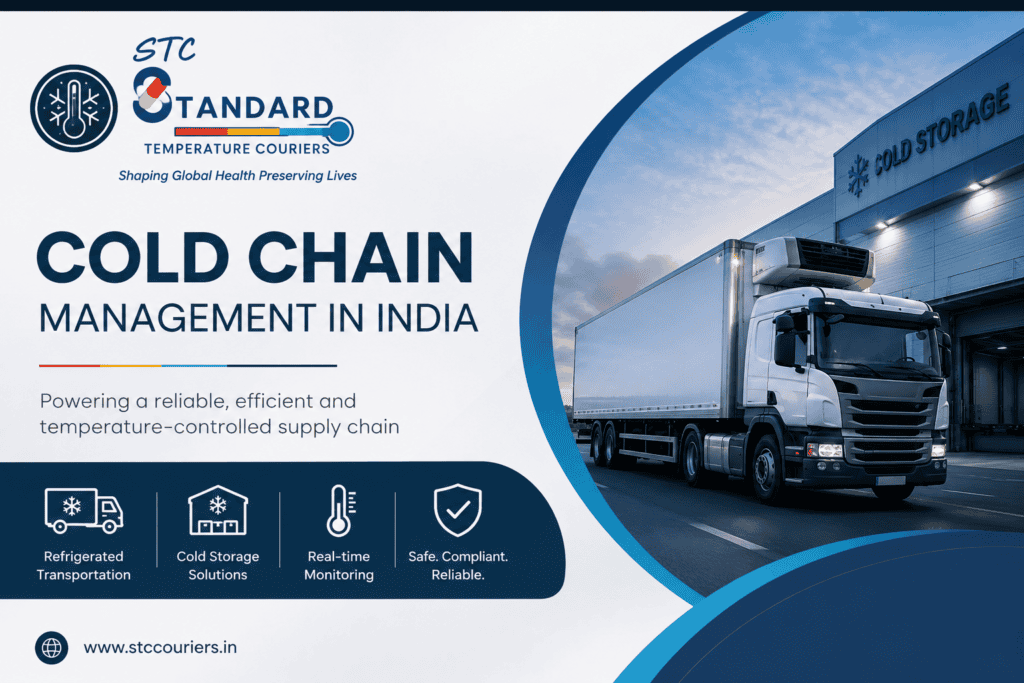
India moves a staggering volume of perishable goods every single day. From fresh vegetables leaving farms in Punjab to vaccines reaching clinics in remote Odisha, the challenge is always the same: keep the product at the right temperature, from start to finish. This is what cold chain management in India is all about, and right now, transportation logistics companies are at the center of making it work.
The India cold chain logistics market was valued at USD 11.53 billion in 2024 and is projected to reach USD 27 billion by 2033, growing at a CAGR of nearly 9%. That is not a small number. It tells you that businesses, investors, and policymakers are all paying attention to cold chain transportation in India like never before.
So what exactly is cold chain, why does it matter so much in India, and how are logistics companies responding? Let us walk through all of it.
What Is Cold Chain Management?
Cold chain management is the process of keeping temperature-sensitive products safe throughout storage and transportation. This includes everything from frozen food and dairy products to medicines, vaccines, chemicals, and fresh produce.
The chain has to stay unbroken. If the temperature goes wrong even once during transit, the product can spoil, lose effectiveness, or become dangerous. A broken cold chain does not just mean financial loss. In the case of medicines or vaccines, it can mean serious harm to people.
In India, cold chain management spans refrigerated warehouses (called cold storage companies), refrigerated trucks and containers, temperature-monitoring systems, and the logistics operations that tie all of this together.
Why India Needs Better Cold Chain Transportation Right Now
India produces more than 330 million tonnes of food every year, making it one of the largest producers of fruits, vegetables, dairy, and meat in the world. Yet an estimated 16 to 18 percent of fresh produce is lost after harvest due to inadequate cold chain infrastructure. That is a massive waste, and it directly affects farmer income, food availability, and prices for consumers.
On top of food, the pharmaceutical sector is booming. India is the world’s largest supplier of generic medicines, and the demand for temperature-controlled pharmaceutical logistics has grown sharply, especially after the COVID-19 pandemic showed how critical vaccine cold chains are.
The e-commerce grocery segment is also adding pressure. Online grocery platforms are expanding fast into Tier 2 and Tier 3 cities, and every order of fresh milk, meat, or frozen food depends on a reliable cold chain from warehouse to doorstep.
India currently has approximately 8,698 cold storage units with a total capacity of around 395 lakh metric tonnes. However, over 60 percent of this capacity is concentrated in just 10 major states. That imbalance is exactly where transportation logistics companies are now focusing their investments.
The Role of Transportation Logistics Companies in Cold Chain
A transportation logistics company does more than just move goods from one place to another. In the context of cold chain, it is responsible for planning the route, maintaining vehicle temperature throughout the journey, handling loading and unloading carefully, tracking the shipment in real time, and making sure the product arrives in exactly the condition it left.
This requires specialized equipment, trained staff, and strong operational processes. Here is a quick look at how cold chain transportation differs from regular logistics:
Factor | Standard Logistics | Cold Chain Transportation |
Vehicle type | Regular trucks and vans | Refrigerated trucks (reefers), insulated containers |
Temperature control | Not required | Required at every step (often 2°C to 8°C or -18°C and below) |
Monitoring | Basic GPS tracking | Real-time temperature and humidity sensors |
Loading process | Standard | Strict protocols to avoid temperature breaks |
Staff training | General logistics training | Specialized cold chain handling training |
Cost | Lower | 30 to 40 percent higher on average |
Risk of spoilage | Low | Very high if process fails |
The higher cost of cold chain transportation is one reason small and mid-size businesses have historically relied on informal arrangements. But with increasing regulations, growing consumer awareness, and better technology, the shift toward organized cold chain logistics companies is accelerating.
Types of Cold Storage Companies and What They Handle
Not all cold storage companies operate the same way. The type of storage a business needs depends on the product it is handling. Here is a comparison of the main types:
Type of Cold Storage | Temperature Range | Products Handled |
Frozen storage | -18°C to -25°C | Frozen meat, ice cream, frozen vegetables |
Chilled storage | 0°C to 4°C | Dairy, fresh meat, seafood, certain medicines |
Controlled atmosphere storage | 2°C to 8°C with regulated gases | Fruits and vegetables (longer shelf life) |
Pharmaceutical cold storage | 2°C to 8°C (strict compliance) | Vaccines, biologics, insulin, blood products |
Ambient temperature-controlled | 15°C to 25°C | Chocolates, certain FMCG products |
A good transportation logistics company works with all these categories, depending on the clients it serves. The key is having the right infrastructure and operational discipline for each temperature range.
Cold Chain Transportation in India: The Gaps and the Opportunities
Cold chain transportation in India still faces some real challenges. These are not hidden problems. Anyone working in the industry will tell you the same things.
The first issue is uneven infrastructure. Most refrigerated warehousing and cold storage companies are concentrated in states like Uttar Pradesh, Maharashtra, and West Bengal. Farmers and businesses in smaller states often have to move goods long distances before accessing proper cold storage, which adds cost and increases spoilage risk.
The second issue is the lack of pre-cooling facilities at farm level. In most developed markets, produce is cooled immediately after harvest. In India, this step is often skipped because the infrastructure is not there. By the time the produce reaches a cold storage company, some of its shelf life is already gone.
The third issue is the shortage of refrigerated vehicles. As per industry estimates, the number of refrigerated trucks in India needs to grow significantly to match demand. The National Centre for Cold Chain Development (NCCD) has projected that refrigerated transport requirements will grow from around 19,000 trucks in 2024 to over 33,000 by 2031.
These gaps, however, are also opportunities. Transportation logistics companies that invest in the right infrastructure today are positioning themselves to capture a market that is set to more than double over the next decade.
Technology Is Changing Cold Chain Management in India
One of the biggest shifts happening right now is the integration of technology into cold chain operations. This is making cold chain management in India more efficient, transparent, and reliable.
IoT-based temperature sensors now allow real-time monitoring of shipments. If a refrigerated truck’s temperature rises beyond a set limit, the system sends an alert immediately so the issue can be addressed before the cargo is damaged.
GPS tracking combined with route optimization helps cold chain transportation companies reduce transit times and fuel consumption, both of which matter in a cost-sensitive market like India.
Blockchain is beginning to find use in end-to-end traceability. A pharmaceutical company, for instance, can track exactly what temperature its consignment was at during every single leg of the journey, from production to the pharmacy shelf.
Automation is entering cold storage companies as well. Indicold, one of India’s cold chain operators, commissioned the country’s first fully automated high-bay frozen warehouse in Gujarat in 2024, with a 10,000-pallet capacity. This kind of facility reduces human handling errors and improves storage efficiency significantly.
Comparing Key Segments: Where Cold Chain Demand Comes From
Understanding which sectors drive demand helps transportation logistics companies prioritize their capabilities. Here is how the main segments stack up:
Sector | Demand Driver | Temperature Requirement | Growth Rate |
Food and agriculture | Population growth, food export | Varies: 0°C to -25°C | Steady |
Pharmaceuticals | Generic medicine exports, vaccines | 2°C to 8°C (strict) | High |
E-commerce grocery | Online shopping growth, quick delivery | 0°C to 8°C | Very high (28%+ annually) |
Dairy | Urbanization, rising consumption | 0°C to 4°C | Moderate to high |
Seafood and meat | Export demand, domestic consumption | -18°C to -25°C | Moderate |
The pharmaceutical and e-commerce segments are growing the fastest and are also the most demanding in terms of compliance and reliability. This is where the best transportation logistics companies are investing heavily in technology and capacity.
What Businesses Should Look for in a Cold Chain Logistics Partner
If you are a business that depends on cold chain transportation in India, choosing the right logistics partner is one of the most important decisions you will make. A poor choice means spoiled goods, regulatory trouble, and unhappy customers.
Here are the things that actually matter when evaluating cold chain companies: First, check whether they have end-to-end capability, meaning refrigerated storage, transportation, and last-mile delivery under one roof or through reliable partnerships. Second, ask about their real-time monitoring systems. Any serious cold chain logistics company today should give you live visibility into temperature and location. Third, look at their compliance record. In pharmaceuticals especially, GDP (Good Distribution Practice) certification is non-negotiable. Fourth, ask about their coverage. A company with warehouses only in major metros may not serve you well if your customers are spread across smaller cities. Fifth, understand their contingency planning. What happens if a refrigerated vehicle breaks down on the highway at midnight? A reliable logistics partner has an answer to that question.
For a deeper understanding of cold chain standards and guidelines in India, the National Centre for Cold Chain Development (NCCD) is a useful government resource that publishes infrastructure norms, cold chain development guidelines, and market data. For global benchmarks on pharmaceutical cold chain logistics, the World Health Organization’s guidance on cold chain management provides detailed technical standards that Indian companies are increasingly adopting.
The Road Ahead for Cold Chain Transportation in India
The next five years will be critical. Government schemes like PM Kisan Sampada Yojana and the Production Linked Incentive scheme for food processing are channeling investment into cold chain infrastructure across the country. Private players are expanding aggressively, adding refrigerated vehicles, upgrading warehouses, and building new cold storage companies in underserved regions.
Uttar Pradesh alone contributes 14.2 percent of national cold chain revenues in 2025, driven by its high agricultural output and growing organized cold storage capacity. States like Bihar, Madhya Pradesh, and the northeast are next in line for serious infrastructure investment.
For transportation logistics companies, this is a defining moment. The companies that build reliable, technology-driven, geographically broad cold chain networks now will dominate this market for the next decade. The demand is real, the growth is confirmed, and the gap between what India has and what it needs is large enough to build an entire industry in.
Cold chain management in India is no longer just a logistics problem. It is a national priority, and the transportation logistics companies that understand that are already moving ahead.