
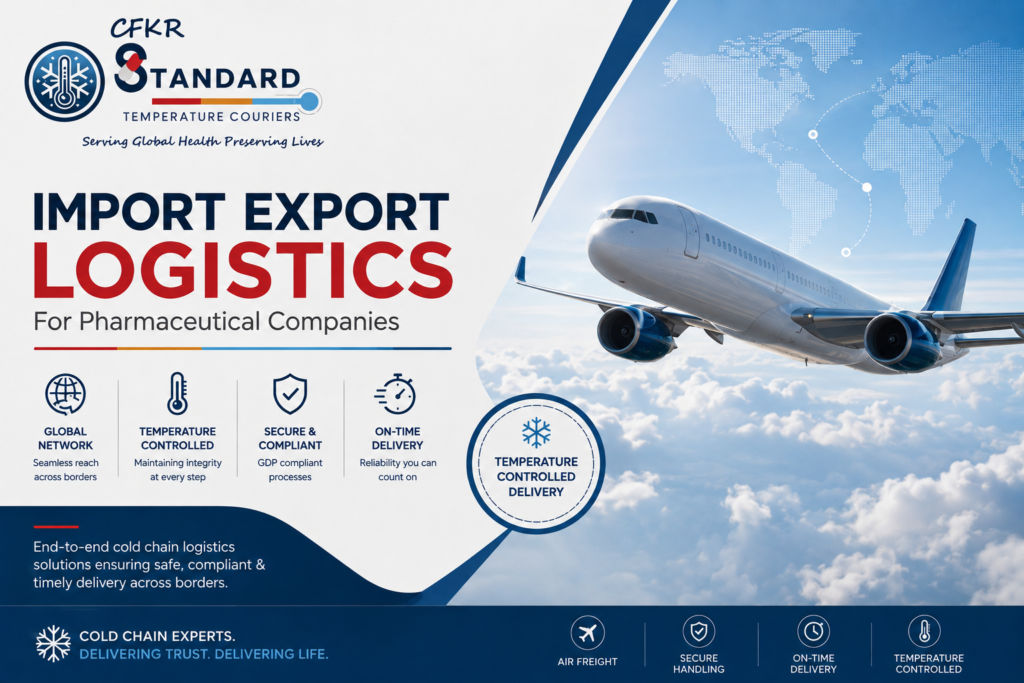
Import export logistics is the backbone of every pharmaceutical company that sources raw materials from abroad, exports finished formulations, or moves clinical samples across borders. For most industries, a delayed shipment is an inconvenience. For pharmaceutical companies, a delayed or mishandled shipment can mean a spoiled vaccine batch, a failed clinical trial sample, or a consignment rejected at customs because the paperwork did not match the product. The stakes are higher, the rules are stricter, and the margin for error is close to zero.
This guide walks through why pharmaceutical import export logistics needs a different approach than general cargo movement, what typically goes wrong when companies treat it like any other shipping task, and what a properly built, temperature controlled logistics setup actually looks like in practice.
Why Pharmaceutical Shipments Need a Different Kind of Import Export Logistics
A shipment of electronics or textiles can sit in a warehouse for a few extra days without losing value. A shipment of insulin, biologics, or a temperature sensitive active pharmaceutical ingredient cannot. Most pharmaceutical products are stable only within a narrow temperature band, often between two and eight degrees Celsius for cold chain items, or within a controlled room temperature range for others. Step outside that band for even a short period and the product can lose potency, and in regulated markets it becomes unsellable.
This is why pharmaceutical import export logistics is treated as its own discipline rather than a subset of general freight. It combines three things that rarely overlap in ordinary cargo movement: continuous temperature control from origin to destination, strict customs and regulatory documentation, and full traceability so that every stage of the journey can be audited if something goes wrong. Global frameworks such as Good Distribution Practice guidelines from the European Medicines Agency exist precisely because medicines lose their integrity the moment handling standards slip, and regulators around the world, including India, expect distributors to demonstrate compliance with equivalent principles.
For companies exporting from India, this also means working within the country’s own trade framework. Every consignment moving out of India needs to align with the licensing and documentation rules set by the Directorate General of Foreign Trade, and pharmaceutical exporters specifically operate under the oversight of bodies such as the Pharmaceuticals Export Promotion Council of India, which handles registration and certification for exporters of bulk drugs, formulations, and biologics.
The financial exposure behind all of this is often underestimated until a company experiences it directly. A single batch of biologics or vaccines can represent lakhs of rupees in raw material, manufacturing time, and regulatory approval work. When that batch is lost to a temperature excursion or held indefinitely at a port because of a paperwork mismatch, the company does not just lose the shipment. It loses the production slot, delays the order to its buyer, and in regulated export markets, may need to explain the deviation to the receiving country’s drug authority before future shipments are cleared without extra scrutiny. This is why import export logistics for pharmaceutical products has to be planned as part of the supply chain strategy, not treated as a transport task handled after manufacturing is complete.
The Problem: What Goes Wrong When Import Export Logistics Isn’t Built for Pharma
Most pharmaceutical companies do not lose shipments because of a single dramatic failure. They lose them because general logistics providers treat pharmaceutical cargo the same way they treat any other cargo, and the small gaps in that approach add up.
The most common issue is a temperature excursion during transit. A refrigerated truck that is not properly pre-cooled, a break in the cold chain during a customs hold, or a transfer between vehicles without validated packaging can push a shipment outside its required range within minutes. Once that happens, the batch is compromised even if it looks fine on arrival, and pharmaceutical companies are then forced to either destroy the stock or run costly stability testing to prove it is still usable.
The second issue is documentation mismatch. Pharmaceutical shipments require far more paperwork than ordinary cargo, including drug licenses, import or export permits, certificates of analysis, and compliance declarations tied to bodies such as the Central Drugs Standard Control Organisation. When a courier partner is not familiar with these requirements, shipments get held at customs, sometimes for days, and every extra day in an uncontrolled holding area increases the risk of a temperature or quality issue.
The third issue is lack of visibility. Many pharmaceutical companies only find out that something went wrong when the shipment arrives late or damaged. Without real time monitoring, there is no way to catch a problem in transit and correct it before the product is lost.
Together, these gaps create a pattern that pharmaceutical companies know well: shipments that arrive late, batches that get flagged during quality checks, and export documentation that has to be redone after customs raises a query. Each of these is avoidable, but only with a logistics partner that has built its process specifically around pharmaceutical requirements.
The Solution: Import Export Logistics Built Around Temperature Control and Compliance
The fix is not more caution applied to a general shipping process. It is a logistics setup designed from the ground up for pharmaceutical movement, where temperature control and regulatory compliance are part of the core process rather than an add-on.
A properly built pharmaceutical import export logistics chain starts with validated, temperature controlled packaging suited to the specific product, whether that is a passive insulated container for a short domestic route or an active temperature controlled unit for a long international transit. This is paired with a transport fleet that is pre-qualified and temperature mapped, so the internal conditions of every vehicle are known and monitored rather than assumed.
Compliance is handled the same way. Instead of assembling export documentation at the last minute, a pharma-focused logistics partner prepares the licensing, customs declarations, and product-specific paperwork in advance, aligned with the standards set by DGFT for outbound shipments and CDSCO requirements for anything entering or leaving India that falls under drug control regulation. This preparation is what keeps shipments moving through customs without unnecessary holds.
The final piece is monitoring. Real time temperature tracking, combined with alerts if conditions drift outside the approved range, gives pharmaceutical companies the ability to act before a shipment is compromised rather than finding out after the fact. This is close to the standard set by air cargo certifications such as IATA’s CEIV Pharma programme, which assesses everything from staff training to temperature mapping and documentation control across the pharmaceutical handling chain.
How STC Couriers Structures Import Export Logistics for Pharmaceutical Shipments
At STC Couriers, pharmaceutical import export logistics is not treated as a variation of standard courier service. It is built as a dedicated process, starting from booking through to final delivery.
The process begins with scheduling through a platform built for pharmaceutical shipments, where product type, temperature requirement, and route are captured before pickup so the right packaging and vehicle are assigned from the start. From there, shipments move through a temperature controlled fleet, with vehicles maintained and monitored so conditions stay within range for the full transit, whether that transit is domestic or crosses into international freight.
Regulatory work happens in parallel rather than after the fact. STC Couriers manages the regulatory compliance side of pharmaceutical shipments, aligning documentation with the requirements pharmaceutical exporters and importers face under Indian trade and drug control regulations, so paperwork is ready before the shipment reaches customs rather than being assembled under time pressure.
The final stage is delivery with real time tracking, giving pharmaceutical companies visibility into where a shipment is and what condition it is in at every point, right up to confirmed delivery. This structure is what supports STC Couriers’ pharmaceutical supply chain work across vaccines, biologics, and formulation shipments that need both speed and precision.
What a Pharma-Ready Import Export Logistics Partner Should Actually Offer
Pharmaceutical companies evaluating a logistics partner often focus on price and delivery speed first, and those matter, but they are not enough on their own. A partner that cannot demonstrate temperature control and documentation readiness will eventually cost more than one that charges slightly more but gets the shipment there intact and cleared without delay.
The packaging used for a shipment should be validated for the specific product and route, not a generic insulated box applied to every consignment regardless of what it is carrying. STC Couriers’ approach to packaging technology reflects this, with solutions designed around the product being shipped rather than a one-size-fits-all container.
Documentation readiness matters just as much as packaging. A partner should be able to explain, before a shipment is booked, exactly what paperwork is required for the specific product, origin, and destination, and should already have a working relationship with the customs and regulatory processes involved. Waiting until a shipment is at the border to discover a missing certificate is how delays and spoiled batches happen.
Finally, a pharma-ready partner should offer full visibility, not periodic status updates. Temperature and location data should be available in real time, so if something starts to go wrong mid-transit, there is still time to intervene.
Common Mistakes Pharmaceutical Companies Make When Managing Import Export Logistics
Even companies that understand the stakes sometimes fall into avoidable patterns. One common mistake is choosing a logistics partner based purely on cost per shipment without asking how that partner handles temperature deviations or documentation. A lower quote often reflects a general freight process rather than a pharma-specific one, and the savings disappear the first time a batch is compromised.
Another mistake is treating documentation as a formality rather than a critical control point. Pharmaceutical companies sometimes prepare export paperwork only after a shipment is packed and ready to move, which leaves no time to correct errors before customs review. Preparing documentation alongside production planning, rather than after it, closes this gap.
A third mistake is relying on periodic check-ins instead of continuous monitoring. A shipment that is only checked once a day can already be compromised long before anyone notices. Continuous, real time tracking is what allows a company to intervene while there is still time to save the shipment.
A Practical Walkthrough: How a Compliant Shipment Moves From Origin to Destination
Consider a pharmaceutical company in India exporting a batch of temperature sensitive formulations to an overseas buyer. The process starts with the company booking the shipment and specifying the product’s temperature range and handling requirements. The logistics partner then prepares export documentation in line with DGFT and applicable drug control requirements, while simultaneously arranging validated packaging suited to the transit duration and route.
Once the shipment is picked up, it moves through a temperature mapped vehicle to the point of export, with conditions monitored continuously. At customs, the pre-prepared documentation allows the shipment to clear without the delays that come from incomplete or last-minute paperwork. During international transit, whether by air or sea, temperature and location tracking continue, and any deviation triggers an alert so corrective action, such as re-icing or rerouting, can happen before the product is compromised.
On arrival, the shipment is handed over with a full record of the conditions it experienced throughout transit, giving the receiving company the traceability needed to confirm the batch is intact and release it for use. This is the difference between import export logistics that simply moves a box from one place to another, and import export logistics built to protect what is inside that box.
Choosing the Right Import Export Logistics Partner for Pharmaceutical Shipments
The right partner for pharmaceutical import export logistics is one that treats temperature control and regulatory compliance as the foundation of the service, not an optional upgrade. Ask a potential partner how they handle temperature mapping, what documentation support they provide before a shipment is booked, and how they respond if a temperature deviation is detected mid-transit. Their answers will tell you quickly whether they understand pharmaceutical logistics or are applying a general freight process to a specialised product.
For companies already dealing with the cost of a spoiled batch, a customs hold, or a rejected shipment, the case for switching to a specialised partner is usually already clear. The question is not whether pharma-specific logistics is worth the investment, it is how quickly a proper process can be put in place before the next shipment goes out.
Frequently Asked Questions:
What makes import export logistics different for pharmaceutical products compared to general cargo?
Pharmaceutical shipments require continuous temperature control, validated packaging, and documentation that meets drug regulatory standards, not just customs requirements. A single break in temperature control or a documentation gap can compromise the entire batch, which is not usually the case with general cargo.
How does temperature controlled logistics prevent shipment loss?
Temperature controlled logistics keeps a shipment within its required range from pickup to delivery, using pre-qualified vehicles, validated packaging, and continuous monitoring. This prevents the kind of temperature excursions that damage vaccines, biologics, and other sensitive formulations during transit.
What documentation is typically needed for pharmaceutical import export shipments from India?
Requirements vary by product and destination, but commonly include export or import licenses, certificates of analysis, drug control clearances, and customs declarations aligned with DGFT and CDSCO requirements. A pharma-focused logistics partner prepares this documentation in advance rather than after the shipment is booked.
How can a pharmaceutical company reduce the risk of customs delays?
The most effective way is to work with a logistics partner who prepares all required documentation before the shipment reaches customs, and who understands the specific regulatory requirements for pharmaceutical products in both the origin and destination country.
Does STC Couriers handle both domestic and international pharmaceutical shipments?
Yes. STC Couriers manages temperature controlled logistics for pharmaceutical shipments both within India and across international routes, covering cold chain transport, regulatory documentation, and real time tracking for the full journey.
What should a pharmaceutical company check before signing on with a logistics partner?
Ask for specifics on temperature mapping and vehicle qualification, request examples of how the partner has handled customs documentation for similar products, and confirm whether monitoring is continuous or periodic. A partner who cannot answer these questions clearly is likely applying a general freight process to a pharmaceutical shipment.
Protect Your Next Pharmaceutical Shipment Before It Leaves the Warehouse
If your pharmaceutical shipments have faced temperature excursions, customs delays, or documentation issues in the past, the fix starts before the next shipment is booked, not after something goes wrong. STC Couriers builds import export logistics around the specific needs of pharmaceutical products, from validated packaging to regulatory documentation to real time monitoring.
Message our team on WhatsApp to discuss your shipment requirements and get a logistics plan that keeps your product compliant and intact from origin to destination.