
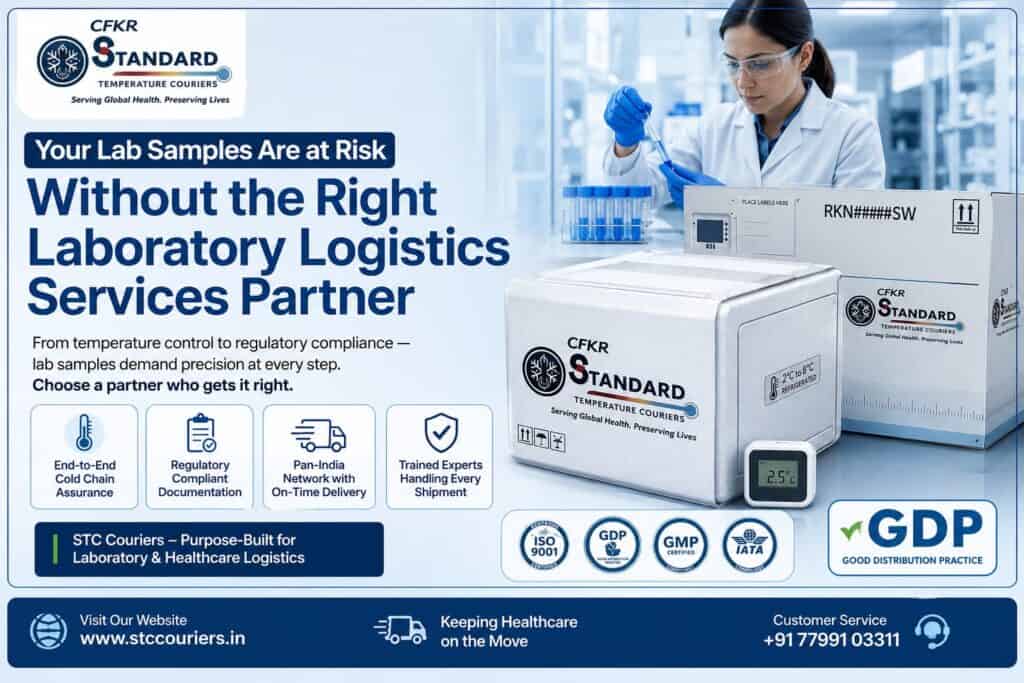
You’ve already done the hard part collected the samples, prepared the shipment, followed all the internal protocols. But then the sample arrives degraded. Or late. Or worse, it never arrives at all.
This isn’t a hypothetical. It happens every week to hospitals, diagnostic labs, pharmaceutical companies, and research institutions across India. And in most cases, the root cause is simple: the wrong logistics partner.
If you’re currently evaluating laboratory logistics services for your organization or you’ve already had a bad experience and you’re looking to switch this blog is for you. No fluff. Just what you need to know to make the right call.
What "Laboratory Logistics" Actually Means (And Why It's Different from Regular Courier)
Standard courier companies move boxes. Laboratory logistics services move samples, reagents, diagnostic kits, biological specimens, and pharmaceutical products items that have strict temperature requirements, regulatory compliance needs, and zero tolerance for delay or mishandling.
The difference matters enormously.
A regular courier driver won’t know what to do if the dry ice in a box runs out mid-transit. They won’t carry the right documentation for transporting biological specimens across state lines. They won’t have a validated cold chain system that maintains -20°C throughout the journey.
Laboratory logistics is a specialised field. It requires trained personnel, proper packaging, calibrated temperature monitoring, and compliance with ICMR, CDSCO, and IATA regulations depending on what’s being moved.
If your current partner can’t check all those boxes, you’re taking on risk every single time you ship.
The Cold Chain Problem Most Labs Ignore Until It's Too Late
Temperature-sensitive shipments are the backbone of laboratory logistics. Vaccines, blood samples, cancer biopsies, PCR reagents, serum samples all of these have specific temperature windows. Break that window, even briefly, and the sample is compromised.
Working with a qualified cold chain logistics company in India is not optional for this kind of work. It’s the baseline requirement.
Here’s what a proper cold chain setup looks like:
Validated Packaging
Not just thermocol boxes with ice packs. Validated insulated packaging that has been tested to maintain the required temperature range (2–8°C, -20°C, -80°C, or ambient depending on the product) for a defined period under real-world conditions.
Temperature Monitoring Devices
Data loggers or digital indicators that record temperature throughout the journey. When the sample arrives, you should be able to pull a complete temperature log not just take someone’s word for it.
Trained Handlers
People who understand why they can’t leave a box sitting in a hot vehicle for 45 minutes. Who know how to repack dry ice correctly. Who understand that certain biological specimens are regulated and need specific handling protocols.
SOP-Driven Operations
Cold chain logistics isn’t something you improvise. Every step from pickup to transit to handover needs to follow a documented, validated standard operating procedure. A cold chain logistics company in India that can demonstrate all of this is rare. That’s exactly why it matters so much to find one that can.
What to Look for in a Laboratory Courier Service
Not every company that calls itself a laboratory courier service is equipped to handle laboratory-grade shipments. Here’s a practical checklist to evaluate any provider:
1. Regulatory Compliance
Are they compliant with IATA Dangerous Goods Regulations for biological specimens? Do they have documentation processes for Category A and Category B infectious substances? Can they handle ADR (hazardous materials) shipments? If the answer to any of these is “we’ll figure it out,” move on.
2. Temperature Range Coverage
Do they support the full range your lab needs? 2–8°C refrigerated, -20°C frozen, -80°C ultra-low, and ambient controlled (15–25°C) a serious laboratory courier service should handle all of these, not just the easy ones.
3. Pickup and Delivery Network
Can they service the locations you need including Tier 2 and Tier 3 cities? Many providers promise pan-India reach but fall apart outside metro areas. If your clinical trial sites are in smaller cities, this is a dealbreaker.
4. Chain of Custody Documentation
Every handoff in the chain should be documented. You should receive proof of delivery with timestamp, recipient name, and condition of the package on arrival.
5. Emergency and Same-Day Capability
Some specimens can’t wait. Biopsies heading to pathology labs, urgent diagnostic samples, time-critical pharmaceutical shipments does your courier have the operational infrastructure to handle genuine urgency?
6. Sector Experience
A courier who primarily handles retail e-commerce is not the same as one who has spent years handling hospital samples and pharma cold chain. Ask for case studies, client references, and specific domain experience.
Industries That Need Specialized Laboratory Logistics Services
If you’re in any of the following sectors, you already know that generic logistics doesn’t work.
Hospitals and Diagnostic Chains
Blood samples, urine samples, tissue biopsies all need to reach reference labs quickly and in perfect condition. For hospital groups operating across multiple cities, managing sample logistics centrally with a reliable partner is critical for both patient outcomes and turnaround times.
Pharmaceutical Companies
Drug stability samples, API shipments, finished goods testing pharmaceutical cold chain is one of the most complex and regulated areas in logistics. Deviations create compliance failures. One bad shipment can delay a product launch or trigger an audit.
Clinical Research Organizations (CROs)
Clinical trial logistics is its own discipline. Multiple sites, multiple sample types, international shipments, strict protocol adherence the provider needs to function almost like an extension of the clinical operations team.
IVF and Fertility Clinics
Handling cryogenic specimens embryos, gametes requires ultra-low temperature capability and absolute precision. There is no “close enough” in this space.
Biotechnology and Research Institutions
Reagents, cell cultures, genetic samples research labs often deal with specimens that are irreplaceable. Losing a sample isn’t just a logistics failure; it’s months of work gone.
STC Couriers: Built for Laboratory-Grade Logistics
STC Couriers was built specifically around the needs of the healthcare and life sciences sector. This isn’t a freight company that added a “lab samples” service to its menu. Laboratory and pharmaceutical logistics is the core of what they do.
What STC Couriers brings to the table:
- Full cold chain capability — from 2–8°C refrigerated to -80°C ultra-low temperature, with validated packaging and continuous temperature monitoring. Every shipment comes with documentation you can use for regulatory purposes.
- Pan-India network with specialised handling — not just metro cities. STC has built pickup and delivery capability across India’s major diagnostic and research hubs, with operational depth to serve locations most couriers treat as an afterthought.
- Regulatory-ready documentation — chain of custody records, temperature logs, proof of delivery, and compliance documentation that meets ICMR, CDSCO, and IATA standards.
- Trained logistics personnel — the people handling your samples aren’t general warehouse staff. They’re trained specifically in biological specimen handling, cold chain protocols, and regulatory documentation.
- Dedicated account management — when something needs to move urgently, you’re not calling a general helpline. You have a point of contact who knows your account, your requirements, and your locations.
The Real Cost of Getting This Wrong
Let’s be direct about what’s at stake when laboratory logistics fails.
Sample degradation means retesting, which means cost, delay, and in clinical settings, delayed patient diagnosis or treatment decisions.
Compliance failures a shipment that doesn’t meet regulatory documentation requirements can create audit issues, impact clinical trial data integrity, or result in regulatory action.
Chain of custody breaks if there’s no clear documentation trail for a specimen, its evidentiary or diagnostic value can be compromised.
Repeat collections when samples are lost or compromised, patients or trial participants sometimes need to be recalled for recollection. Beyond the cost, this damages your organization’s credibility.
Reputation damage if your lab regularly sends degraded or poorly documented samples, it affects how partners and reference labs view your operations.
The cost of working with the right cold chain logistics company in India is a fraction of the cost of dealing with these failures.
Questions to Ask Before You Sign a Contract
Before you commit to any laboratory logistics services provider, run through these questions:
- Can you provide temperature validation certificates for your packaging?
- What is your escalation protocol if a shipment is delayed or a temperature deviation is detected mid-transit?
- Can you handle both domestic and international shipments?
- What documentation do you provide at delivery?
- Do you have experience handling our specific specimen type?
- Can you provide references from clients in our sector?
- What is your pickup SLA and delivery window?
- How do you handle last-mile delivery in non-metro locations?
A provider who can answer these clearly and specifically with documentation to back it up — is a provider worth talking to further.
Ready to Switch to a Logistics Partner That Actually Understands Your Work?
If you’ve been dealing with temperature excursions, incomplete documentation, missed pickups, or simply a provider that treats your lab samples like any other parcel, it’s time to make a change.
STC Couriers works with hospitals, diagnostic chains, pharmaceutical companies, CROs, and research institutions across India. Whether you need a regular collection schedule, cold chain transport for clinical trial samples, or urgent same-day laboratory courier service for time-critical specimens — the infrastructure and expertise are in place.
The conversation starts with understanding your specific needs. Talk to the STC team, share your requirements, and see whether the fit is right.
Because your samples deserve a logistics partner that takes them as seriously as you do.