
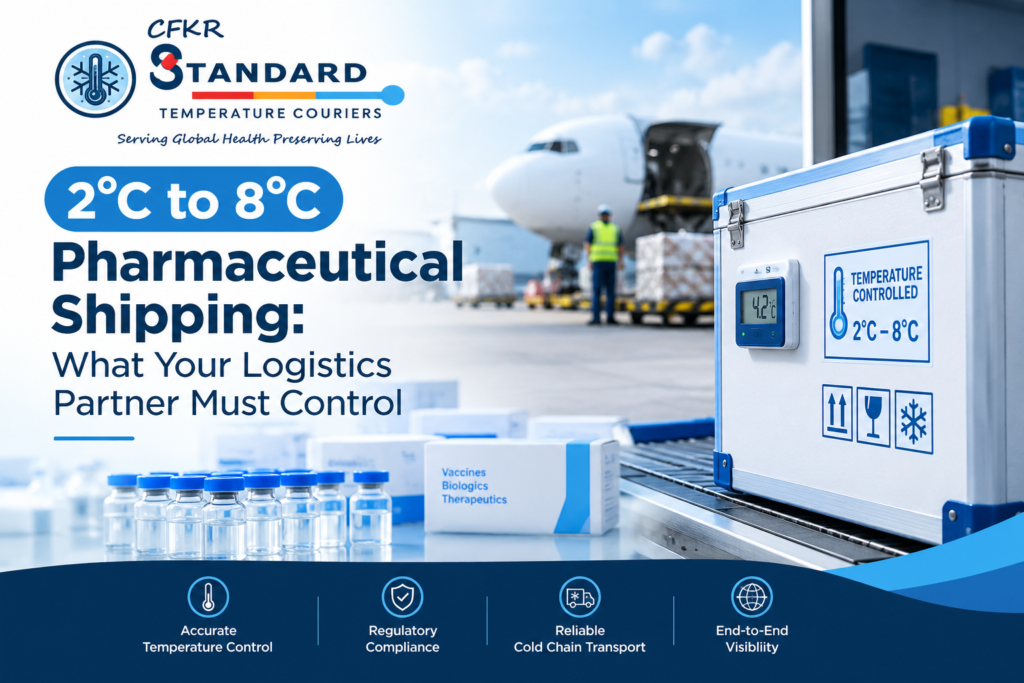
Shipping pharmaceutical products between 2°C and 8°C is not simply a matter of placing medicines inside a refrigerated vehicle.
The entire shipment has to be planned around temperature stability, packaging performance, handling, transit time, monitoring, documentation, and contingency management.
A small temperature deviation can create questions around product quality, usability, and compliance. For pharmaceutical manufacturers, biotech companies, CROs, hospitals, laboratories, and clinical trial teams, that makes the choice of logistics partner critical.
At CFKR STC Couriers, we specialise in cold chain logistics for pharmaceutical and life science shipments. Our focus is on maintaining control throughout the journey, from packaging and pickup to monitored transit and final delivery.
This guide explains what your logistics partner should control when transporting 2°C to 8°C pharmaceutical shipments.
Why 2°C to 8°C Pharmaceutical Shipping Requires Specialist Handling
Many pharmaceutical products are sensitive to temperature changes.
This can include vaccines, biologics, injectables, clinical trial material, diagnostic products, and other temperature-sensitive medicines.
For these products, maintaining the specified temperature range is part of protecting product integrity.
The challenge is that a shipment can be exposed to risk at several points.
It may sit at a loading dock.
It may be transferred between vehicles.
It may spend time at an airport.
It may be delayed in customs.
It may remain inside a vehicle longer than expected.
It may also pass through locations with very different ambient temperatures.
A reliable 2 to 8 degree pharma transport solution therefore has to control more than the vehicle temperature alone.
What Must Be Controlled in a 2°C to 8°C Pharma Shipment?
A strong cold chain process should control the full shipment environment.
That includes the packaging, route, temperature monitoring, handling, timing, documentation, and response plan.
1. Temperature-Controlled Packaging
The first layer of protection is packaging.
For a 2°C to 8°C shipment, the packaging should be selected according to the product, route, transit duration, external conditions, and handling environment.
Packaging Should Be Matched to the Shipment
The same packaging solution should not automatically be used for every pharmaceutical product.
A short domestic shipment may need a different configuration from a multi-day international shipment.
Your logistics partner should consider:
- Required temperature range
- Expected transit time
- Product volume
- External climate
- Number of handovers
- Air or road transport
- Customs exposure
- Potential delays
At CFKR STC Couriers, packaging is treated as part of the logistics strategy rather than a separate afterthought.
2. Packaging Validation
For pharmaceutical shipments, packaging should not be chosen only because it looks insulated.
The logistics provider should understand how the packaging performs under realistic transit conditions.
What Validation Should Address
The packaging solution should be appropriate for:
- Expected journey duration
- Seasonal conditions
- Temperature range
- Product load
- Coolant configuration
- Handling environment
For higher-risk shipments, validated packaging can provide greater confidence that the required range can be maintained through the expected transport window.
3. Pre-Conditioning of Packaging Components
Packaging performance depends partly on how its components are prepared before the shipment starts.
For example, coolant packs may need to be conditioned correctly before use.
If they are too cold or used incorrectly, they can create a different risk by exposing the product to temperatures below the required range.
Why This Matters
Cold chain failure is not always caused by heat.
A shipment can also be damaged by overcooling.
This is why packing procedures should be precise and repeatable.
Your logistics provider should have clear procedures for preparing packaging materials before dispatch.
4. Correct Product Placement Inside the Package
The product should not be placed randomly inside a cold chain shipper.
Its position can affect the temperature it experiences.
Spacing, insulation, coolant placement, and product load all matter.
The Goal
The package should maintain a stable internal environment around the pharmaceutical product.
Poor packing can create hot spots or cold spots even when the overall package appears suitable.
This is one reason why trained handling is important.
5. Temperature Monitoring Throughout Transit
One of the most important controls in pharma cold chain logistics is temperature monitoring.
A logistics partner should be able to provide evidence of what happened during the shipment.
Monitoring Can Include
- Temperature data loggers
- Shipment-level monitoring
- Real-time tracking
- Vehicle temperature monitoring
- GPS tracking
At STC Couriers, temperature-controlled logistics is supported by tracking and monitoring so customers have greater visibility during critical shipments.
6. Correct Data Logger Placement
Using a data logger is useful only if it is placed appropriately.
The logger should reflect the temperature conditions experienced by the product as closely as possible.
Poor placement can make the data less useful.
What Your Logistics Partner Should Understand
The provider should know:
- Where the logger should be placed
- How it should be activated
- How it should be protected
- When it should be stopped
- How the data will be retrieved
For regulated pharmaceutical shipments, the monitoring record can become an important part of shipment review.
7. Controlled Pickup and Loading
The cold chain can fail before the vehicle even leaves.
If temperature-sensitive products are left exposed during loading, the shipment may experience a deviation before transit begins.
Loading Should Be Planned
Your logistics provider should control:
- Pickup timing
- Vehicle readiness
- Loading duration
- Product exposure
- Packaging condition
- Shipment documentation
The objective is to minimise unnecessary time outside the controlled environment.
8. Temperature-Controlled Vehicles
For road transport, the vehicle itself is another critical control point.
A refrigerated vehicle should be appropriate for the product and required temperature range.
Your Provider Should Manage
- Pre-cooling
- Set-point control
- Vehicle maintenance
- Temperature monitoring
- Loading process
- Door opening
- Transit conditions
A vehicle that is not prepared correctly can create instability even if the refrigeration system is working.
9. Transit Time
Time is a major factor in 2°C to 8°C shipping.
The longer a shipment remains in transit, the more exposure it may have to:
- Delays
- Handling
- Weather
- Airport dwell time
- Customs
- Road disruption
Route Planning Matters
A logistics partner should select the route based not only on cost but also on risk.
For critical pharmaceutical products, the shortest route is not always the safest route.
Reliability, transfer points, flight frequency, backup options, and handling conditions should also be considered.
10. Air Freight Handling
International pharmaceutical shipments often rely on air freight.
This adds several additional risk points.
The product may pass through:
- Cargo terminals
- Security screening
- Ground handling
- Aircraft loading
- Connection airports
- Customs
- Destination warehouses
Airport Dwell Time Can Be Critical
A 2°C to 8°C shipment can remain stationary for hours during airport operations.
That is why packaging duration and route planning must account for more than just flight time.
At CFKR STC Couriers, international pharma logistics is planned around end-to-end shipment handling rather than the flight segment alone.
11. Customs and Regulatory Delays
Customs delays can extend transit time unexpectedly.
For temperature-sensitive pharmaceuticals, this can become a serious problem if the packaging was designed around an unrealistic transit window.
Before Dispatch
The logistics partner should review:
- Documents
- Consignee information
- Product description
- Shipping requirements
- Destination procedures
- Expected customs process
The objective is to reduce avoidable delays.
12. Chain of Custody
Pharmaceutical shipments often pass through several people and facilities.
A clear chain of custody helps establish who handled the shipment and when.
This Can Include
Pickup records, handover records, transport documents, shipment milestones, and proof of delivery.
For clinical trials, biologics, and high-value pharmaceuticals, maintaining clear shipment accountability can be particularly important.
13. Documentation
Reliable 2°C to 8°C pharma transport depends on accurate documentation.
Your logistics partner should understand the importance of shipment records.
Relevant Documentation May Include
- Shipment details
- Temperature requirements
- Packaging information
- Tracking records
- Data logger records
- Delivery confirmation
- Exception reports
The exact requirements depend on the product, route, customer procedures, and applicable regulations.
14. Temperature Excursion Management
You should ask your logistics provider a simple question before booking:
What happens if the shipment goes outside 2°C to 8°C?
The answer should be clear.
A Good Response Process Should Include
Detection, escalation, communication, containment, and documentation.
The provider should know who is contacted, how quickly the issue is escalated, what actions can be taken, and how the event will be recorded.
This matters because no logistics network is completely free from risk.
The difference is how quickly and professionally an incident is managed.
15. Backup and Contingency Planning
A shipment plan should account for things going wrong.
Possible disruptions include:
- Vehicle breakdown
- Flight cancellation
- Missed connection
- Customs delay
- Weather disruption
- Airport congestion
- Route closure
Ask About the Backup Plan
A strong logistics provider should be able to explain what alternative actions are available.
For a high-value pharma shipment, waiting until something goes wrong is too late to start planning.
16. Real-Time Shipment Visibility
Customers should not have to repeatedly call the logistics provider just to understand where the shipment is.
Tracking and status updates provide better operational visibility.
Useful Visibility Includes
- Pickup confirmation
- Current location
- Transit milestones
- Delivery status
- Temperature information where available
STC Couriers provides real-time tracking support so customers can monitor critical shipments more effectively.
17. Final Delivery and Handover
The cold chain does not end when the vehicle arrives at the destination.
The final handover should also be controlled.
Delivery Should Confirm
The right consignee, shipment condition, delivery time, and completion of relevant records.
Where required, monitoring data can then be reviewed as part of the shipment closeout process.
18. Post-Shipment Temperature Review
For temperature-sensitive pharmaceuticals, the shipment record may need to be reviewed after delivery.
This can include checking the data logger information for excursions.
Why This Matters
A shipment arriving on time does not automatically mean the temperature requirement was met.
Temperature data helps provide evidence of how the product was handled throughout the journey.
Common Failure Points in 2°C to 8°C Pharmaceutical Shipping
Most cold chain failures are not caused by one dramatic event.
They often result from small gaps in planning.
Poor Packaging Selection
A package may not be designed for the actual transit duration.
Incorrect Coolant Conditioning
Coolant can create freezing risk if used incorrectly.
Long Airport Dwell Time
The product may spend more time on the ground than expected.
Excessive Door Opening
Repeated access to a refrigerated vehicle can affect internal temperature stability.
Missing or Incorrect Documents
Documentation problems can create customs delays.
No Backup Plan
A missed flight or vehicle failure can become much more serious if no alternative has been arranged.
Inadequate Monitoring
Without temperature records, the shipper may not know when a deviation occurred.
2°C to 8°C Pharma Shipping by Road vs Air
The right transport mode depends on the route, urgency, shipment value, and destination.
Road Transport
Road-based 2 to 8 degree pharma transport may be suitable for domestic or regional shipments.
The key controls include vehicle temperature, route planning, monitoring, and delivery timing.
Air Freight
Air freight is often used for long-distance and international pharma shipping.
It can reduce transit time, but it also introduces more handling points.
That means packaging, airport processes, connections, and customs become more important.
Which Option Is Better?
There is no single answer.
The logistics provider should evaluate the shipment based on risk rather than selecting a mode purely on price.
What Should You Ask Before Booking 2°C to 8°C Pharma Transport?
Before choosing a provider, ask a small set of direct questions.
- Can you maintain 2°C to 8°C throughout the required journey?
- What packaging solution will you use?
- Is the packaging suitable for the expected transit duration?
- How is temperature monitored?
- Will a data logger be included?
- How is the logger positioned and retrieved?
- How do you manage airport or customs delays?
- What is the contingency plan for missed connections or vehicle failure?
- What shipment records will I receive?
- How do you handle a temperature excursion?
- Can I track the shipment in real time?
- Who manages the shipment if something goes wrong?
A provider should be able to answer these questions clearly before you book.
Why Choose CFKR STC Couriers for 2°C to 8°C Pharmaceutical Shipping?
CFKR STC Couriers has more than 30 years of experience in pharmaceutical and life science logistics.
We support businesses that need reliable cold chain transportation across domestic and international routes.
Cold Chain Expertise
Our logistics services are designed around temperature-sensitive pharmaceutical and biotech shipments.
Validated Packaging Support
We provide packaging solutions for biological samples, pharmaceuticals, and other sensitive products.
Global Logistics
STC Couriers supports international shipping through:
- Air freight
- Ocean freight
- Express shipping
- Door-to-door logistics
GDP-Focused Processes
Our cold chain operations are built around controlled handling, documentation, monitoring, and shipment visibility.
Real-Time Tracking
Customers can monitor shipment progress and stay informed throughout the journey.
Specialist Life Science Solutions
Our services also cover:
- Clinical trial logistics
- Cell and gene supply chain
- Cryogenic transportation
- Dangerous goods
- Lab logistics
- Pharmaceutical supply chain
When Should You Contact STC Couriers?
You should speak with a specialist logistics provider if you need to move:
- Vaccines
- Biologics
- Temperature-sensitive medicines
- Clinical trial materials
- Pharmaceutical samples
- Diagnostic products
- Cell and gene therapy materials
- High-value life science shipments
The earlier the logistics provider is involved, the easier it is to plan packaging, routing, documentation, and contingencies correctly.
Final Thoughts
Reliable 2°C to 8°C pharmaceutical shipping requires control at every stage.
The most important factors are not limited to refrigerated transport.
Your logistics partner should manage:
- Packaging
- Temperature monitoring
- Data logging
- Loading
- Vehicle conditions
- Route planning
- Airport handling
- Customs risk
- Documentation
- Chain of custody
- Contingency planning
- Final delivery
A successful cold chain shipment is one where every handover and every risk point has been considered before the product moves.
At CFKR STC Couriers, we combine pharmaceutical logistics experience, packaging technology, cold chain expertise, global distribution, and shipment visibility to help life science companies move temperature-sensitive products safely and reliably.
Request a 2°C to 8°C Pharma Shipping Quote
Need to ship temperature-sensitive pharmaceutical products domestically or internationally?
Talk to CFKR STC Couriers about your shipment requirements.
Share your product type, origin, destination, required temperature range, shipment size, and delivery timeline.
Our team can help you plan the appropriate cold chain solution.
Contact STC Couriers today for a tailored pharmaceutical logistics quote.
Frequently Asked Questions
What is 2°C to 8°C pharmaceutical shipping?
It is the controlled transportation of pharmaceutical products that need to remain between 2°C and 8°C during the required shipping period.
Which pharmaceutical products commonly require 2°C to 8°C transport?
Depending on the product specifications, this can include vaccines, biologics, injectables, diagnostic materials, and other temperature-sensitive medicines.
How is temperature monitored during pharma transport?
Temperature can be monitored using devices such as data loggers, vehicle sensors, and other shipment monitoring systems.
What happens if a pharmaceutical shipment goes above 8°C?
The event should be documented and assessed according to the product requirements and the shipper’s quality procedures. The logistics provider should have a clear escalation and reporting process.
Can a pharmaceutical shipment also fail by becoming too cold?
Yes. Products specified for 2°C to 8°C may also be sensitive to freezing or temperatures below their approved range.
Is air freight suitable for 2°C to 8°C pharmaceuticals?
Yes, when packaging, transit time, handling, monitoring, and customs risks are properly planned.
Does STC Couriers provide cold chain packaging?
Yes. CFKR STC Couriers provides validated packaging solutions for pharmaceutical, biological, and other temperature-sensitive shipments.
Can STC Couriers manage international pharmaceutical shipments?
Yes. STC Couriers provides global logistics solutions including air freight, ocean freight, express shipping, and specialised cold chain transport.
Does STC Couriers handle clinical trial shipments?
Yes. Clinical trial logistics is one of the specialist life science solutions offered by STC Couriers.
Does STC Couriers provide cryogenic logistics?
Yes. STC Couriers provides cryogenic transportation as part of its specialist life science logistics services.