
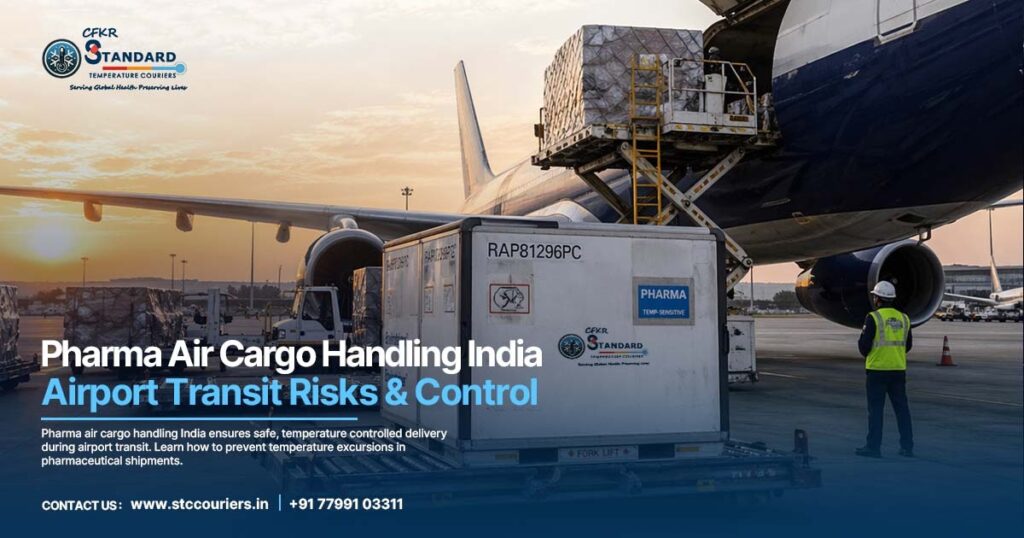
Pharma air cargo handling in India is critical for maintaining temperature controlled pharmaceutical shipments during airport transit. Most people assume pharmaceutical logistics is about moving a shipment from one location to another. But the truth is, the most critical part of the journey doesn’t happen in transit across cities. It happens during short, often overlooked moments at the airport.
Why Pharma Air Cargo Handling India Is Critical for Temperature Control
This is where control is either maintained or lost.
Pharma air cargo handling India shipments are highly sensitive and require strict temperature control during airport transitWhether it is a vaccine, a clinical sample, or a high-value medicine, every shipment depends on strict temperature stability. Even a small variation can affect product integrity. And in India’s climate, that variation can happen faster than expected.
The biggest risk is not always the distance. It is the handling.
Airport Transit Risks in Pharmaceutical Shipments
Airport environments involve multiple stages. A shipment is received, moved, scanned, stored, loaded, unloaded, and then transferred again. Each of these steps creates a point of exposure. If coordination is not precise, even a short delay can lead to temperature fluctuation.
This is what makes pharma air cargo handling in india one of the most sensitive parts of the entire logistics chain.
To understand the bigger picture of how pharmaceutical logistics functions across India, you can explore the broader system here: STC BLOGS
Within that system, airport handling plays a defining role.
How Temperature Excursions Occur During Air Cargo Handling
When a shipment arrives at an airport, it does not immediately move to the next stage. There are operational processes involved, and during that time, the shipment may be exposed to ambient conditions. In high-temperature regions, this exposure becomes a serious concern.
Temperature excursions do not always occur due to major failures. They often happen because of small, unnoticed delays. A shipment waiting longer than expected. A gap in coordination between teams. A temporary hold in a non-controlled zone. These are enough to push sensitive pharmaceuticals outside their required temperature range.
If you want to understand how these deviations impact pharmaceutical shipments, you can explore this in detail through temperature excursion risks in air cargo
How Temperature Controlled Handling Prevents Risk
Preventing such risks requires more than speed. It requires a system built around control.
Temperature-controlled handling begins with planning. Shipments must be scheduled in a way that reduces idle time. The goal is to ensure that a shipment does not remain exposed at any stage longer than necessary.
Infrastructure also plays a key role. Controlled storage areas, rapid transfer mechanisms, and dedicated handling zones help maintain stability. But even with the right infrastructure, success depends on execution.
Coordination between teams is critical. From ground staff to cargo handlers, from airline coordination to final delivery teams, every link must function with precision. A delay in one stage can affect the entire chain.
This is where monitoring becomes essential.
Challenges in Pharma Air Cargo Handling India During Airport Transit
Pharma air cargo handling India faces several challenges during airport transit, especially when dealing with temperature-sensitive pharmaceutical shipments. Unlike standard cargo, pharmaceutical products require strict environmental control at every stage, and even short exposure to external conditions can lead to temperature deviations.
One of the major challenges in pharma air cargo handling India is the time spent at airport handling points. Shipments often go through multiple processes such as unloading, screening, storage, and transfer. During this time, delays or lack of coordination can increase the risk of exposure to ambient temperatures.
Another critical issue is infrastructure variation across airports in India. Not all facilities are fully equipped with temperature-controlled zones, which makes consistent handling more difficult. This creates gaps in the cold chain, especially during peak operational hours.
Handling errors also contribute to the risk. In pharma air cargo handling India, even minor mistakes such as improper placement, delayed movement, or lack of monitoring can impact product integrity. Since pharmaceutical shipments are highly sensitive, these small lapses can lead to significant losses.
In addition, external environmental factors such as high temperatures and humidity further increase the complexity of pharma air cargo handling India. These conditions require faster turnaround times and stronger coordination between teams to maintain stability.
Because of these challenges, pharma air cargo handling India must rely on structured processes, trained personnel, and real-time monitoring systems to ensure that pharmaceutical shipments remain safe and compliant throughout airport transit.
Role of Monitoring and Compliance in Pharma Logistics
Modern pharmaceutical air cargo handling uses real-time tracking systems. Temperature data loggers continuously record conditions inside the shipment. This allows logistics teams to detect even minor deviations and respond immediately.
Unlike traditional systems where issues were identified after delivery, today’s logistics environment focuses on prevention.
Compliance is another important factor that cannot be ignored. Pharmaceutical logistics must follow established guidelines that ensure product safety during transport. These standards are not just about documentation. They define how shipments should be handled at every stage.
Global guidelines from organizations like the World Health Organization highlight the importance of maintaining consistent temperature conditions throughout the supply chain.
When these standards are applied correctly, they reduce risk and improve reliability.
Why Precision Matters in Pharmaceutical Air Cargo
Despite the challenges, air cargo remains the most effective mode for pharmaceutical logistics in India. The primary reason is time. Faster transit reduces exposure and minimizes the number of handling stages. But speed alone is not enough.
It must be supported by controlled handling, active monitoring, and compliance-driven processes.
The cost of failure in pharmaceutical logistics is often underestimated. A shipment may arrive on time and appear intact, but if temperature stability was compromised during transit, the product may no longer be usable. This leads to losses that go beyond cost. It affects operations, timelines, and trust.
This is why pharmaceutical logistics demands precision.
Every shipment must be handled with attention to detail. Every movement must be controlled. Every delay must be anticipated and managed.
Because in this industry, there is no margin for error.
Pharma air cargo handling is not just a process. It is a responsibility that ensures life-saving products reach their destination safely.
Conclusion
Pharma air cargo handling in India is not just about speed, it is about maintaining control at every stage of transit. From airport handling to real-time monitoring, every step plays a role in protecting temperature-sensitive pharmaceutical shipments. In a high-risk environment like India, where even minor exposure can lead to temperature excursions, precision and coordination become essential. Businesses that rely on pharmaceutical logistics must focus on systems that ensure consistency, compliance, and reliability. Because in the end, safe delivery is not just a process, it is a responsibility.
What is pharma air cargo handling?
Why is airport handling critical in pharmaceutical logistics?
What causes temperature excursions in pharma shipments?
How does air cargo reduce pharmaceutical risk?
What role does monitoring play in pharma air cargo handling?
STC Couriers specializes in pharmaceutical air cargo logistics with a strong focus on airport handling precision, temperature control, and time-critical delivery.
With structured processes, real-time monitoring, and compliance-driven operations, STC ensures your pharmaceutical shipments remain protected at every stage of transit.
📞 +91 77991 03311 | 🌐 https://stccouriers.in