
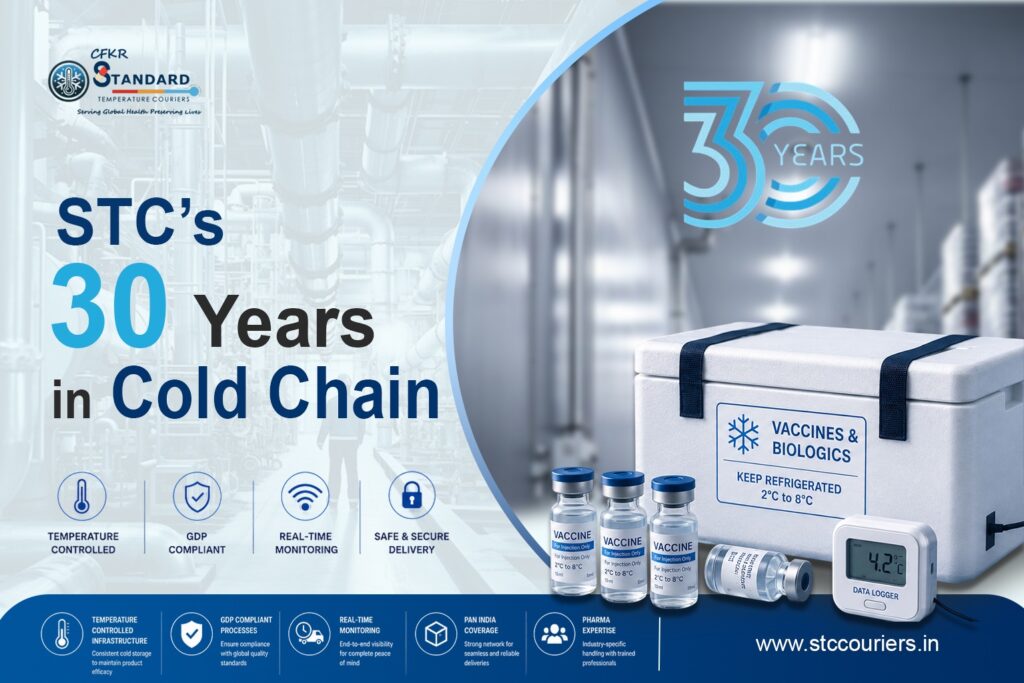
Cold chain logistics is not a service you shop for casually. When a shipment of vaccines or temperature-sensitive medicine leaves a manufacturing facility, there is no room for a delivery delay, a temperature spike, or a paperwork error. One mistake and the product is no longer safe to administer to a patient. STC has spent 30 years operating inside that reality, moving pharmaceuticals and vaccines across India without compromising the cold chain, and what we’ve learned along the way shapes how we run every shipment today.
This isn’t a general overview of what cold chain logistics is. If you’re reading this, you likely already know the basics and you’re trying to figure out who to trust with your next shipment. So this is a straight account of what three decades in pharmaceutical cold chain logistics has actually taught us, and what that experience means for the company evaluating us as a partner.
Why Three Decades in Business Matters When Choosing a Cold Chain Partner
Anyone can promise to keep a shipment cold. Refrigerated trucks and insulated boxes are available to buy. What separates a company that talks about cold chain logistics from one that has actually mastered it is what happens when something goes wrong: a vehicle breaks down on a highway in June, a warehouse loses power during a storm, a shipment gets held up at a checkpoint for four hours longer than planned. These situations are not hypothetical. They happen regularly across a logistics network the size of India’s, and how a company responds to them is the real test of its cold chain capability.
Thirty years gives you two things a newer provider simply cannot have: a large enough sample size of failures to have built real contingency systems around them, and long-standing relationships with regulators, hospitals, and pharmaceutical manufacturers who have watched your track record over time. Both matter more than most people realize when they’re comparing logistics quotes on paper.
What We’ve Learned About Keeping Vaccines Safe
Temperature Control Is Not a Feature, It’s the Entire Job
A lot of general logistics companies list “temperature controlled transport” as one line item among dozens of services. In our experience, that framing is where things start to go wrong. Temperature control cannot be a feature bolted onto a standard freight operation. It has to be the organizing principle behind every decision, from vehicle selection and route planning to how staff are trained to handle a box.
We learned this early. A single unmonitored gap in the cold chain, even for twenty or thirty minutes, can compromise a vaccine’s efficacy without any visible sign that something went wrong. The product looks fine. It isn’t. That’s what makes pharmaceutical cold chain logistics fundamentally different from moving furniture or electronics: the failure is invisible until the product is administered and doesn’t work as intended. Our Cold Chain Solutions are built around that principle rather than treating temperature control as an add-on.
The 2°C to 8°C Rule and Why Small Deviations Cost Millions
Most vaccines and biologics need to stay within a narrow 2°C to 8°C range from the moment they leave the manufacturer until they reach the patient. Some biologics and gene therapies require even tighter, colder ranges. The CDC’s Vaccine Storage and Handling Toolkit lays out just how unforgiving these requirements are, and why routine monitoring at every stage of transport is treated as a baseline requirement rather than a bonus.
What surprises people outside the industry is how easily this range gets breached. A driver leaving a refrigerated door open for a few extra minutes during a delivery stop, a packaging material that wasn’t rated for the ambient temperature on a particular route, a data logger placed in the wrong part of a container. None of these are dramatic failures. All of them can ruin a shipment. Industry estimates suggest a significant share of global vaccine wastage each year traces back to exactly these kinds of preventable temperature control failures during storage and transport, not to manufacturing defects.
Over 30 years, we’ve built our processes around eliminating these small, easy-to-miss failure points rather than just reacting to the big obvious ones.
Documentation and Compliance Aren’t Optional Extras
Pharmaceutical logistics in India operates under strict regulatory expectations, and rightly so. Every shipment needs a documented, auditable temperature history. If a regulator or client ever asks for proof that a batch of vaccines stayed within range for the entire journey, that proof has to exist and has to be retrievable quickly.
Good Distribution Practice, the global standard referenced by pharmaceutical regulators, exists precisely because storage and transport failures are one of the biggest risk points in getting medicine safely to patients. Organizations like the World Health Organization treat supply chain integrity as central to immunization programs, not a secondary concern behind manufacturing quality.
We learned that treating compliance documentation as an afterthought, something you scramble to assemble after a shipment is delivered, is a losing approach. It has to be built into the process from the first pickup, which is part of why our Healthcare Logistics service includes documentation and traceability as a standard part of the service rather than a paid extra.
The Last Mile Is Where Most Cold Chains Fail
The most sophisticated cold storage facility in the country can still lose the plot in the final few kilometers. Last mile delivery is where temperature-controlled vehicles hand off to smaller vans, where deliveries happen in extreme heat, and where the receiving facility may not have the same cold storage capability as the sender.
This is one of the harder lessons we learned, because it isn’t something you can solve with better refrigeration trucks alone. It requires planning the entire route, including the final handoff, before the shipment ever leaves the warehouse. It requires knowing in advance whether the receiving hospital or pharmacy has adequate cold storage on arrival, and building contingency time into the schedule rather than assuming the last leg will go as smoothly as the main transit route.
Redundancy Saves Shipments When Equipment Fails
Refrigeration units fail. It’s not a question of if, it’s a question of when, and a cold chain logistics provider that hasn’t built redundancy into its operations will lose product the first time it happens. Over three decades we’ve dealt with enough equipment failures, power outages, and mechanical breakdowns to know that backup cooling systems, secondary vehicles on standby, and real-time monitoring that flags a problem within minutes rather than hours are not optional investments. They are what separates a provider who occasionally loses a shipment from one who doesn’t.
How STC Applies These Lessons Today
Our On-Time Performance Track Record
None of these lessons matter if they don’t translate into consistent results. STC maintains a 99.88% on-time performance rate for cold chain shipments, a number that reflects three decades of refining routes, vehicles, staffing, and contingency planning specifically for pharmaceutical cargo. For a hospital or manufacturer relying on a vaccine shipment arriving exactly when scheduled, that consistency is the actual product being purchased, not just the transport itself.
Custom Solutions Built Around Regulatory Requirements
Pharmaceutical companies operate under different regulatory demands depending on the product, whether it’s a standard vaccine, a biologic, or a cell and gene therapy requiring ultra-cold conditions. We don’t run a one-size-fits-all cold chain operation. Solutions are built around the specific temperature range, documentation requirements, and handling protocol each product needs. Our Cell and Gene Supply Chain service exists specifically because these products need a level of precision that standard cold chain transport doesn’t provide.
End-to-End Visibility From Facility to Final Delivery
Every shipment we handle is tracked from the moment it leaves the client’s facility to the moment it’s delivered. This isn’t just about knowing where a truck is on a map. It’s about continuous temperature monitoring, documented handoffs, and a chain of custody that can be reviewed after the fact if anything needs to be verified. Our Packaging & Distribution service is designed around this same principle, ensuring that visibility doesn’t stop once a product leaves cold storage.
What This Means If You’re Evaluating a Cold Chain Logistics Partner
If you’re comparing cold chain providers right now, the questions worth asking go beyond price and fleet size. Ask how a provider handles a refrigeration failure mid-transit. Ask how quickly they can produce a full temperature history for a shipment if a regulator requests it. Ask what happens during the last mile handoff if the receiving facility’s cold storage isn’t ready on arrival. A provider with real experience will have specific, detailed answers to these questions rather than general reassurances.
Thirty years in this business means we’ve been asked every one of these questions many times over, and we’ve built our operations around answering them with proof rather than promises. That’s the difference between a logistics company that offers cold chain as a service and one that has built its entire operation around it.
According to industry analysis from the India Brand Equity Foundation, India’s logistics and cold chain sector continues to expand rapidly as pharmaceutical manufacturing and healthcare distribution scale up across the country. That growth is bringing more providers into the space, which makes track record and proven compliance more important, not less, when a pharmaceutical company is choosing who to trust with a shipment.
The United States Pharmacopeia also continues to publish updated storage and distribution standards that global pharmaceutical supply chains are increasingly expected to follow, even outside the US. A provider that stays current with these evolving standards, rather than relying on outdated protocols, is one that takes the compliance side of cold chain logistics as seriously as the transport side.
Frequently Asked Questions
What temperature range do most vaccines need to be stored and transported at?
Most vaccines require a strict 2°C to 8°C range throughout storage and transport. Some biologics, gene therapies, and specialized vaccines require colder, more tightly controlled ranges, which is why the specific product and its documentation should always determine the storage protocol rather than a generic cold chain standard.
How does STC monitor temperature during transport?
Shipments are monitored continuously from pickup to delivery, with documented temperature histories available for every leg of the journey. This gives clients and regulators a verifiable record rather than a simple assurance that the shipment stayed cold.
What happens if a refrigeration unit fails during a shipment?
Redundancy is built into our operations specifically for this scenario. Backup cooling systems and standby vehicles are part of standard planning, not an emergency improvisation, which is a direct result of the equipment failures we’ve learned from over three decades of operation.
Why does the last mile matter so much in cold chain logistics?
The last mile is where cold chain shipments most often break down because it involves smaller vehicles, shorter but exposed handling windows, and receiving facilities that may not have the same cold storage infrastructure as the main distribution network. Planning the final delivery leg with the same rigor as the main transit route is essential to keeping the cold chain intact.
How is STC different from a general logistics company that also offers cold storage?
General logistics providers typically treat temperature control as one service among many. STC’s entire operation, from fleet design to staff training to documentation systems, is built specifically around pharmaceutical cold chain requirements, which is a different level of specialization than a cold storage add-on within a broader freight business.
Work With a Cold Chain Partner With 30 Years of Proof
Choosing a cold chain logistics partner isn’t a decision to make on promises alone. It comes down to whether a provider has actually been tested by the failures that happen in real-world pharmaceutical transport and built systems to handle them. STC has spent 30 years doing exactly that, and our 99.88% on-time performance rate on cold chain shipments reflects it.
If you’re evaluating a partner for your next vaccine or pharmaceutical shipment, get in touch with our team to discuss your specific temperature, compliance, and delivery requirements. We’ll walk you through exactly how we’d handle your shipment, not just what we promise to do.