
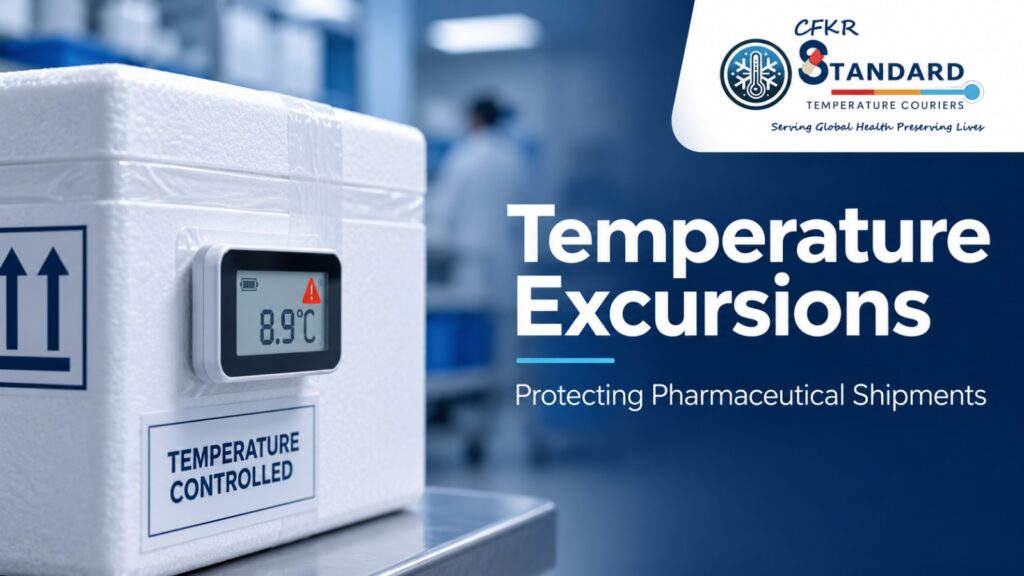
A pharmaceutical shipment can be packed properly, collected on time and still face a temperature excursion before reaching its destination. A delayed handover, unexpected traffic, airport hold, missed delivery window or equipment issue can expose a product to conditions outside its approved range.
For pharmaceutical, biotech and life sciences businesses, the key question is not whether a disruption can ever happen. It is whether the shipment has been planned well enough to reduce the chance of an excursion and whether there is a clear process to respond if one occurs.
This guide explains what a temperature excursion is, why it matters, how businesses can reduce the risk and what should happen when a pharmaceutical shipment does not follow its planned temperature profile.
What Is a Temperature Excursion?
A temperature excursion occurs when a product is exposed to conditions outside its defined storage or transport range. The required range depends on the product. Some products need refrigerated conditions, some require frozen movement and others need controlled ambient handling.
Not every temperature event has the same impact. The significance depends on the product, the degree of variation, the length of exposure and the product’s approved stability information. However, every excursion should be treated seriously and assessed through the shipper’s quality process, in line with recognised frameworks such as the WHO Model Guidance on the Storage and Transport of Time- and Temperature-Sensitive Pharmaceutical Products and the EU Guidelines on Good Distribution Practice.
The logistics provider’s role is to help prevent avoidable events, maintain clear records and communicate quickly if a shipment does not move as planned.
Why Temperature Excursions Matter in Pharma Logistics
Temperature-sensitive pharmaceutical products may be affected when they are exposed to unsuitable conditions. A product may not show any visible change after an excursion, which is why monitoring and documentation are so important.
An excursion can create delays in product release, lead to quality review, affect customer supply and increase operational cost. For high-value products, clinical materials or patient-specific shipments, the impact can be even greater.
Good cold chain logistics does not only focus on keeping a shipment cold. It focuses on protecting the product’s required conditions through storage, packaging, transit, handovers and final delivery. This is especially critical for life sciences logistics, where product stability requirements are often stricter than in general pharma distribution.
Common Causes of Temperature Excursions
Many excursions are linked to process gaps rather than one major failure. A shipment may be ready for pickup before the vehicle arrives. It may be held in an unsuitable location during loading. The packaging may not be designed for the real transit duration. The receiving team may not be ready when the delivery vehicle reaches the destination.
Traffic, weather, delayed flights, customs holds, vehicle issues and missed connections can also affect the planned route — particularly for shipments moving through global logistics networks that cross multiple handovers and jurisdictions. These risks cannot always be removed, but they can be considered before dispatch.
The most reliable cold chain plan is based on realistic operating conditions. It allows time for possible delay and includes clear instructions for each stage of the shipment. For a deeper look at how these risks play out in India specifically, see our guide to temperature controlled logistics in India.
Prevention Begins Before Pickup
The best way to manage a temperature excursion is to reduce the chance of one before the shipment moves. This begins with a clear shipment plan, whether the product is moving through a standard pharmaceutical supply chain or a more specialised route such as clinical trial logistics or the cell and gene supply chain.
The logistics partner should understand the product’s required temperature range, packaging need, route, pickup time, transit window, destination conditions and final delivery schedule. A service should not be selected only because it is the fastest available option. It should be selected because it is appropriate for the shipment.
Before pickup, businesses should confirm that the product is held in suitable storage, the packaging is ready, the vehicle or courier is scheduled, the receiving team knows the expected delivery time and the required documents are complete. Documentation gaps are one of the most common causes of avoidable delay — see our guide on pharmaceutical logistics compliance, GDP, customs and shipping documentation for more detail.
Packaging Must Support the Real Journey
Packaging technology protects a pharmaceutical product from external conditions during handling and movement. But the right packaging decision depends on more than the product’s stated temperature range.
It must also reflect the actual route. A shipment travelling by road within one city has different risks from a domestic air shipment or an international movement with customs clearance. Highly sensitive products, such as those requiring cryogenic transportation, need packaging validated for far longer holdover times than standard 2–8°C shipments. The packaging should support the expected transit window and account for reasonable delays.
Businesses should work with a logistics provider that understands validated packaging technology and can recommend a solution suited to the route. The packaging must be chosen before the shipment is collected, not after a delay has already occurred.
The Importance of Temperature Monitoring
Temperature monitoring provides a record of what happened during storage and transit. Data loggers and monitoring tools can help a shipper understand whether the product stayed within its required range and identify the timing of a possible deviation. Platforms such as STC Couriers Connect are built to give shippers this kind of real-time visibility across a shipment’s journey.
Before dispatch, agree on the monitoring approach. Confirm whether a data logger will travel with the shipment, what information will be available after delivery and who is responsible for reviewing the data.
Monitoring is useful even when a shipment is completed without issue. It gives the customer confidence that the movement was managed according to plan. If an event occurs, it gives the quality team a factual record to support its assessment.
Shipment Visibility Helps Teams Respond Faster
Temperature control and shipment visibility should work together. A business needs to know where the shipment is, whether it is moving according to schedule and whether there is a risk of missing the delivery window. This is particularly important for time-critical movements such as lab logistics and diagnostic sample transport, where delays can compromise sample integrity.
Real-time tracking updates and clear communication allow the shipper, logistics provider and receiving team to act before a small delay becomes a larger problem. If a vehicle is delayed, the destination may be able to extend receiving hours or prepare an alternative handover. If a flight connection is missed, the team can assess the next available option quickly.
The most important part is communication. A logistics provider should not wait until the shipment has failed to arrive before updating the customer.
What to Do When a Temperature Excursion Is Suspected
If a temperature excursion is suspected, the shipment should be handled according to the shipper’s approved quality process. The logistics provider should communicate the event promptly and share available shipment details.
The first priority is to protect the product from further exposure. This may involve moving the shipment into suitable controlled storage, securing the package, checking the delivery environment or arranging an alternative transport solution. Shipments involving dangerous goods classifications may require additional handling precautions during this step.
The next priority is documentation. Record the shipment details, route, timing, temperature information, handling events and communication history. These details can help the shipper’s quality team assess the situation.
The logistics provider should not make product-quality decisions on behalf of the manufacturer or responsible quality function. Its role is to preserve the shipment, provide accurate information and support the agreed response process. This division of responsibility reflects good distribution practice principles, including guidance from USP General Chapter <1079> on Good Storage and Distribution Practices for Drug Products, and is central to the regulatory compliance standards a logistics partner should follow.
The Role of Documentation in Excursion Management
Clear documentation is essential when a shipment does not move according to plan. The shipper may need to review when the delay happened, how long the product was exposed, what the recorded conditions were and what actions were taken.
Useful records may include shipment booking details, pickup and delivery times, route updates, temperature-monitoring data, handover information and communication records. The exact requirement depends on the product and the shipper’s quality system.
Strong documentation also helps businesses identify recurring issues. If the same route, airport or delivery location repeatedly creates delays, the process can be improved for future shipments. Our related guide on life sciences logistics, shipment tracking and cold chain control covers this in more depth.
How to Choose a Logistics Partner That Reduces Excursion Risk
The right logistics partner should understand that pharmaceutical shipments need more than transport capacity. It should be able to plan temperature-controlled movement, recommend suitable packaging, provide shipment visibility and maintain clear communication.
Before selecting a partner, ask how it manages temperature-sensitive shipments from booking to delivery. Ask about storage before dispatch, packaging technology, transport options, monitoring, tracking, escalation and exception handling.
You should also understand what happens when a delivery is delayed. Does the provider have a process for after-hours support? Can it arrange controlled storage if the destination cannot receive the shipment? Does it provide clear incident updates and records?
The best provider will answer these questions with a practical process, not only a general promise.
How CFKR STC Couriers Supports Controlled Pharmaceutical Shipments
CFKR STC Couriers supports pharmaceutical, biotech and life sciences businesses with cold chain logistics, global logistics, packaging technology and regulatory compliance support. Our focus is on safe, precise and reliable movement of temperature-sensitive shipments.
From booking and scheduling to controlled transit and final delivery, our team helps customers plan a service around the actual needs of their shipment. This includes temperature-controlled transportation, validated packaging support, real-time shipment tracking through STC Couriers Connect and clear communication throughout the journey.
With more than 30 years of logistics experience, CFKR STC Couriers understands that successful pharmaceutical distribution depends on preparation as much as transport. We work with customers to reduce avoidable risk and support timely, controlled delivery. Get in touch with our team to discuss your shipment.
Frequently Asked Questions
What is a temperature excursion in pharmaceutical logistics? A temperature excursion is an event in which a pharmaceutical product is exposed to conditions outside its defined storage or transport range. It should be documented and assessed through the shipper’s quality process.
What causes temperature excursions during shipping? Common causes include delays, unsuitable temporary storage, incorrect packaging, missed delivery windows, transport disruption, weather, customs holds and handling gaps during transfer.
Can data loggers help manage temperature excursions? Yes. Data loggers can record temperature conditions during storage and transit. They provide information that can help the shipper’s quality team review a suspected event.
What should happen if a shipment is delayed? The shipment should be protected from further exposure, moved to suitable controlled storage if needed and reported according to the agreed escalation process. The logistics provider should share clear shipment and monitoring information with the customer.
How can a logistics partner reduce excursion risk? A capable logistics partner can reduce risk through route planning, appropriate packaging, controlled transit, monitoring, tracking, communication and a defined response process for unexpected events.
Final Thoughts
Temperature excursions cannot always be prevented, but many risks can be reduced through better planning, packaging, monitoring and communication. The right logistics partner helps businesses prepare for the journey before the shipment moves and respond quickly when conditions change.
For temperature-controlled pharmaceutical, biotech and life sciences logistics, CFKR STC Couriers can help you plan a reliable route from pickup to final delivery. Contact us to get started.