
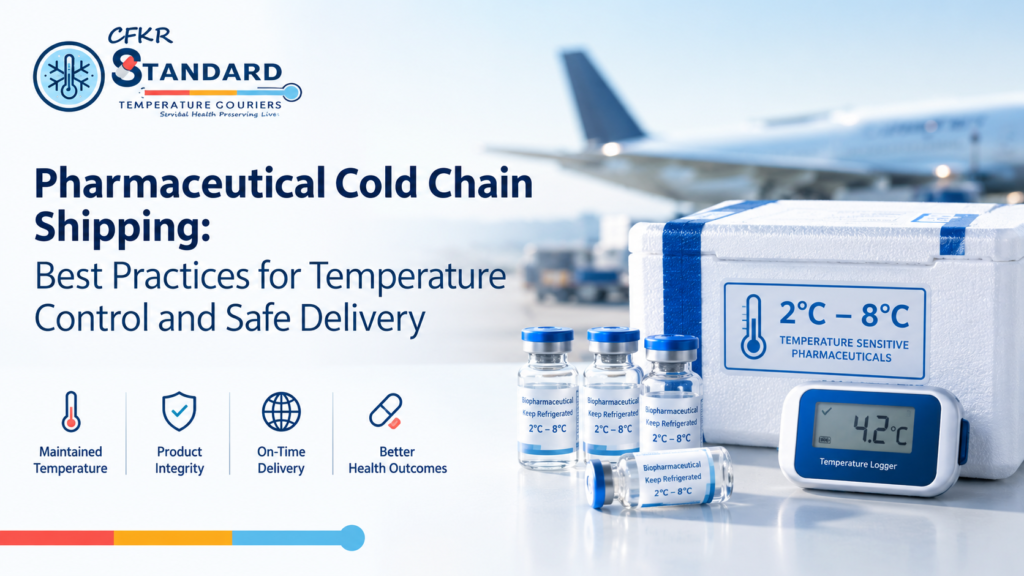
Pharmaceutical products require carefully controlled transportation to maintain their quality throughout the supply chain. Vaccines, temperature-sensitive medicines, biological samples, clinical trial materials, and biotechnology products may be exposed to temperature fluctuations, transit delays, and handling risks during shipping. Without appropriate controls, these conditions can affect product stability, delay distribution, and create additional costs for pharmaceutical companies.
Pharmaceutical cold chain shipping combines temperature-controlled packaging, suitable transportation, storage, monitoring, and regulatory documentation to protect products from collection to final delivery. Each stage must be planned according to the product’s handling requirements, expected transit duration, destination, and applicable regulations.
For pharmaceutical manufacturers, biotechnology companies, clinical research organisations, and healthcare distributors, an effective cold chain process is essential to managing transportation risks and maintaining supply chain reliability.
CFKR STC Couriers provides pharmaceutical cold chain logistics, international freight, temperature-controlled packaging, and life science logistics solutions designed around the requirements of critical shipments.
This guide explains how businesses can improve temperature control, select suitable packaging, manage transportation risks, and plan safer pharmaceutical deliveries.
What Is Pharmaceutical Cold Chain Shipping?
Pharmaceutical cold chain shipping is the transportation of medicines and biological products under specified environmental conditions. Depending on the product, these conditions may include refrigerated, frozen, ultra-low-temperature, cryogenic, or controlled ambient environments.
The objective is to maintain the required conditions throughout the journey and preserve the product’s quality and suitability for its intended use.
A pharmaceutical cold chain typically involves six interconnected components:
- Temperature-controlled packaging: Insulated containers and suitable cooling or heating materials selected for the product and journey.
- Controlled storage: Facilities capable of maintaining the required conditions before dispatch and during transit interruptions.
- Specialised transportation: Air freight, road transportation, ocean freight where appropriate, and express shipping.
- Temperature monitoring: Data loggers and other monitoring technologies used to record shipment conditions.
- Regulatory documentation: Shipping records, customs paperwork, handling instructions, and quality documentation.
- Coordinated delivery: Planned handovers and delivery arrangements that protect the shipment until the receiving facility accepts it.
These components must function as a coordinated system. Suitable packaging cannot eliminate every transportation risk, and a refrigerated vehicle does not independently establish that the product remained within its specified temperature range.
Cold chain management therefore requires a plan for the entire journey, including collection, storage, transportation, transfers, customs clearance, and final delivery.
Why Temperature Control Matters in Pharmaceutical Logistics
Pharmaceutical products have specific storage and transportation requirements based on their formulation, stability, and intended use. Some products tolerate limited temperature variations, while others require tightly controlled conditions.
Exposure outside the permitted range may trigger a quality investigation. Depending on the product and excursion, the shipment may need to be quarantined, assessed, or rejected.
Four common risks deserve particular attention.
1. Temperature excursions
A temperature excursion occurs when a shipment’s recorded temperature falls outside its specified limits.
Possible causes include unsuitable packaging, incorrectly prepared coolants, equipment failure, extended loading periods, and transportation delays.
An excursion does not automatically mean that a pharmaceutical product is unusable. Its impact must be assessed by the responsible quality team using the product’s stability information and applicable procedures.
Accurate temperature records help establish the duration and severity of the event and support an informed decision about the affected shipment.
2. Transportation and customs delays
International pharmaceutical shipments may pass through several airports, cargo terminals, warehouses, customs facilities, and transportation providers.
A missed connection or unexpected customs inspection can extend the journey beyond the original schedule. If the packaging or storage arrangements cannot support the additional time, the shipment may be exposed to unsuitable conditions.
Route planning should account for connection times, clearance requirements, local operating schedules, and arrangements for temporary storage when necessary.
3. Packaging and handling failures
Packaging must be suitable for the product, expected transit duration, and external environmental conditions.
An incorrectly selected coolant, damaged insulated container, or unsuitable packing configuration may compromise temperature control.
Handling procedures also matter. Leaving a shipment in an uncontrolled environment during loading or unloading can introduce risks even when the main transportation equipment is functioning correctly.
4. Incomplete documentation
Missing temperature records, inaccurate shipping information, and unclear handover responsibilities can delay receiving decisions and quality investigations.
Pharmaceutical businesses should establish documentation requirements before dispatch and ensure that the relevant records remain available throughout the shipment’s journey.
1. Establish the Product’s Temperature Requirements Before Shipping
The first step in planning a pharmaceutical shipment is to confirm the product’s approved transportation conditions.
Different pharmaceutical products require different temperature ranges. A refrigerated medicine may require 2°C to 8°C conditions, while another product may require frozen, ultra-low-temperature, cryogenic, or controlled ambient transportation.
These requirements should be obtained from the manufacturer’s specifications and the responsible quality team rather than assumed from the product category.
Before requesting a shipping quotation, confirm:
- Required transportation temperature range.
- Permitted temperature excursions, if defined.
- Product quantity, shipment weight, and dimensions.
- Collection address and final destination.
- Required delivery date and acceptable transit duration.
- Special handling, security, or dangerous goods requirements.
- Applicable permits and customs documentation.
- Receiving facility operating hours and storage capabilities.
This information helps the logistics provider assess the proposed route, packaging requirements, monitoring arrangements, and potential delays.
It also helps prevent avoidable changes after the shipment has been prepared.
CFKR STC Couriers supports pharmaceutical and life science logistics planning around the handling requirements of critical shipments. Providing accurate product and route information at the quotation stage helps establish a suitable transportation plan.
2. Select the Right Temperature-Controlled Packaging
Temperature-controlled packaging protects pharmaceutical products from external temperature changes during collection, transportation, transfers, and delivery.
The packaging must be suitable for the product’s temperature requirements and the expected conditions throughout the journey. An insulated container alone does not guarantee that the shipment will remain within its required range.
Two broad categories of temperature-controlled packaging are commonly used.
Passive temperature-controlled packaging
Passive packaging uses insulated containers and cooling materials to maintain specified temperature conditions without continuous powered refrigeration.
Depending on the application, the configuration may include gel packs, phase change materials, dry ice, or other suitable coolants.
Passive packaging can be appropriate for many pharmaceutical shipments when the system has been qualified for the intended duration and environmental conditions.
Important selection factors include:
- Insulation performance and container design.
- Coolant type, quantity, and placement.
- Product loading configuration.
- External temperature conditions along the route.
- Expected transportation time and allowance for delays.
- Preparation and conditioning procedures.
- Requirements for monitoring and temperature records.
Coolant preparation is particularly important. Different coolant materials have different temperature characteristics, and incorrect conditioning may expose products to freezing or excessive heat.
Dry ice also requires appropriate handling and compliance with applicable air transport and dangerous goods requirements.
Active temperature-controlled packaging
Active packaging uses powered heating or cooling equipment to regulate internal conditions.
These systems may be suitable for shipments requiring active temperature regulation over longer journeys or under demanding environmental conditions.
Selection depends on equipment capacity, operating duration, power availability, monitoring capabilities, and the infrastructure available along the route.
Contingency arrangements should also address equipment malfunction, power interruption, and unexpected delays.
What is packaging qualification?
Packaging qualification involves documented testing and assessment to demonstrate that a packaging configuration can perform as intended under defined conditions.
For pharmaceutical shipping, the assessment may consider:
- Required temperature range.
- Expected transit duration.
- Relevant hot and cold environmental conditions.
- Product load and packaging configuration.
- Transportation and handling conditions.
- Applicable monitoring and acceptance criteria.
A packaging system qualified for one route or duration should not automatically be considered suitable for every shipment.
CFKR STC Couriers offers validated temperature-controlled packaging solutions for pharmaceutical shipments, including biological samples and bulk drug shipments. The appropriate configuration should be selected according to the product, route, and expected transportation conditions.
3. Choose the Appropriate Transportation Method
The transportation method influences transit time, cost, handling requirements, and the number of transfers a shipment must undergo.
Pharmaceutical companies should evaluate the complete journey rather than selecting a service based only on the quoted freight rate.
Air freight for time-sensitive pharmaceuticals
Air freight can reduce long-distance transit times and may be appropriate for urgent pharmaceutical consignments, biological materials, and clinical trial shipments.
However, air transportation does not remove the need for temperature control. Shipments may still spend time in cargo terminals, airport warehouses, customs facilities, and transfer areas.
Before booking, assess flight availability, connection times, handling arrangements, and the availability of suitable storage if delays occur.
Ocean freight for planned pharmaceutical shipments
Ocean freight may be suitable for pharmaceutical cargo when the product’s stability requirements, expected transit duration, and available container arrangements support the journey.
Temperature-sensitive cargo may require refrigerated containers, suitable monitoring, and appropriate handling at ports and storage facilities.
Businesses should consider the potential effects of longer transit times, port congestion, customs clearance, and unexpected schedule changes.
Express shipping for urgent deliveries
Express shipping may help businesses meet tight delivery windows when the available route and handling arrangements are suitable for the product.
However, an express service does not automatically guarantee temperature control. The packaging and transportation plan must still address the shipment’s specific environmental requirements.
How should businesses compare transportation options?
Evaluate each option against the following criteria:
- Product stability and permitted transportation conditions.
- Expected transit time and delivery deadline.
- Availability of suitable temperature-controlled handling.
- Number of transfers and potential delay points.
- Customs requirements and documentation.
- Total shipping cost, including packaging and special handling.
- Contingency arrangements for delays or equipment failures.
CFKR STC Couriers offers air freight, ocean freight, and express shipping solutions for pharmaceutical and international logistics requirements. The appropriate service depends on the product, destination, schedule, and required handling arrangements.
4. Monitor Temperature and Maintain Shipment Records
Temperature monitoring helps establish the conditions experienced by a pharmaceutical shipment during transportation. It can also support investigations when a shipment is delayed or a potential excursion occurs.
The monitoring method should be determined before dispatch based on the product’s sensitivity, transportation route, packaging configuration, and applicable quality requirements.
Temperature data loggers
Temperature data loggers record measurements over a defined period. Depending on the device, the readings may be stored for review after delivery or made available through connected systems.
Before dispatch, confirm that the device is appropriate for the expected conditions and configured according to the monitoring procedure.
The plan should establish where the logger will be positioned, how frequently readings will be recorded, and who will review the results.
Real-time monitoring
Connected sensors and tracking technologies may provide shipment location and condition information during transit.
These capabilities can help logistics teams identify delays, review temperature conditions, and coordinate a response when a shipment is at risk.
However, location tracking and temperature monitoring are different functions. A shipment may have visible tracking updates without continuous temperature data.
Businesses should confirm which monitoring features are included in their selected service and how the resulting information can be accessed.
What should happen when a temperature excursion occurs?
A documented response procedure should be established before the shipment leaves the origin facility.
The procedure should identify the responsible contacts, the escalation process, and the actions required to protect the product.
A suitable response generally includes:
- Recording the event and relevant timestamps.
- Identifying the affected product and shipment.
- Reviewing available temperature records and the duration of exposure.
- Notifying the responsible quality team and logistics contacts.
- Protecting the shipment from further unsuitable exposure.
- Following approved procedures for assessment, disposition, and documentation.
The product should not be released for use simply because its current temperature appears acceptable. The authorised quality process must determine whether the excursion affects product suitability.
5. Follow Applicable GDP and Regulatory Requirements
Good Distribution Practice (GDP) principles help pharmaceutical businesses maintain product quality and appropriate control throughout distribution.
Regulatory requirements vary by jurisdiction, product type, transportation method, and the responsibilities of the organisations involved. Businesses should identify the requirements applicable to each shipment rather than assuming that one standard covers every market.
International pharmaceutical shipments may require attention to:
- Applicable GDP requirements and quality procedures.
- Product-specific storage and handling instructions.
- Import permits and export documentation, where required.
- Customs declarations and accurate product descriptions.
- Dangerous goods classification and transport requirements, where applicable.
- Temperature records and document retention.
- Procedures for deviations, complaints, and investigations.
- Supplier qualification and responsibility across logistics handovers.
Documentation should match the physical shipment. Incorrect descriptions, missing permits, or incomplete supporting documents can delay clearance and affect delivery schedules.
Responsibilities should also be clear between the manufacturer, shipper, freight forwarder, customs broker, receiving facility, and other service providers.
During supplier qualification, businesses should verify relevant certifications, service capabilities, operating procedures, and quality arrangements.
CFKR STC Couriers focuses on GDP-compliant pharmaceutical and biotechnology logistics. Customers should confirm the applicable service scope and documentation requirements for their particular shipment and destination.
6. Prepare a Contingency Plan for Transportation Disruptions
Flight cancellations, severe weather, customs delays, traffic congestion, and equipment failures can disrupt pharmaceutical deliveries.
A contingency plan defines how a shipment will be protected when the original transportation arrangement cannot proceed as planned.
The plan should address the product’s actual requirements and the practical options available along the route.
Identify alternative routes
Where possible, assess alternative flights, transportation connections, and delivery arrangements before dispatch.
Any alternative must remain suitable for the product’s handling requirements. A shorter route is not necessarily better if the required temperature-controlled facilities are unavailable.
Identify suitable temporary storage
Determine whether suitable storage is available at relevant transit points if the shipment needs to be held during a disruption.
Confirm the facility’s ability to maintain the required conditions and whether the transfer can be completed safely within the available time.
Establish escalation contacts
Identify the people responsible for shipment coordination, quality decisions, and receiving arrangements.
The escalation process should specify how urgent issues will be communicated and who is authorised to approve changes to the transportation plan.
Allow for realistic transit delays
Packaging should be selected using realistic transit assumptions and an appropriate allowance for foreseeable delays.
The allowance should be supported by the packaging’s qualified performance and the shipment’s conditions, not by an arbitrary number of extra hours.
Document the response process
The contingency plan should explain how the shipment will be protected, which records must be retained, and when the responsible quality team must become involved.
Planning these steps before dispatch can reduce confusion and support faster decisions during disruptions.
7. Manage Every Handover from Collection to Final Delivery
Pharmaceutical shipments may pass through several organisations before reaching their destination. Every handover must preserve the agreed handling conditions and maintain clear responsibility for the cargo.
Collection, loading, unloading, airport transfers, customs inspections, temporary storage, and final delivery all require appropriate controls.
A handover procedure should address:
- Package condition when responsibility is transferred.
- Applicable product handling instructions.
- Time and location of the handover.
- Required temperature or condition records.
- Identity of the receiving party.
- Procedures for reporting damage or suspected excursions.
Shipment tracking provides information about cargo movement, while delivery confirmation establishes that the shipment reached its intended destination. Neither should be treated as a substitute for temperature records when those records are required.
Communication between the logistics provider, shipper, and receiving facility is particularly important for laboratory deliveries, clinical research sites, and healthcare facilities with restricted receiving hours.
The receiving team should know when the shipment is expected, what handling it requires, and how to respond if it arrives with visible damage or a suspected temperature deviation.
8. Apply Special Handling Procedures to Clinical Trial and Biological Shipments
Clinical trial logistics requires coordination between logistics teams, research organisations, laboratories, and receiving facilities.
Materials may be required for scheduled research activities, patient visits, laboratory testing, or time-sensitive sample processing. Delays or unsuitable transportation conditions can disrupt planned activities and create additional work for clinical operations teams.
Handling requirements depend on the specific material being transported. Investigational medicinal products, biological specimens, laboratory samples, and other clinical trial materials should not be treated as one uniform shipment category.
Before dispatch, establish:
- Material classification and handling requirements.
- Required temperature range and permitted transit duration.
- Destination receiving hours and storage capabilities.
- Applicable permits and shipping documentation.
- Packaging and monitoring requirements.
- Procedures for delays, deviations, and escalation.
- Relevant security and chain-of-custody requirements.
Some materials require cryogenic or ultra-low-temperature transportation. These shipments need equipment and handling procedures appropriate to the material rather than standard refrigerated packaging.
CFKR STC Couriers supports life science logistics, clinical trial logistics, and cell and gene supply chain requirements. Specific service arrangements should be confirmed against the material’s classification, route, and study requirements.
9. Understand the Total Cost of Pharmaceutical Cold Chain Shipping
The lowest initial freight quote does not always represent the lowest overall shipping cost.
The total cost depends on the transportation method, packaging, shipment size, required temperature conditions, destination, documentation, and special handling arrangements.
Businesses should compare the complete shipment cost rather than considering freight charges alone.
Cost component | What to evaluate |
Freight charges | Route, transportation method, weight, dimensions, and service level |
Temperature-controlled packaging | Container type, coolant configuration, and qualification requirements |
Monitoring equipment | Data logger requirements, monitoring services, and data retrieval |
Special handling | Collection, storage, transfers, and delivery arrangements |
Customs and documentation | Applicable clearance charges, permits, and administrative costs |
Contingency arrangements | Potential rerouting, temporary storage, and additional handling |
Delivery coordination | Receiving windows, appointments, and special instructions |
For an accurate quotation, provide the collection and destination details, shipment weight and dimensions, product temperature range, required delivery date, and any special handling requirements.
Confirm whether the quote includes packaging, temperature monitoring, customs brokerage, storage, and final delivery. Depending on the provider and route, these services may be priced separately.
Comparing quotations on a like-for-like basis helps pharmaceutical businesses evaluate both cost and operational suitability.
10. Use a Pre-Dispatch Checklist
A consistent pre-dispatch checklist helps identify missing information before a pharmaceutical shipment leaves the origin facility.
Product requirements
- Confirm the approved transportation conditions.
- Identify restrictions relating to freezing, light exposure, humidity, or handling.
- Verify product classification and applicable dangerous goods requirements.
Packaging and preparation
- Select suitable qualified packaging.
- Prepare coolants according to the approved procedure.
- Confirm that the packaging can support the planned transit duration.
- Position and configure monitoring equipment where required.
Transportation and documentation
- Confirm collection details, route, delivery schedule, and receiving arrangements.
- Verify shipping and customs documents.
- Ensure that relevant parties understand the handling instructions.
- Review the contingency plan and escalation contacts.
Delivery and records
- Establish how temperature records will be reviewed.
- Confirm that the receiving facility can accept the shipment.
- Define procedures for delays, damage, and temperature excursions.
- Retain records according to applicable requirements.
This checklist should be adapted to the product, route, customer requirements, and quality management system. It is a planning aid, not a substitute for validated procedures or regulatory requirements.
How to Choose a Pharmaceutical Cold Chain Logistics Provider
A pharmaceutical logistics provider should be evaluated on more than its ability to arrange transportation. The provider must understand the shipment’s handling requirements and explain how the proposed service addresses relevant risks.
When assessing potential providers, consider the following factors.
Pharmaceutical logistics experience: Determine whether the provider handles pharmaceutical, biotechnology, clinical trial, or biological shipments similar to yours.
Packaging expertise: Ask how the packaging configuration is selected and whether its performance is suitable for the route and expected transit duration.
Transportation options: Assess the availability of air freight, ocean freight, express shipping, and appropriate handling arrangements for the destination.
Quality and regulatory procedures: Request details of relevant operating procedures, certifications, documentation, and responsibility for handling deviations.
Tracking and communication: Clarify which shipment milestones, location updates, and temperature records are available and how delays are escalated.
Contingency planning: Ask what options may be available if a flight is cancelled, customs clearance is delayed, or temporary storage becomes necessary.
Quotation transparency: Confirm the scope of the quote, including packaging, monitoring, handling, customs services, and delivery.
A suitable provider should explain the proposed solution in operational terms, identify its limitations, and establish responsibilities before collection.
Pharmaceutical Cold Chain Solutions from CFKR STC Couriers
CFKR STC Couriers provides specialised logistics solutions for pharmaceutical and life science supply chains, with a focus on temperature-controlled transportation, packaging technology, international freight, and regulatory-focused shipment handling.
Our service areas include:
Cold Chain Logistics: Temperature-controlled shipping solutions for pharmaceutical and biotechnology products.
Global Logistics: Air freight, ocean freight, and express shipping support for international distribution.
Packaging Technology: Validated temperature-controlled packaging solutions for biological samples and bulk drug shipments.
Clinical Trial Logistics: Logistics support for clinical research supply chains.
Cell and Gene Supply Chain: Specialised logistics planning for applicable cell and gene materials.
Regulatory Compliance: GDP-focused logistics processes for pharmaceutical, biotechnology, and clinical trial shipments.
Specialist Life Science Logistics: Support for requirements that may include cryogenic transportation, laboratory logistics, and dangerous goods, subject to shipment classification and service scope.
With more than 30 years of industry experience, CFKR STC Couriers focuses on coordinating critical shipments according to their specific logistics requirements.
Every pharmaceutical shipment has its own temperature limits, packaging needs, route risks, and delivery constraints. The appropriate solution begins with understanding those requirements and selecting a suitable combination of packaging, transportation, documentation, monitoring, and contingency arrangements.
Planning a pharmaceutical shipment? Contact CFKR STC Couriers to discuss your product requirements, temperature range, destination, and delivery schedule.
Frequently Asked Questions
1. What is pharmaceutical cold chain shipping?
Pharmaceutical cold chain shipping involves transporting medicines and biological products under specified environmental conditions. It combines appropriate packaging, controlled storage, transportation planning, monitoring, and documentation to maintain required conditions throughout the journey.
2. Why is temperature control important in pharmaceutical transportation?
Temperature control helps protect products from conditions that may affect their stability and quality. An unacceptable temperature excursion can require investigation, quarantine, or product rejection, depending on the product’s stability information and applicable quality procedures.
3. What temperature range is used for pharmaceutical cold chain shipping?
There is no single temperature range for all pharmaceutical shipments. Some products require 2°C to 8°C conditions, while others need frozen, ultra-low-temperature, cryogenic, or controlled ambient transportation. The manufacturer’s approved specifications determine the required conditions.
4. How can companies reduce temperature excursions during shipping?
Companies can reduce risk by selecting qualified packaging, preparing coolants correctly, planning realistic transit times, monitoring temperature where required, coordinating handovers, and establishing contingency procedures. Receiving facilities should also be prepared to accept and store the shipment appropriately.
5. What is GDP in pharmaceutical logistics?
Good Distribution Practice refers to principles and requirements intended to maintain pharmaceutical quality and control during distribution. Applicable requirements vary by jurisdiction and product. Businesses should establish suitable procedures for handling, documentation, monitoring, deviations, and supplier responsibilities.
6. Is air freight suitable for temperature-sensitive pharmaceutical products?
Air freight can be suitable when the route, packaging, handling arrangements, and transit duration meet the product’s requirements. Airport transfers and customs delays must also be considered. Air transportation alone does not guarantee temperature control.
7. What happens if a pharmaceutical shipment experiences a temperature excursion?
The shipment should be managed according to the established deviation procedure. Relevant records should be preserved, the responsible quality team notified, and the event assessed against the product’s stability information. The authorised quality process determines whether the product remains suitable for use.
8. What information is required for a cold chain shipping quote?
A quotation typically requires collection and destination details, shipment weight and dimensions, product temperature range, required delivery date, packaging requirements, and any special handling or regulatory documentation. These details help determine the appropriate transportation method and expected costs.
9. Does shipment tracking provide temperature monitoring?
Not necessarily. Shipment tracking may show location and delivery milestones, while temperature monitoring records environmental conditions. Some services combine these capabilities, but businesses should confirm exactly which data and alerts are available.
10. How does STC Couriers support pharmaceutical cold chain logistics?
CFKR STC Couriers offers pharmaceutical cold chain logistics, international freight, validated temperature-controlled packaging, and logistics support for biotechnology and clinical trial supply chains. The appropriate service depends on the product, destination, temperature requirements, and applicable handling procedures.
Conclusion
Pharmaceutical cold chain shipping requires coordinated control over packaging, transportation, monitoring, documentation, and delivery. Temperature-related risks can arise at any stage, including collection, temporary storage, customs clearance, transport transfers, and final receipt.
Businesses can strengthen their shipping processes by establishing product requirements before booking, selecting suitable qualified packaging, choosing an appropriate transportation method, maintaining temperature records, preparing for disruptions, and evaluating logistics providers carefully.
For pharmaceutical manufacturers, biotechnology companies, clinical research organisations, and healthcare distributors, these practices support better shipment oversight and more informed logistics decisions.
CFKR STC Couriers provides pharmaceutical cold chain, global freight, packaging technology, and life science logistics solutions designed around the requirements of critical shipments.
Contact STC Couriers to discuss your pharmaceutical shipping requirements and identify a suitable logistics solution for your product, route, and delivery schedule.