
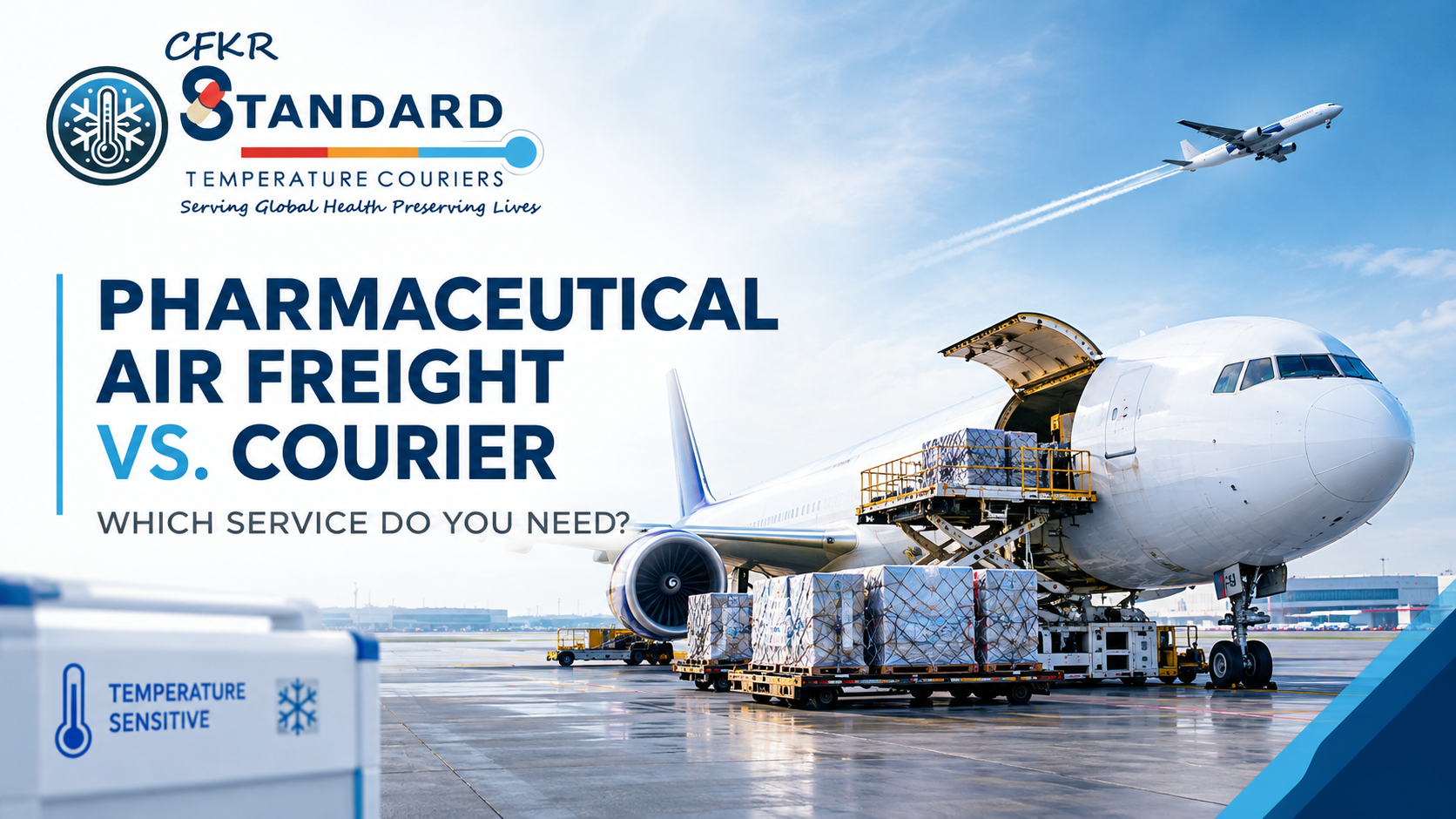
Pharmaceutical shipments need more than transportation from one location to another. They may require temperature control, careful handling, specific documentation, shipment tracking, and delivery within a defined time frame.
When arranging pharmaceutical transport, businesses often compare air freight with courier services. Both options can support domestic and international shipments, but they serve different needs. The right choice depends on the shipment size, destination, urgency, temperature requirements, customs procedures, and delivery arrangements.
For pharmaceutical manufacturers, clinical trial sponsors, research organisations, and laboratories, choosing the wrong service can lead to delays, higher costs, or risks to product quality.
This guide explains the differences between pharmaceutical air freight and courier services, when to use each option, and what to check before booking a shipment.
What Is Pharmaceutical Air Freight?
Pharmaceutical air freight is the transportation of medicines, pharmaceutical ingredients, biological materials, and other healthcare products by aircraft through a freight service.
It is commonly used for larger shipments, planned international movements, and deliveries between manufacturing facilities, distribution centres, hospitals, and research locations.
Air freight can support temperature-controlled transportation when the shipment is booked with suitable packaging, handling procedures, and logistics arrangements. However, using air transport alone does not guarantee temperature control. The complete shipment process must be planned around the product’s storage and transport requirements.
When should you use pharmaceutical air freight?
Air freight may be suitable when:
You need to transport large or consolidated pharmaceutical shipments.
Your shipment is travelling internationally over a long distance.
You are moving products between manufacturing sites, warehouses, or distribution centres.
Your delivery can be planned around airline schedules and cargo handling procedures.
Your shipment requires specialised handling arrangements and documented transport conditions.
You need to coordinate freight movement with customs clearance and onward delivery.
For example, a pharmaceutical manufacturer shipping several pallets of temperature-sensitive products to an overseas distribution centre may benefit from a planned air freight service.
The shipment still needs appropriate packaging, handling instructions, and temperature management throughout the journey.
What Is a Pharmaceutical Courier Service?
A pharmaceutical courier service is designed to arrange the collection and delivery of pharmaceutical products, clinical trial materials, laboratory samples, and other healthcare shipments.
Depending on the service provider and destination, the shipment may move by road, air, or a combination of transport methods. Courier services can offer direct collection, shipment coordination, tracking, and final delivery to the receiving facility.
Specialist pharmaceutical couriers are particularly relevant when a shipment needs careful coordination between the collection point, transport network, and final recipient.
When should you use a pharmaceutical courier?
A courier service may be suitable when:
You need a shipment collected from a specific facility and delivered to a named recipient.
You are sending smaller consignments or individual packages.
You need to arrange urgent delivery, subject to route and service availability.
You are shipping clinical trial supplies or laboratory materials to a research site.
You need shipment tracking and delivery confirmation.
You require a logistics partner to coordinate collection, transport, documentation, and final delivery.
For example, a clinical research organisation sending a package of trial materials to a hospital may prefer a courier service that can coordinate collection and delivery around the site’s receiving arrangements.
Not every courier service is equipped to handle temperature-sensitive pharmaceutical products. Before booking, confirm that the provider can meet the shipment’s specific handling, packaging, monitoring, and documentation requirements.
Pharmaceutical Air Freight vs. Courier: Key Differences
The main difference is how the shipment is organised and delivered. Air freight generally focuses on moving cargo between transport hubs, while a courier service often includes collection and delivery coordination.
| Factor | Pharmaceutical air freight | Pharmaceutical courier |
|---|---|---|
| Typical shipment size | Often suited to larger or consolidated consignments | Often suited to smaller packages and individual shipments |
| Transport method | Air transport, usually with cargo handling and onward delivery arrangements | Road, air, or a combination of transport methods |
| Collection and final delivery | May require separate collection or delivery arrangements | Often includes collection and final delivery, depending on the service |
| Delivery planning | Usually coordinated around cargo schedules and handling cut-offs | Can offer more shipment-specific collection and delivery coordination |
| Temperature control | Available when the service, packaging, and handling plan support it | Available when the courier has suitable specialist capabilities |
| Tracking | Depends on the freight service and tracking arrangements | Depends on the courier service and tracking system |
| Customs clearance | May be handled by the shipper, freight provider, or appointed broker | May be coordinated by the courier or another appointed party |
| Best suited for | Planned cargo movements, larger consignments, and international distribution | Direct delivery requirements, smaller consignments, and coordinated last-mile delivery |
These are general differences, not guarantees. Some courier services handle large international shipments, and some air freight services include door-to-door delivery. Compare the actual service scope rather than relying on the service name alone.
Which Is Better for Temperature-Sensitive Pharmaceutical Shipments?
Neither air freight nor courier is automatically better for temperature-sensitive products. The right option is the one that can maintain the required conditions and manage the risks throughout the complete journey.
Pharmaceutical products may require different temperature ranges depending on their formulation and manufacturer instructions. Common requirements include controlled room temperature, refrigerated conditions, frozen transport, deep-frozen transport, or specialised cryogenic handling.
Before choosing a service, confirm the following:
1. Required temperature range
Provide the exact temperature range specified for your product. Do not assume that a standard refrigerated service will meet the needs of every pharmaceutical shipment.
Ask the provider how the required range will be maintained during collection, transport, airport handling, customs clearance, transfers, and final delivery.
2. Packaging and thermal protection
Packaging should match the product, temperature requirement, expected transit time, and route conditions. Depending on the shipment, this may involve validated insulated packaging, refrigerants, dry ice, or specialised cryogenic systems.
The packaging plan should also account for possible delays and the time the shipment may spend outside a controlled facility.
3. Temperature monitoring
Ask whether temperature monitoring is available and whether the shipment requires a data logger, continuous monitoring, or a temperature report.
Confirm how temperature deviations will be identified, communicated, investigated, and documented.
4. Transit time and handling points
A flight’s duration is only one part of the total journey. Collection, export processing, airport handling, customs clearance, transfers, and final delivery can all affect the time a shipment spends in transit.
Compare the estimated end-to-end transit time, not just the time spent in the air.
5. Contingency planning
Ask what happens if a flight is delayed, customs clearance takes longer than expected, a delivery attempt fails, or the receiving facility cannot accept the shipment.
A suitable contingency plan is especially important for products with limited temperature stability or strict delivery deadlines.
When Is Air Freight the Better Choice?
Pharmaceutical air freight may be the better option when the main requirement is moving a larger shipment over a long distance through an established cargo network.
Consider air freight for the following situations.
Large pharmaceutical consignments
If you are moving multiple cartons, pallets, or consolidated cargo, air freight may provide a practical way to organise the shipment. The final choice will depend on chargeable weight, dimensions, packaging, handling needs, and destination.
International distribution
Air freight can support cross-border pharmaceutical distribution when the route, documentation, customs process, and receiving arrangements are planned in advance.
The shipper should confirm whether the quoted service includes customs clearance, airport-to-door delivery, and temperature-controlled handling at the relevant points.
Planned replenishment shipments
Manufacturers and distributors may use air freight for scheduled replenishment when stock needs to reach a destination faster than a slower transport method would allow.
Shipment planning should include production schedules, export readiness, import requirements, and the receiving warehouse’s capacity.
Specialised cargo handling
Some pharmaceutical shipments require specific cargo handling arrangements. Before booking, confirm that the selected airline, freight provider, packaging solution, and ground-handling partners can support the product’s requirements.
When Is a Pharmaceutical Courier the Better Choice?
A pharmaceutical courier may be the better option when collection, delivery coordination, and shipment-specific handling are central to the requirement.
Clinical trial supplies
Clinical trials often involve deliveries to hospitals, research centres, investigators, and other study locations. A courier service may help coordinate delivery to the correct recipient and support the documentation required for the shipment.
The service should be selected according to the trial materials, delivery schedule, temperature requirements, and receiving site’s procedures.
Laboratory samples
Laboratories may need to send samples to testing facilities, research partners, or specialist laboratories. The correct service depends on the sample type, applicable transport rules, packaging requirements, permitted transit time, and destination.
Not every laboratory sample can be shipped through a standard courier network. Confirm any classification, packaging, labelling, and documentation requirements before dispatch.
Urgent, smaller shipments
A courier service may suit smaller shipments with time-sensitive delivery requirements, particularly when a specific collection point and recipient need to be coordinated.
However, urgent delivery must be confirmed for the actual route and date. A courier label alone does not guarantee same-day or next-day delivery.
Direct delivery to a facility
When a shipment needs to reach a named hospital, laboratory, research site, or pharmaceutical facility, confirm whether the service includes final delivery, recipient coordination, delivery confirmation, and any special receiving instructions.
Can You Combine Air Freight and Courier Services?
Yes. For some pharmaceutical shipments, a combined air freight and courier arrangement may provide the most suitable solution.
The shipment may travel by air between cities or countries, with collection and final delivery arranged through a courier or ground transport partner.
For example, a pharmaceutical shipment travelling internationally might require collection from a manufacturing site, air transport to the destination country, customs clearance, and final delivery to a distribution centre.
A combined service can help coordinate these stages, but the responsibilities of each provider must be clear.
Before booking, confirm who is responsible for:
Collection from the shipper.
Packaging and preparation for transport.
Export and import documentation.
Airline booking and cargo handling.
Temperature monitoring and records.
Customs clearance and any duties or taxes.
Transfers between transport providers.
Final delivery and proof of receipt.
Incident reporting and escalation.
Also confirm how temperature control and shipment tracking will be managed when responsibility passes from one provider to another.
What Affects the Cost of Pharmaceutical Air Freight and Courier Services?
The cheapest quote may not be the most suitable option for a pharmaceutical shipment. Compare the total cost of the service and the requirements it covers.
Shipment weight and dimensions
Air freight charges commonly depend on actual weight and volumetric or chargeable weight. Courier pricing may also consider package dimensions, weight, service level, and destination.
Provide accurate dimensions and weights when requesting a quote.
Origin and destination
The route, delivery location, transport availability, and number of handling points can affect the price. Remote destinations and locations with limited transport options may require additional coordination.
Temperature requirements
Temperature-controlled packaging, refrigerants, specialist equipment, monitoring devices, and handling arrangements can increase the overall cost.
The exact requirements depend on the product and route.
Delivery urgency
Priority services and tightly scheduled deliveries may cost more than planned shipments with flexible delivery windows. Check the confirmed transit time and service conditions before choosing a premium option.
Customs and documentation
International pharmaceutical shipments may require permits, declarations, product information, and supporting documents. Customs brokerage, duties, taxes, inspections, or storage may create additional costs depending on the shipment and destination.
Special handling and delivery requirements
Hazardous materials, dry ice, biological substances, cryogenic materials, and other specialised shipments may require additional checks and approved handling arrangements.
Tell the logistics provider about these requirements before the shipment is booked.
Documents and Information to Prepare Before Booking
Accurate shipment information helps the logistics provider assess the correct service and reduce avoidable delays.
Depending on the product, route, and destination, you may need to prepare:
Commercial invoice, where applicable.
Packing list and shipment details.
Product description, quantity, and intended use.
Safety data sheet or other relevant technical documentation, where required.
Import permits, export licences, or other regulatory approvals, where applicable.
Temperature requirements and packaging instructions.
Relevant declarations for biological substances, dangerous goods, dry ice, or other regulated materials.
Consignee details, receiving hours, and delivery instructions.
Any required chain-of-custody, shipment monitoring, or proof-of-delivery records.
Requirements vary by product and country. Confirm the current rules with your logistics provider, customs broker, and relevant authorities before dispatch. Do not assume that the same documentation applies to every pharmaceutical or biological shipment.
How to Choose the Right Pharmaceutical Logistics Partner
When comparing providers, look beyond the quoted transit time and price. The provider should understand the shipment’s specific requirements and explain how the service will be delivered.
Use these questions to assess your options:
Can the provider handle your product?
Confirm experience with the relevant pharmaceutical products, laboratory materials, temperature ranges, and transport classifications.
Is the complete route covered?
Check collection, airport handling, customs clearance, transfers, and final delivery. Identify any parts managed by third parties.
How is temperature managed?
Ask about packaging, monitoring, handling procedures, temperature records, and the process for investigating deviations.
What tracking is available?
Confirm how you will receive shipment updates, delivery confirmation, and relevant monitoring records.
Who handles documentation?
Establish who prepares, checks, and submits the required shipping and regulatory documents.
What happens if something goes wrong?
Ask how delays, missed connections, temperature excursions, damaged packaging, and failed delivery attempts are escalated.
What exactly does the quote include?
Check for exclusions such as collection, packaging, customs brokerage, storage, delivery surcharges, and temperature-monitoring equipment.
A clear answer to these questions will help you compare services on their ability to meet your requirements, not just on price.
Pharmaceutical Air Freight vs. Courier: Final Recommendation
Pharmaceutical air freight is often a practical choice for larger consignments, planned international cargo movements, and distribution shipments. A pharmaceutical courier may be more suitable when you need coordinated collection and delivery, smaller consignments, or shipment-specific delivery arrangements.
For temperature-sensitive products, neither option should be selected on speed or price alone. The decision should account for product stability, packaging, temperature control, transit time, documentation, customs requirements, and the complete delivery route.
In some cases, a combination of air freight and courier services may be the best way to move a shipment from the point of collection to its final destination.
The best service is the one that meets your product’s requirements and provides a clear plan for every stage of transport.
Arrange Pharmaceutical Shipping with STC Couriers
STC Couriers supports pharmaceutical and life sciences logistics requirements, including temperature-controlled transportation, clinical trial logistics, laboratory logistics, and specialised shipment coordination.
Whether you are planning an international pharmaceutical shipment, arranging delivery of clinical trial materials, or moving temperature-sensitive products between facilities, share your shipment details with the STC Couriers team to identify a suitable transport option.
To help assess your requirements, provide the origin and destination, product type, shipment weight and dimensions, required temperature range, preferred delivery date, and any special handling or documentation needs.
Contact STC Couriers to discuss your pharmaceutical air freight or courier requirements and request a shipping quote.