
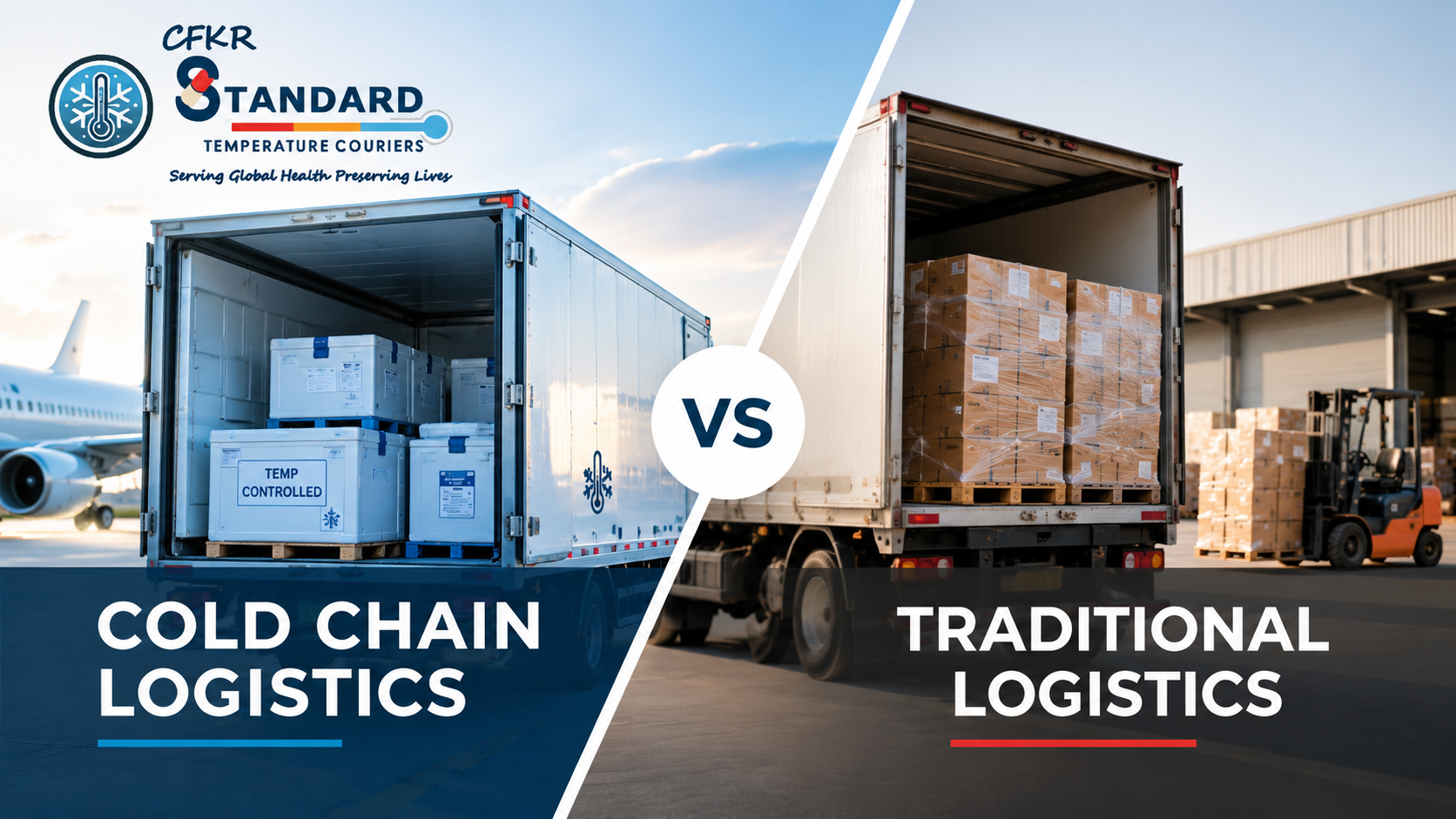
Logistics plays an important role in moving products from manufacturers to customers. However, not every product can be transported under the same conditions.
Some products, such as medicines, vaccines, biological samples, and certain food items, require specific temperature conditions during transportation and storage. Even a small change in temperature can affect their quality, safety, and effectiveness.
This is where cold chain logistics becomes important.
Traditional logistics focuses on transporting and storing products efficiently, while cold chain logistics focuses on maintaining specific temperature conditions throughout the supply chain.
Understanding the difference between these two logistics methods helps businesses choose the right transportation and storage solutions for their products.
What Is Traditional Logistics?
Traditional logistics refers to the transportation, storage, and distribution of goods under normal environmental conditions.
It includes activities such as inventory management, warehousing, order processing, transportation, and final delivery.
Traditional logistics is commonly used for products that do not require strict temperature control during transportation or storage.
Examples include clothing, furniture, electronics, construction materials, and packaged household products.
The main objective of traditional logistics is to deliver products safely, on time, and at an efficient cost.
For example, a company transporting electronic accessories from a warehouse to a retail store can use standard transportation services, provided the products are protected from damage and other environmental risks.
What Is Cold Chain Logistics?
Cold chain logistics is a specialized logistics process that maintains specific temperature conditions during the storage, handling, and transportation of temperature-sensitive products.
It is commonly used in the pharmaceutical, biotechnology, healthcare, and food industries.
Products such as vaccines, insulin, biological samples, and certain medicines may require refrigeration, freezing, or ultra-low temperature conditions.
Cold chain logistics uses temperature-controlled vehicles, specialized packaging, refrigerated storage facilities, and temperature monitoring systems to protect these products.
The main objective is to maintain the required temperature range throughout the supply chain and prevent damage caused by temperature changes.
For example, a pharmaceutical shipment requiring storage between 2°C and 8°C must remain within its specified temperature range during transportation and delivery.
A temperature deviation may affect the quality of the product and could make it unsuitable for use.
Key Differences Between Cold Chain Logistics and Traditional Logistics
Although both logistics methods involve transportation, storage, and distribution, they differ in several important areas.
1. Temperature Requirements
The most important difference is temperature control.
Traditional logistics generally operates under normal environmental conditions. Products may be exposed to changes in outdoor temperature during transportation, provided those conditions do not damage the goods.
Cold chain logistics requires specific temperature conditions to be maintained throughout the supply chain.
For example, a shipment of clothing can usually be transported in a standard delivery vehicle. However, certain vaccines may require continuous temperature control between 2°C and 8°C.
The required temperature depends on the product and its manufacturer’s storage instructions.
2. Transportation Equipment
Traditional logistics commonly uses standard trucks, delivery vans, shipping containers, and other transportation methods.
Cold chain logistics requires specialized equipment designed to maintain the required temperature.
This may include refrigerated vehicles, insulated containers, temperature-controlled air freight packaging, and validated shipping systems.
The choice of equipment depends on the product, shipment duration, transportation route, and required temperature range.
3. Storage Facilities
Traditional logistics uses warehouses and distribution centers designed for general goods.
Cold chain logistics requires temperature-controlled storage facilities that maintain specific environmental conditions.
These facilities may include refrigerated rooms, frozen storage areas, and ultra-low temperature freezers.
For pharmaceutical products, storage conditions must be suitable for the product and follow applicable quality and regulatory requirements.
4. Packaging Requirements
Packaging protects products from physical damage, contamination, and environmental exposure.
Traditional logistics generally uses standard packaging materials such as cardboard boxes, protective foam, and pallets.
Cold chain logistics requires packaging that helps maintain the required temperature during transportation.
Depending on the shipment, this may include insulated containers, gel packs, phase change materials, dry ice, or liquid nitrogen systems.
The packaging must be suitable for the product’s temperature requirements and the expected shipping duration.
For pharmaceutical shipments, packaging systems may also require testing and qualification to demonstrate their ability to maintain the required temperature under defined conditions.
5. Temperature Monitoring
Traditional logistics may use shipment tracking systems to monitor the location and delivery status of goods.
Cold chain logistics requires additional monitoring to track temperature conditions during transportation and storage.
Temperature monitoring devices, data loggers, and sensors help identify temperature changes that may affect product quality.
For example, if a pharmaceutical shipment experiences a temperature excursion, the recorded data can help the responsible team assess the incident and determine whether the product can still be used.
Temperature monitoring is particularly important for medicines, vaccines, biological samples, and clinical trial materials.
6. Regulatory Compliance
Traditional logistics must follow applicable transportation, customs, safety, and handling requirements.
Cold chain logistics involves additional requirements when transporting regulated products such as pharmaceuticals, biological substances, and dangerous goods.
Pharmaceutical transportation may require compliance with Good Distribution Practice (GDP) requirements, appropriate temperature controls, shipment documentation, and procedures for handling temperature excursions.
International shipments may also require compliance with applicable customs regulations and air transportation requirements.
The exact requirements depend on the product, destination, transportation method, and applicable regulations.
7. Cost of Transportation
Traditional logistics generally has lower transportation and storage costs for products that do not require special handling.
Cold chain logistics can involve higher costs because it requires specialized equipment, temperature-controlled storage, validated packaging, monitoring systems, and trained personnel.
For example, transporting a standard package through a regular courier service may cost less than transporting a pharmaceutical shipment in a validated temperature-controlled container.
However, the cost of cold chain logistics must be considered alongside the risk of product damage, financial loss, and potential delays caused by temperature-related issues.
8. Risk Management
Traditional logistics focuses on risks such as theft, physical damage, delivery delays, and inventory loss.
Cold chain logistics must manage these risks as well as temperature-related risks.
A temperature deviation, equipment failure, or delay may affect the quality of a temperature-sensitive product.
Cold chain logistics providers need suitable contingency plans, temperature monitoring procedures, and appropriate handling processes to manage these risks.
For pharmaceutical products, any temperature excursion must be assessed according to the product’s requirements and the applicable quality procedures.
Cold Chain Logistics vs. Traditional Logistics: Comparison Table
| Feature | Traditional Logistics | Cold Chain Logistics |
|---|---|---|
| Temperature control | Usually not required | Required within specified limits |
| Transportation | Standard vehicles and containers | Temperature-controlled vehicles and specialized packaging |
| Storage | General warehouses | Temperature-controlled facilities |
| Packaging | Standard protective packaging | Insulated and temperature-controlled packaging |
| Monitoring | Shipment location and delivery status | Shipment tracking and temperature monitoring |
| Compliance | General transportation requirements | Additional temperature and product-specific requirements |
| Cost | Generally lower | Generally higher |
| Main risk | Damage, theft, and delays | Temperature excursions, damage, theft, and delays |
| Common industries | Retail, manufacturing, electronics | Pharmaceuticals, biotechnology, healthcare, and food |
Which Industries Need Cold Chain Logistics?
Cold chain logistics is important for industries that handle products requiring specific temperature conditions.
Pharmaceutical Industry
Medicines, vaccines, insulin, and certain injectable products may require controlled temperatures during storage and transportation.
Maintaining the required temperature helps protect product quality and supports safe distribution.
Biotechnology Industry
Biological products, cell therapies, gene therapies, and other specialized materials may require refrigerated, frozen, or cryogenic transportation.
These products often need specialized packaging and handling procedures.
Clinical Research
Clinical trial materials and biological samples may require temperature-controlled transportation between manufacturers, laboratories, research centers, and clinical trial sites.
Maintaining the required conditions helps protect the quality of the materials used in research.
Food and Beverage Industry
Fresh food, dairy products, frozen foods, and other temperature-sensitive products may require refrigeration or freezing during transportation and storage.
Cold chain logistics helps maintain product quality and reduce spoilage.
When Should Businesses Choose Cold Chain Logistics?
Businesses should choose cold chain logistics when their products require specific temperature conditions during storage or transportation.
This is particularly important for pharmaceutical companies, biotechnology businesses, clinical research organizations, and healthcare providers.
Before selecting a logistics provider, businesses should consider the product’s temperature requirements, shipment duration, transportation route, packaging requirements, monitoring capabilities, and regulatory obligations.
For products that do not require temperature control, traditional logistics may be a suitable and cost-effective option.
However, when product quality depends on maintaining a specific temperature range, cold chain logistics is necessary.
How to Choose the Right Cold Chain Logistics Provider
Selecting the right logistics provider is important for protecting temperature-sensitive products.
Businesses should evaluate the provider’s experience, transportation network, packaging solutions, temperature monitoring systems, and quality management procedures.
For pharmaceutical and biotechnology shipments, it is also important to understand how the provider manages temperature excursions, shipment delays, and other unexpected situations.
A reliable cold chain logistics provider should be able to explain how it maintains the required temperature conditions and protects products throughout the transportation process.
Conclusion
Cold chain logistics and traditional logistics both support the movement of goods, but they serve different transportation requirements.
Traditional logistics is suitable for products that can be transported and stored under normal environmental conditions.
Cold chain logistics is designed for products that require specific temperature conditions to maintain their quality and safety.
For pharmaceutical, biotechnology, and clinical research companies, choosing the right logistics method is essential for protecting sensitive products and maintaining supply chain reliability.
CFKR STC Couriers provides specialized logistics solutions for pharmaceutical and biotechnology shipments, including cold chain transportation, clinical trial logistics, cryogenic transportation, and temperature-controlled packaging.
With suitable transportation methods, packaging solutions, and temperature monitoring, businesses can protect their shipments and maintain the required conditions throughout the supply chain.
Need reliable transportation for temperature-sensitive pharmaceutical or biotechnology products? Contact CFKR STC Couriers to discuss your cold chain logistics requirements.