
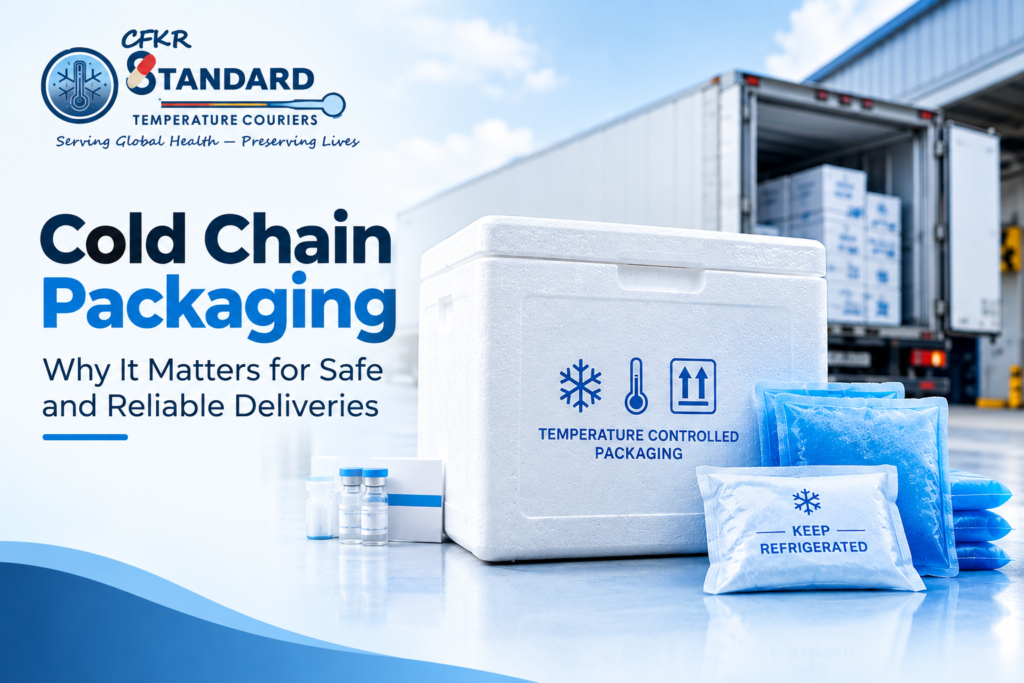
Cold chain packaging is the single decision that determines whether a temperature sensitive shipment reaches its destination usable or ruined. Vaccines, biologics, reagents, blood products and specialty drugs do not fail because of bad roads or delayed flights. They fail because the packaging around them could not hold the required range long enough. If you are evaluating cold packaging for an upcoming shipment, or trying to fix a pattern of temperature excursions, this guide walks through what actually works, what to check before you commit to a vendor, and how STC Couriers builds cold chain packaging solutions around the product rather than the other way around.
This is written for the person who already understands the stakes. You are not here to learn what “cold chain” means in the abstract. You are here to pick a packaging approach and a logistics partner that will not let you down on the next shipment.
Why Cold Chain Packaging Decides the Outcome, Not the Vehicle
A refrigerated truck or a temperature controlled warehouse only protects a shipment while the product sits inside them. The moment a package leaves the truck, moves through a tarmac, sits at a customs checkpoint, or waits on a loading dock in Chennai in May, the packaging is the only thing standing between the product and the ambient temperature outside. Good cold chain packaging is designed to absorb exactly those gaps.
This matters because most temperature excursions do not happen during transit itself. They happen during handoffs. A shipment moves from a warehouse to a vehicle, from that vehicle to an airport, from the airport to another vehicle, and finally to the receiving facility. Each handoff is a point where the product is briefly outside active climate control. Packaging that has not been validated for the full duration of these gaps will fail exactly when it matters, even if every other part of the logistics chain performed correctly.
For pharmaceutical and life sciences companies, this is not a minor operational detail. Regulatory bodies treat it as a core compliance requirement. India’s Guidelines on Good Distribution Practices for Pharmaceutical Products, issued by CDSCO, require that products showing signs of a specified environmental deviation, such as temperature, be identified and quarantined without delay. That single requirement puts the burden squarely on packaging performance, because a poorly designed cold pack cannot prove it held the required range, and a shipment that cannot prove its temperature history is treated as compromised whether or not it actually was.
The Real Cost of Getting Cold Packaging Wrong
A failed cold chain shipment rarely shows up as an obvious, visible problem. Vaccines that have been exposed to heat do not change color or smell different. Biologics that have partially degraded still look identical to a healthy batch. This is exactly why the financial and regulatory damage is so severe. Companies discover the failure only after potency testing, after a clinical trial site rejects a batch, or worse, after a patient receives a compromised dose.
Beyond the cost of the wasted product, there is the cost of the investigation. Every temperature excursion triggers a deviation report, a root cause analysis, and in regulated industries, documentation that has to satisfy an auditor. If packaging was not validated for the actual transit profile, that investigation drags on because nobody can say with confidence where the failure occurred. This is the difference between a five minute conversation with a data logger printout and a multi week investigation that delays a product launch or a clinical trial milestone.
There is also a reputational cost that is harder to quantify but easier to lose. A distributor, hospital network or clinical research organization that receives a compromised shipment once will start asking pointed questions about your packaging validation before they place a second order. In an industry where trust is the actual product being sold, one packaging failure can cost far more than the shipment itself.
Types of Cold Chain Packaging Solutions
Not every shipment needs the same packaging approach. The right choice depends on the required temperature range, the transit duration, the shipment volume and the level of documentation the receiving party expects. Broadly, cold chain packaging solutions fall into three categories.
Passive Packaging Systems
Passive packaging relies on insulation and a pre-conditioned thermal mass, usually gel packs, phase change material or dry ice, to hold a temperature range without any external power source. These systems are the most widely used because they are cost effective, do not require charging or monitoring hardware, and work well for shipments that stay within a predictable transit window, typically 24 to 120 hours depending on the design.
The limitation with passive systems is that their performance is only as good as their validation. A gel pack qualifier that has been tested at 25 degrees ambient will not necessarily perform the same way during a Delhi summer tarmac delay at 45 degrees. This is why passive packaging needs to be selected and tested against the actual lane and season, not a generic specification sheet.
Active Packaging Systems
Active packaging uses powered refrigeration or heating units built into the container itself, giving it the ability to maintain a set point regardless of external temperature swings. These are the right choice for high value biologics, cell and gene therapy materials, or any shipment where the cost of failure far exceeds the cost of the packaging itself.
Active containers also tend to include built in temperature logging, which removes the guesswork during a compliance review. The tradeoff is cost and logistics complexity, since these units are heavier, require battery management, and often need to be returned to the sender after use.
Hybrid Packaging Systems
Hybrid systems combine passive insulation with a smaller active component, often a solid state or Peltier based temperature control unit layered inside a passive shell. This approach has gained traction for mid duration shipments where full active refrigeration is not cost justified but a purely passive system does not offer enough of a safety margin. It is a middle ground that suits many pharmaceutical distribution shipments moving within India on lanes with variable handling times.
Choosing between these three categories is not a packaging decision made in isolation. It has to be made alongside the carrier’s actual cold chain capability, because packaging that performs well on paper still depends on a logistics partner that handles handoffs quickly and correctly.
How to Choose the Right Cold Chain Packaging Solution for Your Shipment
Match Packaging to the Actual Temperature Range Required
Most temperature sensitive products fall into one of three ranges: 2 to 8 degrees Celsius for refrigerated biologics and most vaccines, 15 to 25 degrees for controlled room temperature products, or deep frozen ranges below minus 20 degrees for certain cell and gene materials. The packaging solution has to be validated for the specific range on the product label, not a generic “cold” designation. A qualifier built for 2 to 8 degrees will not necessarily hold a minus 20 degree range, and using the wrong packaging class is one of the most common and preventable causes of excursions.
Factor In Real Transit Time, Not Best Case Transit Time
Packaging validation should be based on the worst realistic transit scenario, including customs delays, weather related flight cancellations and last mile delivery windows in areas with limited infrastructure. A packaging solution rated for 48 hours that is used on a lane where deliveries routinely take 60 hours because of customs clearance will fail on a predictable, recurring basis. This is where working with a logistics partner that understands specific lanes, rather than a generic courier, becomes a genuine differentiator.
Verify Validation and Documentation Before You Commit
Ask any potential packaging or logistics provider for their qualification data before signing a contract. That means summer and winter profile testing, documented thermal performance curves, and proof that the packaging has been tested under conditions similar to your actual shipping lane. If a vendor cannot produce this documentation on request, treat that as a warning sign rather than a minor gap. This aligns directly with how regulators evaluate compliance. The USP general chapter on storage and distribution practices addresses the systems, people, facilities, equipment, documentation and handoffs involved in protecting finished medications throughout the supply chain, and packaging validation records are a core part of that documentation trail.
Consider Total Landed Cost, Not Just the Packaging Price
The cheapest packaging option is rarely the cheapest choice once you account for the cost of a single failed shipment. A passive cooler that costs a fraction of an active container looks attractive on a line item basis, but if it fails on ten percent of shipments on a particular lane, the cost of replaced product, investigation time and delayed deliveries will exceed the savings many times over. The right way to evaluate cost is per successful delivery, not per unit purchased.
Compliance Standards That Govern Cold Chain Packaging
Cold chain packaging does not exist in a regulatory vacuum, particularly for pharmaceutical and healthcare shipments. In India, the regulatory compliance framework for temperature sensitive distribution is shaped by CDSCO guidance that mirrors international standards. Globally, several bodies define what “acceptable” cold chain packaging performance actually looks like.
The World Health Organization sets the benchmark for storage and distribution practices that most national regulators, including India’s, reference directly. CDSCO’s guidelines were developed following WHO Technical Report Series 1025, Annex 7 on Good Storage and Distribution Practices for Medical Products, which means Indian shippers working to CDSCO standards are effectively also working to the WHO framework. Anyone building a compliance program around cold chain packaging should treat the WHO guidance on good storage and distribution practices as a primary reference point.
For shipments moving by air, the IATA Temperature Control Regulations and CEIV Pharma certification define the operational standards that airlines, ground handlers and freight forwarders are expected to meet when handling temperature sensitive cargo. A logistics partner that holds or works within CEIV Pharma aligned processes has already demonstrated that their packaging, facilities and staff have been independently audited against this checklist.
For vaccine specific cold chains, the CDC Vaccine Storage and Handling guidance offers detailed, field tested protocols for handling temperature excursions and managing storage equipment, much of which applies directly to how packaging should be conditioned and monitored before dispatch.
None of this is optional reading for a company shipping pharmaceuticals. It is the baseline that determines whether a shipment clears customs, satisfies a receiving facility’s quality team, and holds up under audit.
Common Mistakes Companies Make With Cold Packaging
The most frequent mistake is treating packaging as a fixed, one size fits all purchase rather than something that needs to be re-evaluated for every new lane, season and product. A packaging configuration that performed well shipping from Mumbai to Delhi in December has no guarantee of performing the same way shipping from Hyderabad to a remote district during peak summer. Seasonal requalification is not a bureaucratic formality, it is the difference between a shipment that arrives intact and one that does not.
Another common mistake is under-conditioning the thermal mass before dispatch. Gel packs and phase change materials need to reach their full target temperature before loading, and rushing this step to meet a pickup deadline undermines the entire packaging design regardless of how good the container itself is.
A third mistake is relying on packaging alone without pairing it with active temperature monitoring. Passive packaging without a data logger gives you no way to prove what actually happened during transit, which becomes a serious liability the moment a receiving facility questions the shipment’s integrity. Monitoring devices are not an added expense, they are the evidence that protects both the shipper and the receiver when a dispute arises.
Finally, many companies choose a courier based purely on delivery speed or price without asking about packaging validation, temperature mapping or handoff procedures. Speed means nothing if the product arrives outside its required range. This is where evaluating a partner’s actual packaging technology matters more than a quoted transit time.
Why Businesses Choose STC Couriers for Cold Chain Packaging Solutions
STC Couriers has spent more than 30 years focused specifically on pharmaceutical and healthcare logistics, which means cold chain packaging is not a side offering added to a general courier service. It is the core discipline the company was built around.
Every shipment is matched to a packaging configuration based on the product’s actual temperature range, the transit lane and the season, rather than a generic default. This includes passive, active and hybrid packaging options selected after reviewing the specific route and handling profile, not after the fact. The packaging technology used across shipments is validated for real world conditions, including the handoff delays that generic couriers tend to ignore during their own testing.
STC Couriers also builds regulatory compliance directly into the packaging and documentation process, so that shipments arrive with the temperature history, chain of custody records and deviation reports that a pharmaceutical company’s quality team or an auditor will actually ask for. This matters for companies operating in the pharmaceutical supply chain, where a single undocumented excursion can hold up an entire batch release.
The company operates its own fleet and warehouse network across multiple cities, which reduces the number of third party handoffs a shipment goes through. Fewer handoffs mean fewer opportunities for a package to sit outside active climate control, which is precisely the gap that cold chain packaging exists to cover. For a more detailed look at how this fits into broader distribution strategy, our guide on temperature controlled logistics in India breaks down how packaging, fleet and compliance work together end to end.
How to Get Started With STC Couriers
If you are currently dealing with recurring temperature excursions, preparing to launch a new pharmaceutical product, or simply reviewing whether your current cold packaging vendor can actually back up their claims with validation data, the next step is a direct conversation rather than another comparison sheet.
STC Couriers works with shipping teams to review the specific product, temperature range and lane before recommending a packaging configuration, rather than selling a one size fits all package. This includes reviewing your current excursion history if you have one, since that data usually points directly to where the current packaging or handoff process is failing.
You can reach the team through the STC Couriers contact page to request a packaging assessment for your next shipment or to discuss a longer term cold chain logistics partnership. For companies shipping regularly, this conversation typically results in a packaging plan that is tested against your actual lanes before it is ever used on a live shipment, which is the only way to know it will hold up when it matters.
Frequently Asked Questions
What is the difference between cold chain packaging and cold storage?
Cold storage refers to fixed facilities like refrigerated warehouses or cold rooms that hold products at a set temperature while they are stationary. Cold chain packaging refers to the containers, insulation and temperature control components that protect a product while it is in motion, including during the gaps between storage points where no external climate control is available.
How long can passive cold chain packaging maintain temperature?
It depends on the design, the ambient conditions and the thermal mass used, but most validated passive systems hold a target range for anywhere between 24 and 120 hours. Any claim beyond that range should be backed by actual summer and winter profile test data specific to your product and route, not a generic manufacturer specification.
Do I need active packaging for every pharmaceutical shipment?
No. Active packaging is generally reserved for high value biologics, cell and gene therapy materials, or shipments on lanes with unpredictable, extended transit times. Many standard pharmaceutical distribution shipments are well served by properly validated passive or hybrid packaging, provided the configuration is matched to the actual temperature range and transit duration.
What documentation should a cold chain packaging provider give me?
At minimum, you should receive thermal performance validation data for both summer and winter conditions, temperature monitoring records for the actual shipment, and a documented chain of custody. This documentation is what allows you to demonstrate compliance during an audit and is consistent with the recordkeeping expectations set out in CDSCO’s Good Distribution Practices guidelines.
How does STC Couriers decide which packaging solution to use for a shipment?
STC Couriers reviews the product’s required temperature range, the transit lane, expected handling delays and the season before recommending a passive, active or hybrid packaging configuration. This assessment happens before the shipment is booked, not as an afterthought, which is what allows the packaging to be matched to real conditions rather than a generic default.
What happens if a temperature excursion occurs during transit?
A properly packaged and monitored shipment will include a data logger or temperature indicator that records the full transit history. If an excursion occurs, that data allows the shipper and receiver to immediately identify the deviation, quarantine the affected product if needed, and investigate the cause, which is the process required under CDSCO’s distribution guidelines and similar frameworks globally.