
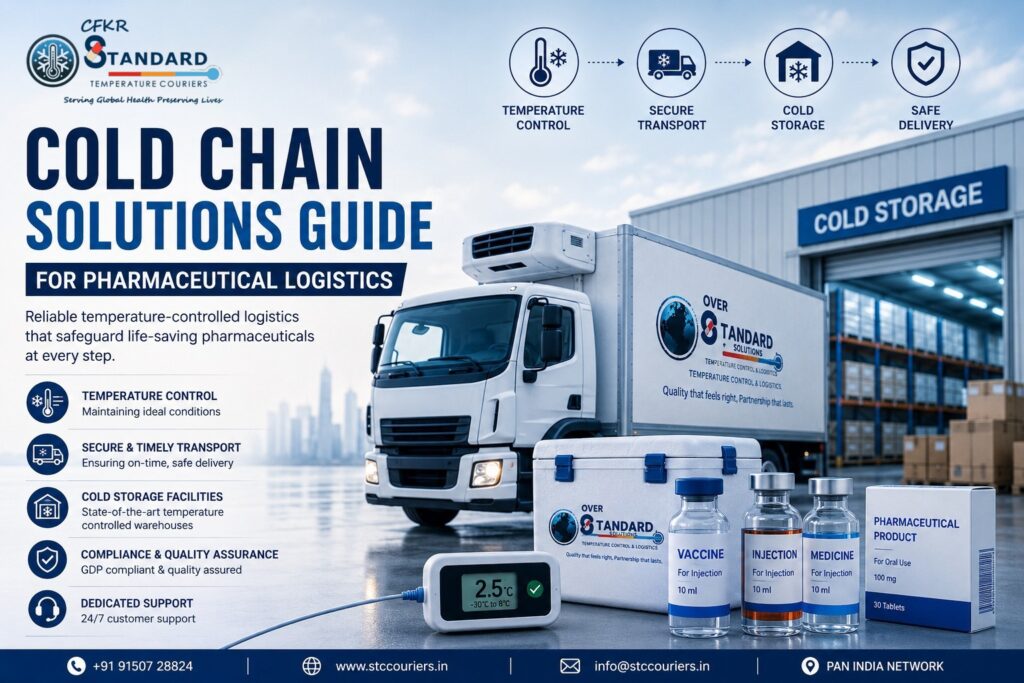
Cold chain solutions are often reduced to “keeping things cold” in casual conversation, but that description misses most of what actually protects a shipment. A working cold chain covers packaging design, vehicle specification, route planning, staff training, documentation, and contingency response, all working together so a product leaves the manufacturer at the correct temperature and arrives at the correct temperature, with proof of that fact at every checkpoint.
Pharmaceutical products do not share one temperature requirement. Vaccines typically need 2°C to 8°C. Certain biologics and cell therapies need frozen conditions between minus 20°C and minus 80°C. Cryogenic shipments involving liquid nitrogen can require minus 150°C to minus 196°C. Ambient shipments still need protection, usually between 15°C and 25°C, because heat exposure degrades many formulations just as badly as cold exposure. A cold chain solutions provider that cannot demonstrate control across this full range is not equipped to handle a diverse pharmaceutical portfolio.
Packaging and Monitoring Are Not Optional Extras
Validated packaging matters as much as the vehicle carrying it. Insulated containers, phase change materials, and vacuum insulated panels are chosen based on route duration, ambient conditions, and product sensitivity, not picked off a shelf. On top of that, monitoring devices track temperature, humidity, light, tilt, and sometimes pressure throughout transit, so any deviation is caught and documented rather than discovered after delivery. The World Health Organization has published detailed guidance on storage and distribution practices for medical products precisely because packaging and monitoring failures are the most common cause of product loss across the industry, as outlined in its health products policy and standards.
Why Temperature Controlled Logistics Fails Without the Right Partner
Most pharmaceutical companies do not lose product because of a dramatic breakdown. They lose it in small, quiet ways. A refrigerated vehicle that was not pre-cooled properly before loading. A handoff between carriers where nobody checked the internal temperature of the container. A route that ran two hours longer than planned because of traffic, pushing a shipment past the safe window of its packaging. None of these failures show up as an obvious accident. They show up weeks later as a rejected batch or a compromised clinical trial arm.
This is why temperature controlled logistics cannot be treated as a generic freight service with a refrigerated truck attached. The Centers for Disease Control and Prevention has documented how easily vaccine potency is lost when storage and handling protocols are not followed with precision, which is why its Vaccine Storage and Handling Toolkit exists as a standing reference for anyone moving temperature sensitive biological products. The same discipline applies whether the shipment is moving across a city in Hyderabad or across international borders.
What to Look for Before You Sign With a Cold Chain Provider
If you are down to comparing two or three providers, the decision usually comes down to a handful of factors that separate a genuine cold chain specialist from a courier company that added refrigerated vehicles to its fleet.
Validated Packaging and Real Time Visibility
Ask any prospective partner to walk you through their packaging validation process. GDP compliant packaging should be ISTA validated and tested against the specific temperature range your product needs, not a generic insulated box. You should also expect real time visibility into every shipment, not a status update after the fact. If a provider cannot show you live temperature data during transit, you are trusting the cold chain blind, which defeats the purpose of paying for temperature controlled logistics in the first place.
Regulatory Compliance Built Into the Process
Good Distribution Practice is not a marketing phrase. It is a regulatory framework that governs how pharmaceutical products move through storage and transport, and it applies whether your shipment is domestic or international. The International Air Transport Association created the CEIV Pharma certification specifically because air cargo handlers were struggling to meet the quality, security, and compliance expectations pharmaceutical shippers require, and that certification has become a recognized benchmark across the industry, detailed on the IATA CEIV Pharma program page. A provider who cannot speak fluently about GDP, CDSCO requirements, and documentation standards is not ready to handle regulated pharmaceutical freight.
Track Record With Similar Shipments
Ask for numbers, not adjectives. On time performance rate for cold chain shipments specifically, not general freight. Years operating in pharmaceutical logistics specifically, not logistics broadly. How many clinical trial shipments, vaccine consignments, or biotech transfers they have actually handled. A provider with three decades of pharmaceutical specific experience will answer these questions without hesitation. One that has recently pivoted into cold chain from general courier services usually cannot.
Contingency Planning for When Things Go Wrong
Even the best planned shipment can run into a delay, a vehicle breakdown, or a border hold. What matters is what happens next. Ask whether the provider maintains backup cold storage for rapid stabilization, whether they can reroute a shipment in real time, and whether their monitoring systems trigger automated alerts the moment a temperature excursion begins rather than after the fact. This single question filters out a large share of providers who look capable on paper but have never actually managed a live cold chain failure.
How STC Couriers Delivers Cold Chain Solutions Across India
STC Couriers has been building temperature controlled logistics capability in Hyderabad since 2008, and that history shows up in how the operation is structured, not just in the equipment used. Our cold chain expertise covers the full temperature spectrum a pharmaceutical shipper actually needs, from cryogenic transport using liquid nitrogen down to minus 196°C, through frozen and ultra low freezer ranges, refrigerated 2°C to 8°C transport for vaccines and biologics, and ambient 15°C to 25°C shipping for products that still require protection from heat.
Every consignment moves in GDP compliant, ISTA validated packaging built around pre-conditioned phase change materials and vacuum insulated panels, matched to the actual duration and conditions of the route rather than applied as a one size fits all default. Environmental monitoring runs throughout transit, tracking temperature, humidity, and shock with automated alerts, so any deviation is flagged immediately instead of discovered at delivery. On-site packing is handled by GDP trained specialists who work directly with dry ice and liquid nitrogen for the coldest shipments, which is the kind of detail that separates a specialist cold chain operator from a general courier offering refrigerated add-ons.
Our risk management framework includes backup cold storage for rapid stabilization during unexpected delays and route adjustment capability to keep a shipment within its safe window when conditions change mid-transit. This is the operational depth described on our pharmaceutical supply chain solutions page, and it reflects how the entire organization is built around one category of freight rather than treating pharmaceuticals as one product line among many.
Industries That Rely on Our Temperature Controlled Logistics
Pharmaceutical manufacturers depend on us to move finished drug products, active pharmaceutical ingredients, and biologics between manufacturing sites, distribution centers, and pharmacies without a single break in the cold chain. Clinical research organizations and trial sponsors rely on our understanding of what clinical trial logistics actually demands, which we cover in detail in our breakdown of what clinical trial logistics companies do and why they matter. Trial materials often move on tight timelines to investigative sites and, in decentralized trials, directly to patients, and any delay or temperature failure can compromise data integrity for an entire study arm.
Vaccine distributors and public health programs also depend on strict cold chain discipline, since the difference between 2°C and 10°C during transport can mean the difference between a viable dose and a wasted one. UNICEF has documented how central this discipline is to immunization programs at scale through its cold chain and logistics guidance, and Gavi has invested heavily in cold chain equipment optimization for exactly this reason, described on its Cold Chain Equipment Optimisation Platform page. Cell and gene therapy developers, diagnostic laboratories shipping specimens, and hospitals moving sensitive biological materials round out the list of clients who choose us because the margin for error in their shipments is close to zero.
The Real Cost of Getting Cold Chain Logistics Wrong
Companies rarely calculate the true cost of a cold chain failure until after it happens. The obvious number is the value of the destroyed product, but that is usually the smaller part of the loss. A rejected clinical trial batch can push back an entire study timeline by months, which affects funding, regulatory submissions, and the eventual market launch of a therapy. A compromised vaccine shipment sent to a public health program does not just cost the product itself, it costs the immunization coverage of everyone who was supposed to receive that dose. A pharmaceutical manufacturer that experiences repeated temperature excursions also risks closer scrutiny from regulators during future audits, which slows down every subsequent shipment even after the original problem is fixed.
This is why the cheapest quote is rarely the right choice when you are comparing cold chain solutions providers. A lower price often reflects thinner packaging, less frequent monitoring, or a smaller contingency network, and those gaps only become visible when something goes wrong mid-shipment. Pharmaceutical logistics is one of the few areas of a supply chain where the cost of prevention is consistently smaller than the cost of failure, which is exactly why serious providers build their pricing around validated packaging and real time monitoring rather than stripping those elements out to compete on cost.
Domestic and International Cold Chain Shipments Need Different Planning
A shipment moving within Hyderabad or across Indian states faces different risks than one crossing international borders, and a capable provider plans for both differently rather than applying one template to every route. Domestic shipments depend heavily on vehicle reliability, power backup at storage points, and route planning around traffic and weather, particularly in regions where grid power can be inconsistent. International shipments add customs clearance, extended transit times, multiple carrier handoffs, and compliance with the regulations of the destination country, all of which introduce additional points where a cold chain can break down if it is not actively managed.
Air freight in particular carries its own layer of requirements. Pharmaceutical shippers moving product by air depend on ground handlers and carriers who understand time and temperature sensitive cargo specifically, which is the gap the aviation industry built CEIV Pharma certification to close. A provider who can manage both the first mile pickup and the international leg of a shipment, while keeping documentation and monitoring continuous across every handoff, removes one of the biggest failure points in pharmaceutical logistics: the gap between two providers who each assume the other is watching the temperature.
Cold Chain Solutions Checklist Before You Choose a Partner
Before you finalize a provider, confirm five things directly with them rather than relying on their marketing material. Confirm the exact temperature range their packaging is validated for, and ask to see the validation data, not just a claim. Confirm whether monitoring is live during transit or only reported after delivery. Confirm their documented on time performance rate specifically for cold chain shipments. Confirm what their contingency process looks like when a shipment is delayed or a vehicle fails. Confirm how many years they have operated in pharmaceutical logistics specifically, since general courier experience does not transfer directly to regulated pharmaceutical freight.
A provider that answers all five clearly and quickly is one worth trusting with your next shipment. A provider that hesitates, deflects, or answers in generalities is telling you something important about how they will handle your product when something actually goes wrong. Our own performance on this front, including a 99.88% on time performance rate for cold chain shipments, is detailed on our about us page, and we are happy to walk any prospective client through the specifics before they commit to anything.
Why STC Couriers Is the Cold Chain Partner Pharmaceutical Companies Trust
Healthcare products only save lives when they arrive in the condition they left in. That single fact drives everything about how we operate. We do not treat pharmaceutical shipments as a category within a larger courier business. Cold chain and temperature controlled logistics is the business, and every process, from packaging validation to route planning to contingency response, is built around that focus.
If you are currently evaluating cold chain solutions providers and need a partner who can demonstrate GDP compliance, validated packaging, real time monitoring, and a documented track record rather than promises, get in touch with our team through stccouriers.in and place your order directly through our platform. Our team will schedule pickup at your convenience and keep you informed with real time tracking updates from the moment your shipment leaves your facility to the moment it reaches its destination.
Frequently Asked Questions
What temperature ranges do cold chain solutions typically cover in pharmaceutical logistics?
Most pharmaceutical cold chain shipments fall into four categories. Refrigerated transport covers 2°C to 8°C and is used for vaccines and many biologics. Frozen transport covers minus 20°C to minus 80°C using ultra low freezers. Cryogenic transport goes down to minus 150°C to minus 196°C using liquid nitrogen, typically for cell and gene therapies. Ambient transport, usually 15°C to 25°C, still requires temperature protection because many formulations degrade in heat even though they do not need refrigeration.
How do I know if a cold chain provider is actually GDP compliant?
Ask for their documentation directly rather than accepting a general claim. A genuinely compliant provider can show you their quality management system, staff training records, packaging validation reports, and how they handle temperature excursions. If a provider cannot produce this documentation on request, treat that as a warning sign rather than an oversight.
What happens if a shipment experiences a temperature excursion during transit?
With a properly built cold chain, monitoring devices trigger an alert the moment a deviation begins, which allows the logistics team to respond immediately rather than discovering the problem at delivery. A strong provider maintains backup cold storage and rerouting capability specifically for this scenario, so the shipment can be stabilized or redirected before the product is compromised.
Is temperature controlled logistics only relevant for vaccines?
No. While vaccines are the most commonly discussed example, temperature controlled logistics also applies to active pharmaceutical ingredients, biologics, cell and gene therapies, clinical trial samples, diagnostic specimens, and even some ambient products that are sensitive to heat exposure during transport. Any product with a defined storage condition on its label depends on cold chain discipline to remain effective.
How much does it cost to work with a specialized cold chain logistics provider compared to standard courier services?
Cold chain shipping typically costs more than standard courier delivery because of the packaging, monitoring, and specialized handling involved. That said, the cost of a single failed shipment, whether measured in wasted product, delayed trial data, or regulatory consequences, is almost always higher than the premium paid for a properly managed cold chain. Providers can usually give you a direct quote once they understand your product, volume, and route.
How do I get started with STC Couriers for a pharmaceutical shipment?
Visit stccouriers.in and place your order through the platform, or reach out to the team directly to discuss your specific temperature range, volume, and timeline. Once details are confirmed, pickup is scheduled at your convenience and your shipment moves in validated, temperature regulated conditions with real time tracking from dispatch to delivery.