
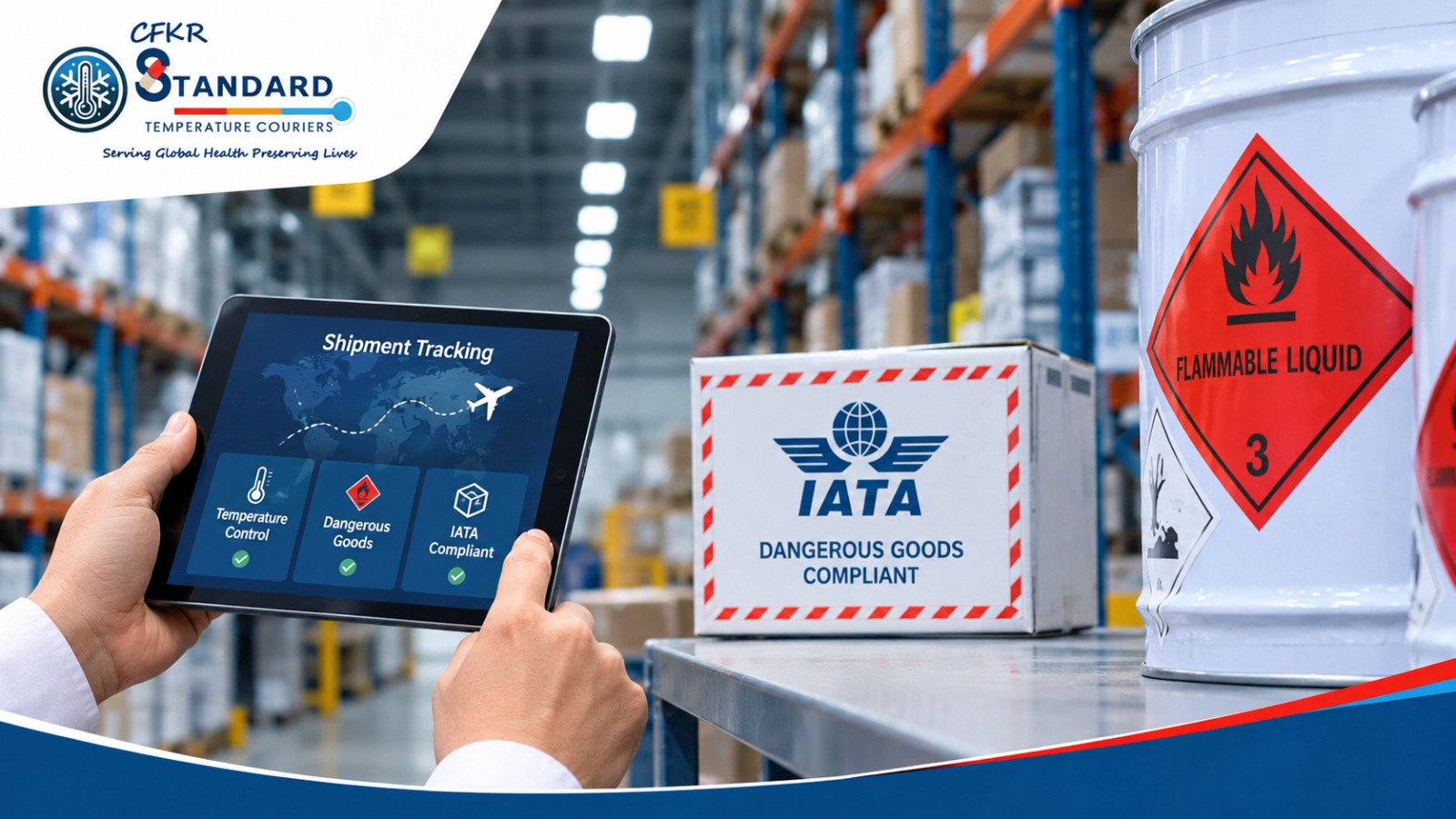
Shipping dangerous goods by air requires proper classification, packaging, labelling, documentation, and handling. A mistake at any stage can result in shipment rejection, transportation delays, additional costs, or safety risks.
For pharmaceutical companies, chemical manufacturers, biotechnology businesses, laboratories, and healthcare organisations, choosing the right dangerous goods shipping provider is an important part of international logistics.
Not every courier or freight forwarding company has the experience and operational capabilities required to handle regulated cargo. Businesses need a logistics partner that understands the applicable transportation regulations, has appropriately trained personnel, and can manage the documentation and handling requirements for their shipments.
If your business is planning to transport dangerous goods internationally, this guide explains how to identify an IATA-compliant shipping provider, what to verify before booking, and how to compare different logistics companies.
What Is an IATA-Compliant Dangerous Goods Shipping Provider?
An IATA-compliant dangerous goods shipping provider is a logistics company that can manage air shipments of dangerous goods in accordance with the applicable IATA Dangerous Goods Regulations (DGR), along with relevant national, international, and airline requirements.
IATA stands for the International Air Transport Association. Its Dangerous Goods Regulations provide requirements and guidance for the safe transportation of hazardous materials by air.
These regulations cover several areas, including:
Classification of dangerous goods
Packaging requirements
Package marking and labelling
Shipping documentation
Handling and storage
Training and responsibilities
Restrictions on dangerous goods transportation
A logistics provider handling dangerous goods should understand these requirements and have suitable processes to check shipments before offering them to an airline.
It is important to understand that IATA DGR compliance does not automatically mean a company holds a general IATA certification. Businesses should verify the actual training credentials, operational capabilities, and approvals relevant to the service being offered.
Which Products Require Dangerous Goods Shipping Services?
Dangerous goods include substances and articles that may create risks to people, property, or the environment during transportation.
The classification depends on the material’s properties and the applicable transportation regulations.
Some common categories include:
| Dangerous goods category | Examples |
|---|---|
| Class 1: Explosives | Certain explosive substances and articles |
| Class 2: Gases | Compressed, liquefied and certain other gases |
| Class 3: Flammable liquids | Certain solvents and flammable liquid chemicals |
| Class 4: Flammable solids | Certain reactive and self-reactive substances |
| Class 5: Oxidising substances | Oxidising agents and organic peroxides |
| Class 6: Toxic and infectious substances | Certain toxic chemicals and infectious substances |
| Class 7: Radioactive material | Radioactive substances used in approved industrial and medical applications |
| Class 8: Corrosive substances | Certain acids and alkaline materials |
| Class 9: Miscellaneous dangerous goods | Dry ice and other regulated materials not covered by the other classes |
Not every product within these broad categories has identical transportation requirements. Some goods may be forbidden, restricted, or permitted only under specific conditions.
The correct classification must be established before arranging transportation.
How to Find an IATA-Compliant Dangerous Goods Shipping Provider
Finding the right provider requires more than comparing shipping prices. You need to check the company’s experience, training, documentation process, packaging capabilities, and transportation network.
Here are the important factors to consider before selecting a logistics partner.
1. Check Experience in Dangerous Goods Transportation
Start by reviewing the company’s experience in handling dangerous goods.
A general courier company may have experience with regular parcels but may not have the resources or trained personnel required for regulated hazardous cargo.
Ask the provider about its experience with your specific product category.
For example, a pharmaceutical company shipping regulated biological substances may require different handling arrangements from a chemical manufacturer transporting flammable liquids.
Check whether the provider has experience with:
Pharmaceutical and biopharmaceutical shipments
Chemicals and laboratory reagents
Biological substances
Radioactive materials, where authorised
Temperature-sensitive dangerous goods
International air cargo transportation
Ask for relevant service examples and references where available.
2. Verify Dangerous Goods Training and Staff Competency
Personnel involved in dangerous goods transportation must have the training and competency required for their assigned responsibilities.
This is an important factor when evaluating a shipping provider.
Ask the company:
Are the employees involved in dangerous goods handling appropriately trained?
Is the training relevant to their assigned responsibilities?
How frequently is training reviewed and updated?
Who checks dangerous goods documentation before dispatch?
Who is responsible for package inspection and shipment acceptance?
IATA has established Dangerous Goods Regulations training programmes covering the responsibilities and tasks involved in preparing and transporting dangerous goods by air.
Training requirements depend on the role performed by each person in the transportation process.
Do not rely only on a general statement that a company is IATA trained. Ask for relevant training evidence and confirm that the personnel handling your shipment have the required competencies.
3. Check Compliance With the Latest IATA Dangerous Goods Regulations
Dangerous goods transportation requirements can change. Therefore, the logistics provider should work with the applicable current edition of the IATA DGR.
Before selecting a company, ask how it manages regulatory updates and checks whether shipments meet the applicable requirements.
The provider should understand the relevant requirements for:
Dangerous goods classification
Packing instructions
Quantity limitations
Package specifications
Hazard labels and markings
Shipper’s Declaration
Air Waybill requirements
Airline-specific variations
Also check whether the provider considers the destination country’s requirements and the operating airline’s additional restrictions.
Airlines may impose requirements beyond the general regulations and may refuse to carry certain dangerous goods.
4. Evaluate Dangerous Goods Packaging Capabilities
Packaging is one of the most important parts of dangerous goods transportation.
The package must be suitable for the specific material and comply with the applicable packing instructions.
Depending on the shipment, requirements may include approved UN specification packaging, suitable inner packaging, absorbent materials, cushioning, and other protective components.
Before booking, ask the provider:
Can you arrange the required dangerous goods packaging?
Do you work with approved packaging suppliers?
Can you check package specifications?
Can you support the required labelling and marking?
Can you manage special packaging requirements for temperature-sensitive cargo?
For pharmaceutical and biotechnology shipments, additional thermal protection may also be required.
The packaging must satisfy both the dangerous goods requirements and the product’s specific transportation conditions.
5. Review Documentation and Shipment Preparation Procedures
Incorrect or incomplete documentation can delay dangerous goods shipments.
A professional logistics provider should have a clear process for reviewing shipment information before it is presented to the airline.
Depending on the shipment, documents may include:
Safety Data Sheet (SDS)
An SDS provides information about a substance’s properties, hazards, handling, and safety requirements. It can help the shipper and logistics provider understand the material.
However, an SDS should not automatically be treated as the final transport classification. IATA places responsibility for correct dangerous goods classification on the shipper, who should obtain the correct information from the manufacturer, distributor, or an appropriate technical source.
Dangerous Goods Declaration (DGD)
The Shipper’s Declaration for Dangerous Goods certifies that the consignment has been prepared in accordance with the applicable requirements. It must be completed by the appropriate shipper or authorised party.
Air Waybill (AWB)
The Air Waybill records important shipment and transportation details.
Commercial Invoice and Packing List
These documents provide information about the goods, shipment value, quantity, and package details, where applicable.
Other supporting documents
Depending on the product and destination, additional permits, licences, certificates, or regulatory documents may be necessary.
Before confirming the booking, ask the provider who will review the documents and how discrepancies will be resolved.
6. Check the Company’s International Shipping Network
International dangerous goods transportation involves multiple parties, including the shipper, freight forwarder, ground handling agents, airlines, and destination-side service providers.
A logistics company should understand the transportation requirements at both the origin and destination.
Check the following:
Countries and destinations covered
Available airline connections
Transit time estimates
Customs clearance support
Destination handling arrangements
Local delivery capabilities
Restrictions on specific dangerous goods
A company with an international logistics network may help coordinate different stages of the shipment.
However, confirm that its network supports your particular product category. Not every airline or destination accepts every type of dangerous goods shipment.
7. Confirm Temperature-Controlled Transportation Options
Some dangerous goods, particularly pharmaceutical and biological products, also require temperature-controlled transportation.
In such cases, the provider must manage both the dangerous goods requirements and the product’s temperature requirements.
Ask whether the company can arrange:
Temperature-controlled packaging
Insulated shipping containers
Dry ice shipments, where permitted
Liquid nitrogen or cryogenic transportation, where authorised
Temperature data loggers
Temperature monitoring reports
Special handling arrangements
The packaging and transportation method must be suitable for the material being shipped.
For example, a pharmaceutical product requiring refrigerated transportation may need a qualified thermal packaging system in addition to dangerous goods-compliant packaging.
Do not assume that a standard refrigerated shipment arrangement is suitable for every dangerous goods category.
8. Review Shipment Tracking and Communication
Shipment visibility is important when transporting regulated materials internationally.
Before selecting a provider, understand how it monitors shipment progress and communicates with customers.
Ask whether the company provides:
Shipment tracking
Pickup and dispatch confirmation
Transit updates
Estimated delivery information
Exception notifications
Delivery confirmation
Temperature monitoring records, where applicable
You should also have a clear contact person for shipment-related queries.
If there is a delay, documentation issue, or airline rejection, the provider should explain the reason and the steps required to resolve it.
9. Compare Pricing and Service Inclusions
Dangerous goods transportation can involve additional operational and documentation requirements compared with standard cargo.
The quotation should clearly explain what is included in the service.
When comparing different providers, review the following cost components:
| Cost component | What to check |
|---|---|
| Freight charges | Air freight or other transportation charges |
| Dangerous goods handling | Applicable handling and processing fees |
| Packaging | Approved packaging and preparation costs |
| Documentation | Declaration and documentation support charges |
| Special handling | Temperature control or other specialised services |
| Customs clearance | Applicable clearance and handling charges |
| Destination charges | Local handling and delivery costs |
| Additional services | Storage, monitoring and other agreed services |
Request an itemised quotation instead of comparing only the total shipping price.
A lower quotation may exclude important services that another provider includes.
10. Ask About Insurance and Shipment Liability
Before booking, understand how the provider handles shipment damage, loss, delays, and transportation incidents.
Ask about:
Cargo insurance options
Insurance coverage limits
Exclusions for dangerous goods
Liability terms
Claims procedures
Responsibilities of the shipper and logistics provider
Insurance coverage depends on the policy and the type of goods being transported.
Do not assume that standard cargo insurance automatically covers all dangerous goods categories.
Review the policy wording and confirm coverage before dispatch.
Questions to Ask Before Hiring a Dangerous Goods Shipping Company
Before signing a contract or confirming an international shipment, ask the logistics provider these questions.
| Question | Why it matters |
|---|---|
| Do you handle my specific dangerous goods classification? | Confirms whether the provider can support the shipment |
| Are your relevant personnel appropriately trained? | Helps verify staff competency |
| Do you follow the current IATA DGR? | Checks regulatory processes |
| Can you arrange compliant packaging? | Confirms packaging support |
| Who reviews the Dangerous Goods Declaration? | Establishes documentation responsibility |
| Which airlines accept this type of cargo? | Confirms carrier availability |
| Do you support temperature-controlled shipments? | Checks special handling capabilities |
| Can you provide shipment tracking? | Establishes shipment visibility |
| What is included in the quotation? | Helps compare actual service costs |
| What happens if the airline rejects the shipment? | Clarifies exception handling |
Getting clear answers to these questions can help you avoid choosing a provider that does not have the capabilities required for your shipment.
Common Mistakes to Avoid When Selecting a Dangerous Goods Shipping Provider
Businesses can face unnecessary delays and additional costs when they select a logistics company without checking its operational capabilities.
Some common mistakes include:
Choosing a provider based only on price
Dangerous goods transportation requires specialised handling, documentation, and coordination. A low price does not confirm that the provider can meet the shipment requirements.
Assuming every IATA member is qualified to handle dangerous goods
Membership or general industry affiliation should not be treated as proof of dangerous goods handling competency. Verify the relevant training, experience, and operational procedures.
Ignoring airline-specific restrictions
Even when a shipment meets the general IATA DGR requirements, an airline may have additional restrictions or may decline the cargo.
Providing incomplete product information
The shipper should provide accurate product details and classification information. Missing or incorrect information can lead to shipment rejection.
Overlooking packaging requirements
Using ordinary packaging when specialised packaging is required can make a shipment unacceptable for transportation.
Not checking destination requirements
International shipments may be subject to additional national, customs, and import requirements. These should be checked before dispatch.
Why Choose CFKR STC Couriers for Dangerous Goods Transportation?
CFKR STC Couriers provides specialised logistics solutions for dangerous goods, pharmaceutical products, biotechnology shipments, and other sensitive materials.
The company focuses on transportation arrangements that consider shipment classification, packaging, documentation, and handling requirements.
Its dangerous goods transportation services are designed to support businesses that need assistance with regulated and sensitive cargo.
Dangerous Goods Transportation
CFKR STC Couriers offers transportation solutions for dangerous and sensitive materials, with attention to applicable transportation requirements and shipment handling procedures.
The service can be discussed according to the material being shipped, its classification, destination, and transportation requirements.
Pharmaceutical and Biopharmaceutical Logistics
For pharmaceutical and biotechnology businesses, CFKR STC Couriers provides specialised logistics solutions for temperature-sensitive shipments.
These services can support businesses that need coordinated transportation and appropriate packaging arrangements.
Packaging and Temperature-Controlled Solutions
The company highlights insulated packaging solutions using Phase Change Materials (PCM) and Vacuum Insulated Panels (VIP) technology.
Packaging requirements should be confirmed according to the product’s temperature range, shipment duration, and applicable dangerous goods regulations.
International Transportation
CFKR STC Couriers states that it has a logistics network covering more than 160 countries.
Businesses planning international dangerous goods shipments can discuss destination coverage, transportation routes, documentation, and handling requirements with the team.
If your company is looking for a dangerous goods shipping provider, contact CFKR STC Couriers to discuss your shipment details and request a tailored transportation solution.
Frequently Asked Questions
1. What is an IATA-compliant dangerous goods shipping provider?
An IATA-compliant dangerous goods shipping provider is a logistics company that has suitable processes, trained personnel, and operational capabilities to manage air shipments in accordance with applicable IATA Dangerous Goods Regulations and other relevant requirements.
2. How can I verify whether a dangerous goods shipping company follows IATA regulations?
Ask the company about its dangerous goods training, shipment classification process, packaging procedures, documentation checks, and experience with regulated cargo. You should also verify the relevant training records and operational capabilities.
3. Is IATA certification mandatory for dangerous goods shipping companies?
There is no single general IATA certification that automatically qualifies every logistics company to transport all dangerous goods. The relevant requirements depend on the company’s role, the services performed, and the applicable regulations. Personnel must meet the training and competency requirements relevant to their assigned responsibilities.
4. What documents are required for dangerous goods air transportation?
Documents may include a Safety Data Sheet, Dangerous Goods Declaration, Air Waybill, commercial invoice, packing list, and applicable permits or supporting certificates. Requirements depend on the dangerous goods classification, shipment, airline, and destination.
5. Can dangerous goods be shipped internationally by air?
Yes, many dangerous goods can be transported internationally by air when they meet the applicable classification, packaging, quantity, labelling, documentation, and carrier requirements. Some substances are forbidden or subject to additional restrictions.
6. What is the IATA Dangerous Goods Declaration?
The Dangerous Goods Declaration is a document used by the shipper to certify that the dangerous goods consignment has been prepared in accordance with the applicable IATA Dangerous Goods Regulations. It must be completed by the appropriate responsible party.
7. How much does international dangerous goods shipping cost?
The cost depends on the dangerous goods classification, shipment weight, dimensions, destination, packaging, airline charges, documentation, and special handling requirements. Request an itemised quotation based on the actual shipment details.
8. Can pharmaceutical products classified as dangerous goods be shipped using temperature-controlled packaging?
Yes, subject to the product’s classification, packaging requirements, temperature specifications, and applicable transportation regulations. The packaging arrangement must meet both the dangerous goods requirements and the product’s temperature-control needs.
9. What should I check before booking a dangerous goods courier?
Check the company’s experience, staff training, packaging support, documentation procedures, destination coverage, airline arrangements, shipment tracking, and pricing. Also confirm that it handles your specific dangerous goods classification.
10. How can I request a dangerous goods shipping quotation from CFKR STC Couriers?
Contact CFKR STC Couriers through its website and share the product description, dangerous goods classification, shipment weight, dimensions, pickup location, destination, and required delivery timeline. The team can review the requirements and discuss the available transportation options.
Find the Right Dangerous Goods Shipping Partner
Selecting a dangerous goods shipping provider requires careful evaluation of its training, regulatory knowledge, packaging capabilities, documentation procedures, and international transportation network.
Before booking, confirm that the company can handle your specific material and meet the applicable transportation requirements.
CFKR STC Couriers provides specialised logistics solutions for dangerous goods, pharmaceuticals, biotechnology products, and other sensitive shipments.
If you are planning an international dangerous goods shipment, contact CFKR STC Couriers to discuss your requirements and request a transportation quotation.
Contact CFKR STC Couriers
Website: https://www.stccouriers.com/
Contact the team to discuss your dangerous goods transportation requirements.