
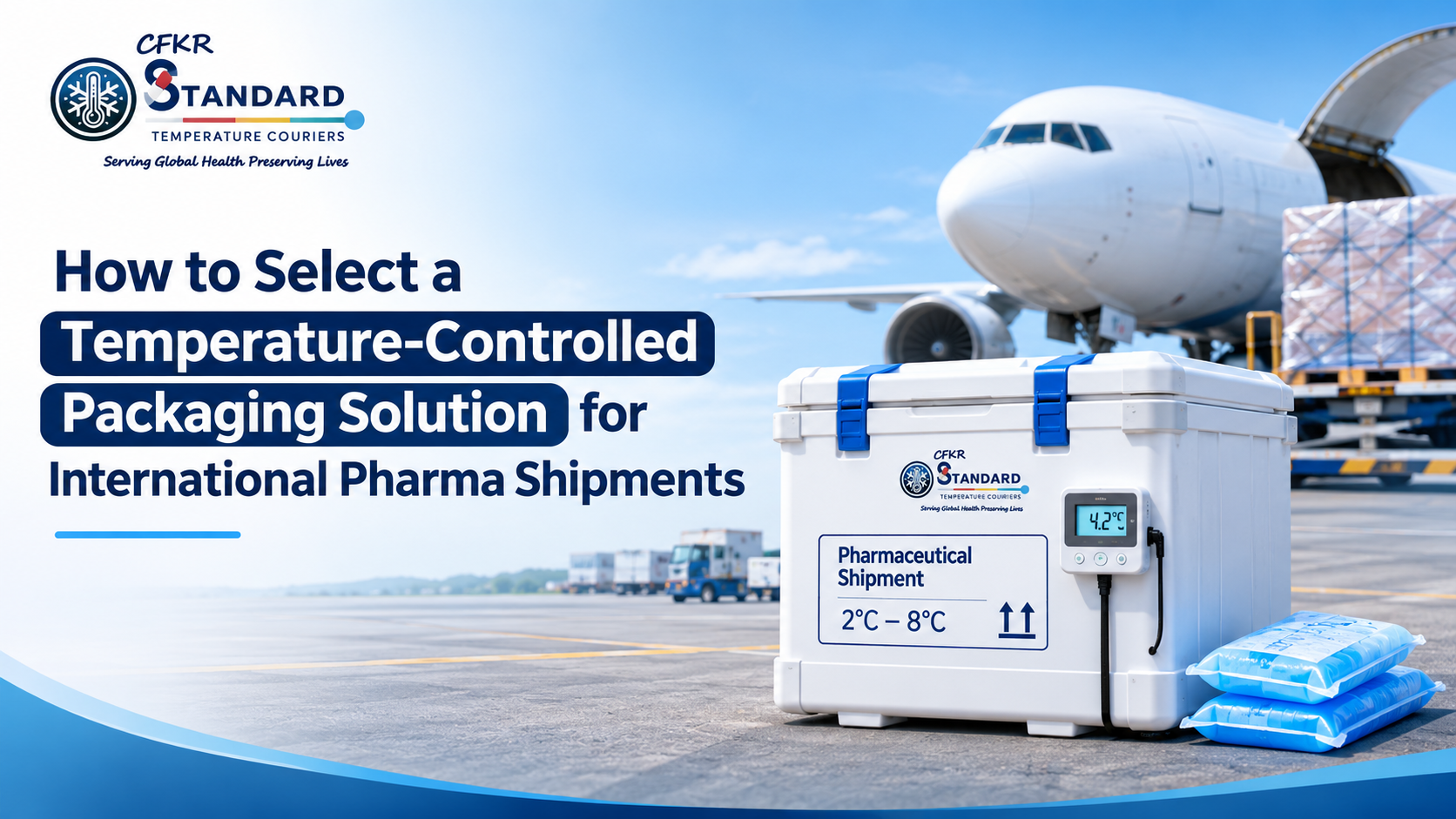
International pharmaceutical shipments require careful planning, reliable packaging, and continuous temperature management. Unlike regular commercial shipments, pharmaceutical products can be sensitive to temperature changes during transportation. Exposure to unsuitable conditions can affect product stability, quality, and usability.
When medicines, vaccines, biological samples, and other temperature-sensitive products travel across international borders, they may pass through multiple airports, warehouses, customs facilities, and transportation networks. Each transfer introduces the possibility of delays or temperature fluctuations.
Selecting the right temperature-controlled packaging solution is therefore an important decision for pharmaceutical manufacturers, biotechnology companies, and healthcare organizations.
The packaging must maintain the required temperature throughout the expected transportation period, protect the product during handling, and perform under different environmental conditions.
However, not every packaging solution is suitable for every pharmaceutical shipment. The right choice depends on the product’s temperature requirements, transportation duration, shipping route, packaging configuration, and handling conditions.
This guide explains how businesses can evaluate and select a suitable temperature-controlled packaging solution for international pharmaceutical shipments.
1. What Is Temperature-Controlled Packaging in Pharmaceutical Logistics?
Temperature-controlled packaging refers to specialized packaging systems designed to maintain a defined temperature range for products during storage and transportation.
These systems protect temperature-sensitive pharmaceutical products from external temperature changes throughout the shipping process.
Unlike standard packaging, temperature-controlled packaging uses insulation, refrigerants, thermal materials, and sometimes active temperature-control equipment to maintain suitable internal conditions.
Pharmaceutical shipments may require different temperature ranges depending on the product.
Common examples include:
Controlled room temperature products.
Refrigerated pharmaceutical products.
Frozen medicines and biological materials.
Ultra-low-temperature products.
Cryogenic biological materials.
The packaging solution must be selected according to the manufacturer’s specified storage and transportation conditions.
For international shipments, packaging must also account for transportation duration, airport handling, customs clearance, transfer delays, and the environmental conditions expected along the route.
A packaging system that performs well during a short domestic shipment may not provide sufficient protection during a multi-day international journey.
2. Why Is the Right Packaging Important for International Pharma Shipments?
International pharmaceutical transportation involves several stages. Products may move between manufacturing facilities, distribution centres, airports, customs warehouses, and healthcare destinations before reaching their final location.
During this process, shipments may experience changes in external temperature, handling conditions, and transportation schedules.
The right packaging helps protect products throughout these stages.
Maintaining Required Temperature Conditions
Pharmaceutical products must remain within their specified temperature ranges during transportation.
A suitable packaging system uses insulation and appropriate cooling materials to reduce the impact of external temperature changes.
This is particularly important for vaccines, biologics, injectable medicines, and other temperature-sensitive products.
Protecting Products During Long-Distance Transportation
International shipments may take longer than expected due to flight schedules, customs inspections, connecting flights, or operational delays.
Packaging must be designed around the expected shipping duration and include an appropriate protection margin.
Selecting packaging based only on the planned flight duration can create problems if the shipment remains in transit or temporary storage for longer than expected.
Reducing Temperature Excursion Risks
A temperature excursion occurs when a product is exposed to conditions outside its specified temperature range.
Temperature excursions can happen because of insufficient insulation, incorrect refrigerant placement, packaging failures, or unexpected transportation delays.
The right packaging configuration helps reduce these risks and supports better temperature management.
Supporting Product Quality and Regulatory Requirements
Pharmaceutical companies must maintain suitable storage and transportation conditions according to product specifications and applicable regulations.
Temperature-controlled packaging supports these requirements by helping maintain environmental conditions and providing a suitable system for transporting sensitive products.
However, packaging alone does not establish regulatory compliance. Businesses must also consider qualification, monitoring, documentation, handling procedures, and the quality systems governing the shipment.
3. Understand Your Pharmaceutical Product’s Temperature Requirements
The first step in selecting a packaging solution is understanding the product being shipped.
Different pharmaceutical products have different temperature requirements. Using the wrong packaging configuration can expose products to freezing, overheating, or other unsuitable conditions.
Before selecting a packaging system, review the product’s stability information and approved storage and transportation requirements.
Controlled Room Temperature Shipments
Some pharmaceutical products require controlled room temperature conditions.
These shipments may need insulated packaging to reduce exposure to extreme external temperatures during transportation.
The packaging configuration should consider the expected external temperature, transit duration, and handling conditions.
Refrigerated Pharmaceutical Shipments
Many pharmaceutical products require refrigerated transportation.
These shipments commonly use insulated containers with qualified refrigerants designed to maintain the required temperature range.
The number, type, and placement of refrigerants must be determined through suitable packaging design and qualification.
Frozen Pharmaceutical Shipments
Certain medicines and biological products require frozen transportation conditions.
These shipments may need specialized insulation and frozen refrigerants, depending on the required temperature range and transportation duration.
Packaging must also be designed to prevent unintended exposure to temperatures below the product’s permitted limits.
Ultra-Low-Temperature Shipments
Some advanced pharmaceutical and biological products require ultra-low-temperature transportation.
These shipments need specialized packaging systems designed for the required temperature range and expected transportation duration.
The selection process should include an assessment of insulation performance, cooling capacity, monitoring requirements, and handling procedures.
Cryogenic Shipments
Certain cell and gene therapy materials and biological products require cryogenic transportation.
These shipments may use specialized cryogenic containers or liquid nitrogen dry shippers.
Cryogenic transportation requires specific operational procedures, suitable equipment, and trained personnel. Standard refrigerated packaging should not be treated as a replacement for cryogenic shipping systems.
4. Compare Active and Passive Temperature-Controlled Packaging
One of the most important decisions when selecting pharmaceutical packaging is choosing between active and passive temperature-controlled systems.
Both solutions are used in pharmaceutical logistics, but they operate differently.
Active Temperature-Controlled Packaging
Active packaging systems use powered equipment to regulate internal temperature.
Depending on the system, they may include refrigeration units, heating elements, sensors, and automated temperature-control mechanisms.
These systems can maintain defined temperature conditions through longer transportation periods when appropriately configured and operated.
Advantages of active packaging:
Active temperature regulation.
Suitable for selected long-distance shipments.
Temperature settings can be controlled.
Monitoring and control features may be integrated.
Useful for shipments requiring specific environmental management.
Limitations to consider:
Higher equipment and transportation costs.
Power or battery requirements.
Equipment handling and maintenance requirements.
Availability and operational restrictions on certain routes.
Additional planning for international transportation.
Active systems may be suitable for high-value pharmaceutical shipments, certain large-volume shipments, and transportation routes with demanding temperature-control requirements.
Passive Temperature-Controlled Packaging
Passive packaging systems maintain internal temperatures through insulation and thermal materials without continuous powered refrigeration.
They commonly use insulated containers, phase change materials, gel packs, refrigerants, and other thermal components.
The packaging is designed to maintain the required temperature for a defined period under specified conditions.
Advantages of passive packaging:
No continuous external power requirement.
Easier handling across different transportation stages.
Suitable for various shipment sizes.
Can be designed for specific temperature ranges.
Often practical for international air freight and courier shipments.
Limitations to consider:
Performance depends on the packaging configuration.
Protection is limited by the qualified duration.
Incorrect refrigerant placement can affect performance.
Packaging may require additional space and weight.
Unexpected delays can exceed the designed protection period.
Passive packaging is widely used for pharmaceutical shipments where the packaging configuration can maintain the required conditions throughout the planned transportation period.
Active vs. Passive Packaging: Which Should You Choose?
| Comparison | Active Packaging | Passive Packaging |
|---|---|---|
| Temperature control | Powered temperature regulation | Insulation and thermal materials |
| Power requirement | Usually required | Not required for temperature maintenance |
| Shipment duration | Depends on equipment capacity | Depends on qualified thermal performance |
| Maintenance | Equipment maintenance required | Packaging inspection and preparation |
| Initial cost | Generally higher | Varies by packaging design |
| Best suited for | Selected complex or long-duration shipments | Qualified shipments across defined temperature ranges |
The right choice depends on the product, route, shipping duration, shipment size, and operational requirements.
There is no single packaging solution that works for every pharmaceutical shipment.
5. Evaluate the International Shipping Route and Transit Duration
Transportation duration is one of the most important factors when selecting temperature-controlled packaging.
A pharmaceutical shipment travelling between two major international airports may have a relatively short flight duration. However, the complete shipping process includes more than time spent in the aircraft.
Businesses should calculate the total expected time from packaging preparation to final delivery.
Consider the following stages:
Packaging and dispatch: Time required to prepare the shipment, condition refrigerants, pack the product, and complete dispatch documentation.
Airport handling: Time spent during acceptance, screening, loading, unloading, and temporary storage.
Flight duration: Time spent travelling between departure and arrival airports.
Customs clearance: Time required for import documentation, inspections, and release procedures.
Transfer and transit: Additional time required when shipments move through connecting airports or logistics facilities.
Final delivery: Time required to transport the shipment from the destination airport to the receiving facility.
For example, a shipment with a planned transportation duration of 24 hours may require a packaging system qualified for a longer period to account for potential delays.
The required protection duration should be based on a realistic assessment of the route, historical transit performance, seasonal conditions, and contingency requirements.
A reliable logistics provider should help businesses evaluate these factors before finalizing the packaging configuration.
6. Check Packaging Qualification and Validation
Packaging qualification is an important part of pharmaceutical transportation.
A packaging solution should not be selected only because it is insulated or has been used for other shipments.
Businesses need evidence that the packaging configuration can maintain the required temperature conditions under defined transportation and environmental conditions.
Thermal Performance Testing
Thermal testing evaluates how a packaging system performs under specified external temperature conditions.
The testing should consider the intended product temperature range, shipment duration, refrigerant configuration, and expected transportation environment.
Summer and Winter Testing
International shipments may travel through regions with significantly different seasonal temperatures.
Packaging performance should be evaluated under relevant hot and cold external conditions.
A system qualified for one environmental profile should not automatically be assumed suitable for another.
Packaging Configuration Testing
The complete packaging configuration matters.
This includes:
Insulated container.
Refrigerant type and quantity.
Refrigerant placement.
Product arrangement.
Internal packaging.
Temperature monitoring devices.
Packing procedures.
Changing any of these elements may affect the performance of the packaging system.
Documentation and Qualification Records
Businesses should request relevant qualification documentation from their packaging supplier or logistics provider.
This may include thermal performance reports, test conditions, packing instructions, qualification results, and approved configuration details.
These records help quality teams evaluate whether the packaging solution is suitable for the intended shipment.
7. Consider Temperature Monitoring and Data Logging
Selecting suitable packaging is only one part of pharmaceutical cold chain management.
Businesses also need a way to monitor and review the temperature conditions experienced by their shipments.
Temperature data loggers and monitoring devices provide information about the conditions inside the shipment during transportation.
Before selecting a packaging solution, consider how temperature monitoring will be managed.
Temperature Data Loggers
Data loggers record temperature readings at defined intervals.
They can help businesses review temperature history after the shipment reaches its destination.
For international pharmaceutical transportation, data loggers should be selected according to the required measurement range, accuracy, calibration status, recording interval, and data retrieval method.
Real-Time Temperature Monitoring
Some shipments may require real-time monitoring.
Connected monitoring devices can transmit temperature information during transportation, allowing authorized teams to review shipment conditions remotely.
Depending on the device and route, connectivity may not be available throughout every stage of international transportation.
Businesses should understand how the monitoring system handles communication gaps and stores data when a network connection is unavailable.
Temperature Excursion Alerts
Monitoring systems can be configured to identify readings outside specified limits.
Alerts help logistics teams investigate potential problems and follow the relevant corrective procedures.
However, an alert does not automatically mean a product is damaged. The product’s quality team must evaluate the temperature history, exposure duration, and product stability information before making a decision.
Shipment Documentation
Temperature records should be reviewed as part of the shipment documentation process.
Businesses should ensure that temperature data can be accessed, retained, and reviewed when required.
This supports traceability, quality investigations, and internal compliance procedures.
8. Evaluate Packaging Materials and Insulation Performance
The materials used in temperature-controlled packaging directly affect its thermal performance.
Businesses should evaluate the insulation material, refrigerants, container design, and packaging configuration before selecting a solution.
Insulated Packaging
Insulated containers reduce the rate at which external temperatures affect the products inside.
Common materials include expanded polystyrene, polyurethane, and other specialized insulation materials.
The selection should consider insulation performance, shipment weight, dimensions, handling requirements, and transportation duration.
Phase Change Materials
Phase change materials (PCMs) are designed to absorb or release thermal energy during a change of physical state.
They can help maintain a defined temperature range when properly selected and conditioned.
Different PCMs have different phase transition temperatures, so businesses must select materials appropriate for the product’s requirements.
Gel Packs and Refrigerants
Gel packs and other refrigerants are commonly used in passive temperature-controlled packaging.
Their performance depends on the material, conditioning process, quantity, and placement inside the container.
Incorrect preparation or placement can result in inadequate cooling or unintended freezing.
Vacuum Insulated Panels
Vacuum insulated panels provide high thermal resistance in relatively thin packaging structures.
They may be useful when shipment dimensions and insulation performance are important considerations.
However, their suitability depends on the packaging design, handling conditions, and cost requirements.
The packaging material should be evaluated as part of the complete system rather than selected independently.
9. Check International Shipping Regulations and Packaging Requirements
International pharmaceutical shipments must meet applicable transportation, product handling, and regulatory requirements.
Packaging selection should account for the destination country, product classification, transportation method, and applicable documentation.
Good Distribution Practice (GDP)
Good Distribution Practice provides principles for maintaining the quality and integrity of medicinal products throughout the distribution process.
GDP-related expectations include suitable transportation conditions, temperature monitoring, documentation, risk management, and appropriate handling procedures.
Businesses should assess whether their logistics provider has quality systems and operational procedures appropriate to the applicable GDP requirements.
IATA Requirements for Air Transportation
International pharmaceutical shipments frequently travel by air.
Businesses should evaluate applicable airline acceptance conditions, cargo handling requirements, packaging specifications, and any relevant dangerous goods requirements.
Certain products and materials may require additional documentation and specialized handling.
Import and Export Documentation
International pharmaceutical shipments may require commercial invoices, packing lists, product documentation, permits, and other country-specific import or export documents.
The exact requirements depend on the product and destination.
Incorrect or incomplete documentation can delay customs clearance and increase the time a shipment remains in transit.
Packaging and Environmental Considerations
Businesses should also evaluate the packaging system’s compliance with relevant transportation requirements and environmental considerations.
Where applicable, packaging should be suitable for handling, storage, and disposal requirements along the transportation route.
Regulatory requirements vary by product, country, and shipping method. Businesses should confirm the latest applicable requirements before dispatch.
10. Assess Packaging Size, Weight, and Shipping Costs
Packaging selection also affects international shipping costs.
Temperature-controlled packaging can increase the overall shipment dimensions and weight. This may affect air freight charges, handling costs, and transportation capacity.
Businesses should evaluate the total shipping cost rather than comparing packaging prices alone.
Important cost factors include:
Packaging purchase or rental cost: The initial cost of acquiring the insulated container or temperature-controlled equipment.
Packaging weight: Additional packaging weight can increase transportation charges.
Dimensional weight: Large insulated containers may attract higher freight charges even when the actual product weight is low.
Refrigerant requirements: The quantity and type of thermal materials affect packaging costs.
Monitoring equipment: Temperature data loggers and real-time monitoring devices may add to shipment expenses.
Qualification and testing: Packaging qualification and thermal performance testing involve additional costs.
Reverse logistics: Reusable packaging may require collection, inspection, cleaning, and return transportation.
A packaging system with a lower purchase price may not always provide the lowest overall shipping cost.
Businesses should compare packaging performance, transportation charges, product protection, and operational requirements before making a decision.
11. Common Mistakes to Avoid When Selecting Pharmaceutical Packaging
Selecting packaging without evaluating the complete transportation process can create unnecessary risks.
Here are some common mistakes businesses should avoid.
Choosing Packaging Based Only on Price
Low-cost packaging may not provide sufficient thermal protection for long-distance transportation.
Businesses should evaluate packaging performance, qualification records, and suitability before comparing prices.
Ignoring Customs and Airport Delays
Packaging designed only for the planned flight duration may not provide sufficient protection during customs clearance or unexpected delays.
The complete transportation journey should be considered.
Using the Same Packaging for Every Product
Different pharmaceutical products have different temperature requirements.
A packaging system suitable for refrigerated medicines may not be appropriate for frozen products or cryogenic materials.
Not Checking Packaging Qualification
Businesses should not assume that an insulated container can maintain a particular temperature range without supporting performance evidence.
The complete packaging configuration should be evaluated.
Ignoring Temperature Monitoring
Packaging without suitable monitoring can make it difficult to establish the temperature conditions experienced during transportation.
Businesses should determine the appropriate monitoring and documentation requirements before dispatch.
Poor Refrigerant Conditioning
Incorrect refrigerant preparation or placement can affect the internal temperature of the packaging system.
Packing teams should follow approved packing instructions and procedures.
Not Having a Contingency Plan
International transportation can involve unexpected delays, route changes, and operational disruptions.
Businesses should establish procedures for investigating delays, temperature excursions, and other shipment-related issues.
12. How to Choose the Right Temperature-Controlled Packaging Provider
Selecting the packaging system is important, but choosing the right packaging and logistics partner is equally important.
A suitable provider should understand pharmaceutical transportation requirements and be able to support the packaging process from preparation to final delivery.
Before selecting a provider, evaluate the following factors.
Pharmaceutical Logistics Experience
Check whether the provider has experience handling pharmaceutical products, biological samples, and other temperature-sensitive shipments.
Industry experience helps teams understand product handling requirements and transportation challenges.
Validated Packaging Solutions
Ask whether the provider offers packaging solutions supported by appropriate qualification and thermal performance documentation.
The provider should be able to explain the intended temperature range, protection duration, and packaging configuration.
Temperature Monitoring Capabilities
Evaluate the provider’s temperature monitoring systems and data logging procedures.
Understand how temperature records are collected, stored, reviewed, and shared.
International Shipping Network
International pharmaceutical transportation involves coordination between multiple logistics partners.
Check the provider’s experience with international transportation, customs procedures, airport handling, and destination delivery.
Regulatory and Quality Processes
Review the provider’s quality management procedures, documentation practices, and relevant certifications.
Ask how temperature excursions, shipment delays, and product handling issues are investigated.
Packaging Customization
Different shipments may require different packaging configurations.
A provider should understand the product’s temperature requirements, shipment dimensions, transportation duration, and route conditions before recommending a packaging solution.
13. Why Choose CFKR STC Couriers for Pharmaceutical Packaging and Logistics?
Choosing the right temperature-controlled packaging solution requires an understanding of both packaging technology and pharmaceutical transportation.
CFKR STC Couriers provides specialized logistics solutions for pharmaceutical, biotechnology, and life sciences supply chains.
With more than 30 years of industry experience, STC focuses on temperature-controlled transportation, pharmaceutical logistics, packaging technology, and global distribution.
Validated Temperature-Controlled Packaging Solutions
STC Couriers offers packaging technology solutions for biological samples and bulk drug shipments.
The selection of packaging should consider product requirements, transportation duration, temperature range, and applicable handling conditions.
Cold Chain Logistics
STC provides cold chain logistics solutions for pharmaceutical and biotech shipments.
Its services support temperature-sensitive transportation requirements where product handling and shipment conditions are important.
Global Pharmaceutical Logistics
International pharmaceutical transportation requires coordination across different locations and transportation stages.
STC supports global logistics requirements for pharmaceutical and bioscience shipments.
Regulatory Compliance
Pharmaceutical transportation requires suitable quality procedures and documentation.
STC focuses on regulatory compliance and logistics processes for pharmaceutical, biotechnology, and clinical trial shipments.
Clinical Trial and Life Sciences Logistics
Clinical trial materials and biological samples require careful transportation planning.
STC provides specialized logistics solutions for clinical trial and life sciences supply chains.
Whether you are shipping pharmaceutical products, biological samples, or bulk drug materials, selecting the right packaging and transportation solution is essential.
Planning an international pharmaceutical shipment? Contact CFKR STC Couriers to discuss your temperature-controlled packaging and logistics requirements.
14. Final Checklist Before Selecting Temperature-Controlled Packaging
Before approving a packaging solution for international pharmaceutical transportation, businesses should review the following points.
| Evaluation criteria | What to check |
|---|---|
| Product temperature range | Confirm the manufacturer’s specified temperature requirements |
| Shipping duration | Calculate total transit time, including handling and customs |
| Packaging type | Evaluate active or passive packaging |
| Thermal performance | Review qualification and testing documentation |
| Insulation | Check suitability of insulation materials |
| Refrigerants | Confirm the correct material, quantity, and conditioning procedure |
| Monitoring | Evaluate data loggers and real-time monitoring requirements |
| International handling | Check airline, customs, and destination requirements |
| Shipment weight | Calculate actual and dimensional weight |
| Documentation | Maintain packaging, temperature, and shipment records |
| Contingency planning | Establish procedures for delays and temperature excursions |
| Logistics provider | Evaluate experience, infrastructure, and quality processes |
Reviewing these factors before dispatch helps businesses select a packaging system that meets product requirements and supports reliable international transportation.
Conclusion
Selecting the right temperature-controlled packaging solution is an important part of international pharmaceutical logistics.
The packaging must protect products against external temperature changes, support the required transportation duration, and maintain suitable conditions throughout the shipping process.
Businesses should evaluate product temperature requirements, transportation routes, packaging qualification, insulation materials, refrigerants, temperature monitoring, regulatory requirements, and overall shipping costs before selecting a solution.
Active and passive packaging systems offer different advantages, and the right choice depends on the shipment’s specific requirements.
However, packaging is only one part of the cold chain. Reliable transportation, proper handling, temperature monitoring, documentation, and experienced logistics teams are equally important.
CFKR STC Couriers supports pharmaceutical and life sciences businesses through cold chain logistics, validated temperature-controlled packaging solutions, global logistics, and regulatory-focused transportation services.
Looking for a pharmaceutical logistics partner for your international shipments? Get in touch with CFKR STC Couriers to discuss your packaging and temperature-controlled transportation requirements.
Frequently Asked Questions
1. What is the best temperature-controlled packaging for international pharmaceutical shipments?
The best packaging depends on the product’s temperature requirements, shipment duration, transportation route, and external environmental conditions. Businesses can choose between active and passive packaging systems based on their operational requirements and qualification evidence.
2. What is the difference between active and passive pharmaceutical packaging?
Active packaging uses powered equipment to regulate internal temperature. Passive packaging uses insulation and thermal materials, such as phase change materials and gel packs, to maintain a defined temperature range for a qualified period.
3. How long can temperature-controlled pharmaceutical packaging maintain the required temperature?
The protection duration depends on the packaging design, insulation materials, refrigerants, external temperature conditions, and shipment configuration. Businesses should review the packaging qualification results before using it for international transportation.
4. Why is packaging qualification important in pharmaceutical logistics?
Packaging qualification provides evidence that a particular packaging configuration can maintain the required temperature conditions under defined testing conditions. It helps businesses assess whether the system is suitable for the intended shipment.
5. Are temperature data loggers necessary for international pharmaceutical shipments?
Temperature data loggers help record shipment conditions during transportation. Their use should be determined by product requirements, applicable quality procedures, and regulatory expectations. They support temperature history reviews and investigations.
6. What are phase change materials in pharmaceutical packaging?
Phase change materials are thermal materials that absorb or release energy during a change of physical state. They are used in certain passive packaging systems to help maintain a defined temperature range.
7. How does international shipping affect pharmaceutical packaging selection?
International shipments may involve longer transportation times, multiple handling points, customs delays, and changing external temperatures. Packaging should be qualified for the expected transportation conditions and appropriate contingency duration.
8. What should businesses check before choosing a pharmaceutical packaging provider?
Businesses should evaluate pharmaceutical logistics experience, packaging qualification, temperature monitoring, documentation, international shipping capabilities, quality procedures, and the provider’s ability to support different product requirements.
9. Does CFKR STC Couriers provide temperature-controlled packaging solutions?
Yes. CFKR STC Couriers offers validated temperature-controlled packaging solutions for biological samples and bulk drug shipments, along with pharmaceutical cold chain and global logistics services.
10. How can I get a quote for international pharmaceutical transportation?
You can contact CFKR STC Couriers with details about your product, temperature requirements, shipment size, origin, destination, and expected shipping schedule to discuss suitable logistics and packaging solutions.
Contact CFKR STC Couriers
Website: https://www.stccouriers.com/
Phone: Contact the STC Couriers team through the website to discuss your shipment requirements.