
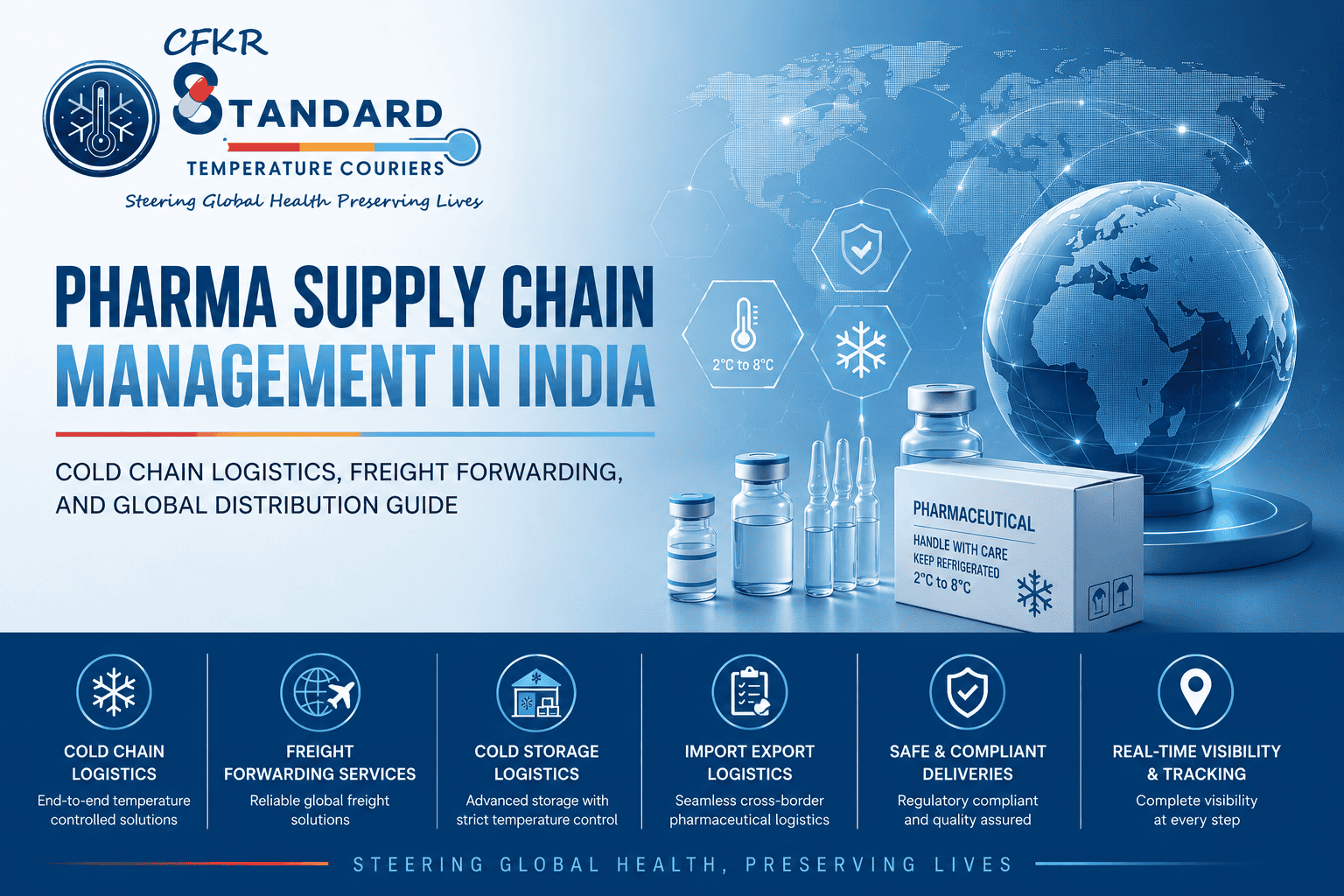
India has become one of the world’s most important pharmaceutical manufacturing hubs. The country supplies medicines, vaccines, active pharmaceutical ingredients, and healthcare products to more than 200 countries. However, manufacturing quality products is only one part of the equation. Getting those products safely and efficiently to their destination is equally important. This is where pharma supply chain management plays a critical role.
Pharmaceutical products are highly sensitive. Many require strict temperature control, regulatory compliance, secure handling, and real-time visibility throughout transit. A delay at customs, a storage issue, or a temperature excursion can compromise product quality and create significant financial losses. As pharmaceutical exports continue to grow, companies are increasingly investing in advanced logistics networks, cold chain infrastructure, and global transportation solutions to maintain product integrity from production to delivery.
Understanding Pharma Supply Chain Management
Pharma supply chain management refers to the complete process of sourcing, manufacturing, storing, transporting, and distributing pharmaceutical products. The goal is to ensure that medicines and healthcare products reach healthcare providers, distributors, pharmacies, and patients safely and on time.
Unlike traditional supply chains, pharmaceutical logistics operate under strict regulatory requirements. Every shipment must be tracked, documented, and handled according to industry standards. Product quality must remain intact throughout the journey regardless of transportation mode or destination.
The pharmaceutical supply chain typically includes raw material suppliers, manufacturers, warehouses, logistics providers, freight forwarders, distributors, hospitals, pharmacies, and end users. Every stakeholder plays an important role in maintaining efficiency and compliance.
Why Pharma Supply Chain Management Matters
The pharmaceutical industry directly impacts patient health. Any disruption in the supply chain can affect medicine availability and treatment outcomes. Efficient pharma supply chain management helps organizations reduce risks while ensuring uninterrupted product availability.
A strong supply chain improves inventory visibility, reduces product losses, minimizes transportation delays, supports regulatory compliance, and protects product quality. It also enables pharmaceutical companies to expand into international markets with confidence.
As demand for specialty medicines, biologics, vaccines, and clinical trial materials continues to increase, supply chain reliability has become a major competitive advantage.
Key Components of a Pharmaceutical Supply Chain
The pharmaceutical supply chain consists of several interconnected stages that must work together seamlessly.
The process begins with sourcing raw materials and active pharmaceutical ingredients from qualified suppliers. These materials are then transported to manufacturing facilities where medicines are produced under strict quality standards.
After manufacturing, products move into warehousing facilities where they are stored under controlled conditions. Once orders are received, shipments are prepared and transported through domestic or international logistics networks before reaching distributors, healthcare facilities, or pharmacies.
Every stage requires careful planning, monitoring, and documentation to ensure product integrity and compliance.
The Growing Importance of Cold Chain Logistics
Many pharmaceutical products cannot tolerate temperature fluctuations. Vaccines, insulin products, biologics, blood products, and specialty medicines often require transportation and storage within precise temperature ranges.
Cold chain logistics refers to the process of maintaining required temperatures throughout transportation and storage. This includes temperature-controlled packaging, refrigerated vehicles, monitoring systems, and specialized warehouses.
The importance of cold chain logistics has increased significantly in recent years as pharmaceutical innovation has led to more temperature-sensitive products entering the market.
The table below highlights common pharmaceutical temperature requirements.
| Product Category | Temperature Range | Examples |
|---|---|---|
| Controlled Ambient | 15°C to 25°C | Tablets and capsules |
| Refrigerated | 2°C to 8°C | Vaccines and biologics |
| Frozen | -20°C | Certain specialty medicines |
| Ultra-Low Temperature | Below -70°C | Advanced biologics and research products |
Maintaining these temperatures consistently helps ensure product safety and effectiveness.
Cold Chain Logistics India: Current Landscape
India’s pharmaceutical industry relies heavily on efficient cold chain logistics infrastructure. The country exports temperature-sensitive products across global markets while also serving a large domestic healthcare network.
However, cold chain logistics India faces unique challenges. Long transportation distances, varying climatic conditions, infrastructure gaps, and increasing demand for specialty medicines require continuous investment in logistics capabilities.
Modern logistics providers are addressing these challenges through temperature-controlled transportation, real-time monitoring systems, GPS tracking, validated packaging solutions, and advanced warehouse management technologies.
As pharmaceutical exports continue to rise, cold chain logistics is becoming an essential component of India’s healthcare supply chain ecosystem.
Cold Storage Logistics and Product Protection
Storage plays a crucial role in pharmaceutical logistics. Even if transportation conditions are maintained perfectly, inadequate storage can compromise product quality.
Cold storage logistics involves the use of temperature-controlled warehouses specifically designed for pharmaceutical products. These facilities include refrigeration systems, backup power supplies, environmental monitoring tools, and compliance documentation systems.
The difference between standard warehousing and pharmaceutical cold storage logistics is significant.
| Standard Warehouse | Pharmaceutical Cold Storage |
|---|---|
| General storage environment | Temperature-controlled environment |
| Basic inventory management | Continuous environmental monitoring |
| Limited compliance requirements | Strict regulatory compliance |
| Standard handling processes | Specialized pharmaceutical handling |
| Minimal temperature tracking | Real-time temperature recording |
Proper cold storage infrastructure helps pharmaceutical companies reduce product losses while maintaining compliance with industry regulations.
The Role of Freight Forwarding Services in Pharma Logistics
Global pharmaceutical distribution requires more than transportation alone. International shipments involve customs clearance, documentation management, carrier coordination, and regulatory compliance.
This is where freight forwarding services become essential.
Freight forwarders act as logistics coordinators who manage the movement of pharmaceutical products across international markets. They help ensure shipments reach their destinations efficiently while complying with local and international regulations.
For pharmaceutical companies, freight forwarding services often include route planning, customs support, shipment tracking, documentation management, carrier selection, and risk mitigation.
A reliable freight forwarding partner can help reduce delays, improve shipment visibility, and support regulatory compliance across complex international supply chains.
Import Export Logistics in the Pharmaceutical Sector
India is one of the world’s leading pharmaceutical exporters. As a result, import export logistics plays a critical role in maintaining global supply chain efficiency.
International pharmaceutical shipments must comply with multiple regulations across different countries. Documentation accuracy, customs procedures, packaging standards, and temperature requirements all affect shipment success.
Efficient import export logistics helps pharmaceutical companies expand into new markets while minimizing delays and compliance risks.
Organizations that invest in strong international logistics networks gain greater flexibility, improved delivery performance, and stronger customer relationships across global markets.
Common Challenges in Pharma Supply Chain Management
Despite technological advancements, pharmaceutical supply chains continue to face operational challenges.
Temperature excursions remain one of the most significant concerns. Even minor deviations can affect product quality and lead to product rejection.
Regulatory compliance requirements continue to evolve, creating additional complexity for pharmaceutical companies operating internationally.
Transportation disruptions caused by weather conditions, customs delays, infrastructure issues, or geopolitical events can impact delivery schedules and inventory availability.
Counterfeit medicines also remain a concern in certain markets, making traceability and shipment visibility increasingly important.
Addressing these challenges requires investment in technology, process optimization, and trusted logistics partnerships.
Technology Transforming Pharmaceutical Logistics
Technology is playing a major role in modern pharma supply chain management.
Real-time shipment tracking provides greater visibility throughout transportation. Internet of Things sensors continuously monitor temperature, humidity, and location data.
Cloud-based logistics platforms help organizations manage inventory, transportation, compliance documentation, and performance reporting from a single system.
Artificial intelligence is improving demand forecasting and route optimization, helping organizations reduce costs while improving service levels.
These technologies enable pharmaceutical companies to identify risks earlier and make faster operational decisions.
Best Practices for an Efficient Pharmaceutical Supply Chain
Successful pharmaceutical supply chains focus on visibility, compliance, quality control, and risk management.
Organizations should invest in validated transportation systems, qualified logistics partners, temperature monitoring technologies, and robust documentation processes.
Regular audits, staff training programs, and contingency planning also help strengthen supply chain resilience.
Most importantly, companies should work with logistics providers that understand the unique requirements of pharmaceutical transportation and temperature-sensitive shipments.
Conclusion
As India’s pharmaceutical industry continues to grow, efficient pharma supply chain management has become more important than ever. From manufacturing facilities and cold storage logistics to freight forwarding services and import export logistics, every stage of the supply chain contributes to product quality and patient safety.
Organizations that invest in reliable cold chain infrastructure, advanced monitoring technologies, and experienced logistics partners are better positioned to meet regulatory requirements and support global expansion.
For pharmaceutical companies seeking dependable transportation and temperature-controlled logistics solutions, experienced providers such as STC Couriers can help support safe, compliant, and efficient pharmaceutical distribution across domestic and international markets.
Frequently Asked Questions
What is pharma supply chain management?
Pharma supply chain management is the process of sourcing, manufacturing, storing, transporting, and distributing pharmaceutical products while maintaining quality, compliance, and product integrity.
Why is cold chain logistics important in pharmaceuticals?
Cold chain logistics helps maintain required temperatures for sensitive products such as vaccines, biologics, and specialty medicines, ensuring product safety and effectiveness.
What is the difference between cold chain logistics and cold storage logistics?
Cold chain logistics covers temperature-controlled transportation and storage, while cold storage logistics specifically focuses on temperature-controlled warehousing.
How do freight forwarding services support pharmaceutical companies?
Freight forwarding services manage international transportation, customs clearance, documentation, shipment tracking, and regulatory compliance.
What challenges affect pharmaceutical supply chains?
Common challenges include temperature excursions, regulatory compliance requirements, transportation delays, inventory visibility issues, and counterfeit product risks.
Why is import export logistics important for pharmaceutical companies?
Import export logistics enables pharmaceutical companies to move products across international markets while meeting customs and regulatory requirements.
How does technology improve pharmaceutical logistics?
Technology improves shipment visibility, temperature monitoring, inventory management, compliance tracking, and demand forecasting.
What products require cold chain logistics?
Vaccines, biologics, insulin products, blood products, specialty medicines, and clinical trial materials often require cold chain logistics.
How can pharmaceutical companies reduce supply chain risks?
Companies can reduce risks through real-time monitoring, qualified logistics partners, compliance management, contingency planning, and advanced tracking technologies.
What should companies look for in a pharmaceutical logistics provider?
Organizations should prioritize compliance expertise, temperature-controlled capabilities, shipment visibility, industry experience, and reliable transportation networks.