
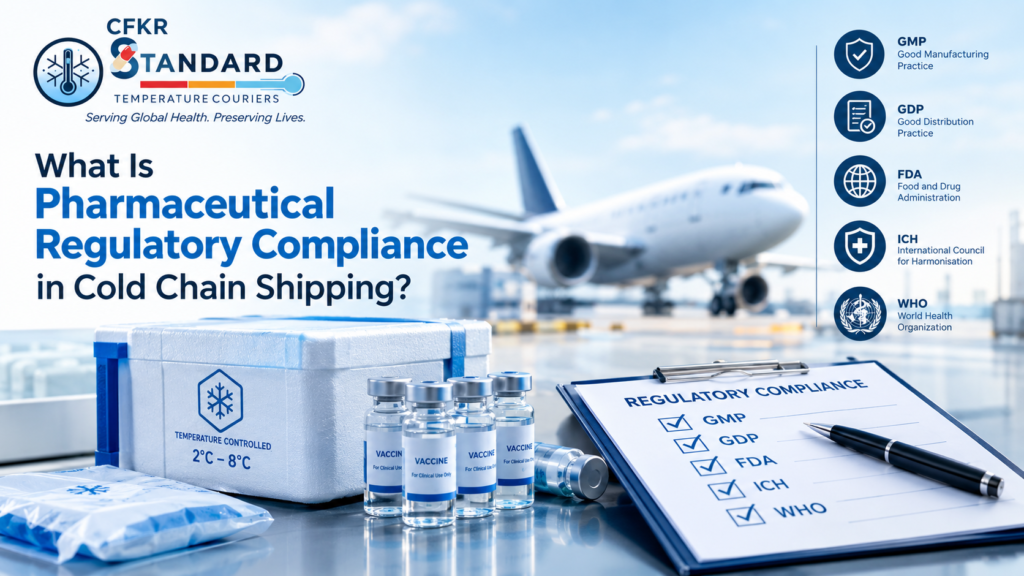
Pharmaceutical regulatory compliance in cold chain shipping is not a paperwork exercise you complete after a shipment leaves the warehouse. It is the difference between a batch of insulin reaching a hospital in usable condition and that same batch getting quarantined at a port because a temperature log has a gap in it. Every stakeholder in the chain, from the manufacturer to the last-mile courier, carries legal responsibility for keeping a medicinal product within its approved conditions from release to delivery. If you are evaluating a logistics partner for pharma, biotech, or clinical trial shipments right now, this article gives you the exact criteria regulators check and the questions you should be asking before you sign anything.
What Pharmaceutical Regulatory Compliance Actually Covers
Pharma regulatory compliance in logistics sits at the intersection of three obligations: product quality, legal documentation, and traceability. A shipment can fail an audit even when the medicine itself arrives physically intact, because inspectors are checking whether the process that moved it followed a documented, repeatable, and verifiable standard.
This means compliance covers temperature control during transit, the accuracy of customs and hazard classification, the completeness of shipping documentation, the training record of the personnel handling the product, and the ability to reconstruct the entire journey of a shipment on demand. A courier who delivers on time but cannot produce a validated temperature log, a signed chain-of-custody record, or proof of GDP training for the driver has not met the compliance bar, regardless of the delivery outcome.
For companies moving vaccines, biologics, active pharmaceutical ingredients, or clinical trial materials, this standard applies to every leg of the journey, including domestic transfers between warehouses and last-mile delivery to a hospital or trial site.
Why a Compliance Failure Costs More Than a Fine
A regulatory lapse in pharmaceutical logistics rarely stays contained to one shipment. When a temperature excursion goes undetected or a customs declaration is filed incorrectly, the consequences extend into the sponsor’s or manufacturer’s own license standing.
Regulators can suspend an import license, force a product recall, or place a facility under increased inspection frequency after repeated non-conformances traced back to distribution. For manufacturers running under India’s revised Schedule M, inspection activity has already intensified through late 2025 and into 2026 as the Central Drugs Standard Control Organisation moves state authorities toward stricter enforcement of GMP requirements across the supply chain, distribution included. A logistics failure that surfaces during one of these inspections becomes the manufacturer’s problem, not just the courier’s.
There is also a patient safety dimension that no compliance program can treat as secondary. A vaccine that spends four hours outside its approved 2 to 8 degree Celsius range may lose potency without any visible change, which is exactly why regulators demand continuous, validated monitoring rather than a visual check at delivery.
The commercial cost compounds quickly once a compliance issue surfaces publicly. Hospital networks, distributors, and clinical trial sponsors now run their own vendor audits before renewing a logistics contract, and a documented non-conformance from a regulator becomes part of that vendor file for years. Losing a long-term pharma client over a preventable documentation gap tends to cost far more than the investment needed to close that gap in the first place. Insurance underwriters covering cargo also price temperature-sensitive shipments differently once a provider has a history of excursions, which raises the operating cost of every future shipment, not just the one that failed.
The Regulatory Frameworks Every Pharma Shipment Has to Satisfy
CDSCO and the Revised Schedule M Standard
In India, the Central Drugs Standard Control Organisation sets the baseline for how pharmaceutical products must be manufactured, stored, and distributed under the Drugs and Cosmetics Act. The revised Schedule M brought Indian GMP requirements closer to WHO and international standards, adding explicit expectations around quality risk management, computerised systems, and lifecycle validation. CDSCO has been running phased compliance deadlines through 2025 and 2026, with inspections targeting manufacturers who delayed the upgrade. A distribution partner operating in this environment needs to understand how CDSCO’s regulatory framework intersects with transport, because a manufacturer’s own audit readiness now depends partly on the paper trail their logistics provider can produce.
WHO Good Distribution Practice
Good Distribution Practice, as laid out in WHO Technical Report Series Annex 5, is the reference framework most national regulators build on. GDP requires a documented quality system, risk assessment before storage or transport, calibrated and traceable monitoring equipment, and a formal process for investigating and closing out any deviation. It applies to every party in the distribution chain, not only the manufacturer, which is why logistics providers working in pharma are expected to hold their own GDP-aligned quality system rather than simply following instructions handed down to them.
FDA DSCSA for US-Bound Shipments
Shipments moving into or through the United States fall under the Drug Supply Chain Security Act. The law requires interoperable, electronic tracing of prescription drugs at the package level across every trading partner, with the final enforcement phase for smaller dispensers landing in November 2026. For a courier or freight forwarder, this means transaction data, chain-of-custody records, and verification responses need to be retrievable within a short window if the FDA or a trading partner requests them. Manual, paper-based tracking no longer satisfies this requirement.
EU GDP and IATA CEIV Pharma
Within the European Union, distribution of medicinal products is governed by the Guidelines on Good Distribution Practice of Medicinal Products for Human Use, published in the Official Journal, which set out wholesaler and transport obligations for storage, temperature mapping, and prevention of falsified medicines entering the legal supply chain. For air freight specifically, IATA’s CEIV Pharma certification has become the recognized benchmark for airlines, ground handlers, and freight forwarders handling temperature-sensitive pharma cargo, covering everything from packaging validation to staff competency.
What a GDP-Compliant Logistics Partner Has to Prove
Documentation and Chain of Custody
Every pharmaceutical shipment needs a complete paper and digital trail: pro-forma invoices, air waybills or consignment notes, dangerous goods declarations where applicable, and temperature records that match the shipment from pickup to delivery. Auditors do not accept reconstructed records after the fact. The documentation has to be generated in real time and stored in a way that can be produced within hours of a request. This is one of the areas covered under STC Couriers’ regulatory compliance expertise, where documentation handling is built into the standard operating procedure for every shipment rather than treated as an add-on service.
A Trained, Named Responsible Person
GDP and Schedule M both expect a designated Responsible Person, along with a trained deputy, who holds accountability for quality decisions related to distribution. This is not a job title assigned for the sake of an org chart. The person needs documented training against a recognized standard and the authority to quarantine a shipment or escalate a deviation without waiting for commercial sign-off.
Validated, Temperature-Mapped Packaging
Packaging has to be validated for the specific route, season, and duration of transit, not selected off a generic catalog. A shipment moving from Mumbai to a rural clinic in peak summer needs different thermal protection than the same product moving between two metro warehouses in winter. Validated packaging technology that has been mapped and stress-tested against real transit conditions is what separates a compliant cold chain provider from one that is simply using insulated boxes and hoping for the best.
Accurate Classification and Customs Coding
Misclassifying a shipment, whether as a hazard category, a customs tariff code, or a licensing category, creates delays that themselves become a compliance risk once a temperature-sensitive product sits at a port beyond its validated packout duration. An Authorized Economic Operator status and direct working relationships with bodies like IATA, MHRA, and the FDA reduce the chance of classification errors that trigger holds.
Common Compliance Gaps That Trigger Regulatory Action
Most compliance failures traced back to logistics fall into a small number of repeat patterns. Gaps in continuous temperature monitoring during handoffs between carriers are among the most common, because responsibility for the shipment often becomes unclear exactly at the point of transfer. Missing or incomplete deviation reports are another recurring issue: a temperature excursion that gets noticed but never formally investigated and closed out looks worse to an inspector than one that gets caught and documented properly.
Inconsistent SOPs across different shipment types also create exposure. A provider that applies the same generic process to a routine finished-dose shipment and a cryogenic cell therapy transfer is not meeting the tailored SOP expectation that GDP and Schedule M both require. Understanding the distinction matters more now that temperature excursions during transit are drawing closer scrutiny from both regulators and sponsors auditing their supply chain vendors.
Weak visibility into subcontracted legs of a journey causes a similar problem. Many shipments change hands between a primary carrier and a regional distributor for the final delivery, and if that handoff is not covered by the same quality system and monitoring standard, the entire chain of custody becomes unverifiable at the exact point where products are most vulnerable to mishandling. Inspectors increasingly ask logistics providers to demonstrate control over subcontracted partners rather than accepting a general assurance that “the last mile is handled.”
Outdated training records round out the list. GDP and Schedule M both expect refresher training on a defined cycle, not a one-time induction session years earlier. A Responsible Person whose certification has lapsed, or ground staff who have never received specific instruction on handling dry ice, cryogenic shippers, or dangerous goods classifications, represent exactly the kind of finding an inspection is designed to catch.
How STC Couriers Builds Regulatory Compliance Into Every Shipment
CFKR STC Couriers operates as an Authorized Economic Operator and works directly with regulatory bodies including IATA, MHRA, and the FDA to keep pharmaceutical, biotech, and clinical trial shipments compliant across borders. The Quality and Compliance Team includes a dedicated Responsible Person and Deputy, both trained to the Cogent Gold Standard, backed by more than 15 years of combined experience in life sciences logistics.
Every shipment is supported by tailored Standard Operating Procedures rather than a one-size-fits-all process, with documentation covering pro-forma invoices, air waybills, and dangerous goods declarations handled end to end. This applies across pharmaceutical supply chain shipments, clinical trial logistics, and specialized transfers like cell and gene therapy supply chains, where the tolerance for deviation is close to zero.
Classification of materials follows a structured process covering hazard assessment, government regulatory requirements, and trade compliance guidance on valuation and customs coding, which keeps shipments moving without the delays that come from incorrect declarations.
Cold chain performance is supported by validated temperature-controlled transport built around the actual route and season rather than a standard template, and shipments that require specialized handling, such as dangerous goods or cryogenic transfers, are routed through staff trained specifically for that cargo type rather than generalist logistics teams. For lab samples and diagnostic materials, the same quality standard applies through dedicated lab logistics handling, which keeps chain-of-custody requirements consistent whether the shipment is a finished drug product or a research sample awaiting analysis.
What to Ask Before You Sign With a Compliance Partner
Before committing to a logistics provider for pharmaceutical or biotech shipments, get direct answers on a handful of specifics. Ask who the named Responsible Person is and what training they hold. Ask to see a sample temperature-mapped SOP for a route similar to yours, not a generic template. Ask how deviations are logged, investigated, and closed, and how quickly documentation can be produced if your own QA team or an inspector requests it. Ask whether the provider holds AEO status or equivalent recognition, and whether they have direct experience with the specific regulatory framework your shipment falls under, whether that is CDSCO, WHO GDP, FDA DSCSA, or EU GDP.
A provider that answers these questions with specifics, rather than general reassurances about reliability, is the one that will hold up under audit. It also helps to request references from other pharma or biotech clients who have gone through an actual regulatory inspection while using that provider, since a clean track record over years of real inspections tells you more than a sales presentation ever will.
One more question worth adding to the list: how does the provider handle a shipment that arrives at a border or airport and gets flagged for additional customs scrutiny. Delays at this stage are one of the most common causes of packout duration overruns, where a validated cold chain package exceeds the time window it was designed to hold temperature for. A provider with strong regulatory relationships and correct documentation from the outset resolves these holds faster, while a provider without that experience can turn a routine customs check into a spoiled shipment.
Get Your Pharma Shipments Audit Ready
Regulatory compliance in pharmaceutical logistics is not something you retrofit after a shipment has already left the facility. It has to be built into the SOP, the packaging, the documentation, and the training before the first pallet moves. If you are shipping vaccines, biologics, APIs, or clinical trial materials and need a partner who can produce a validated, audit-ready paper trail on demand, get in touch with the CFKR STC Couriers team to review your current shipping SOPs and identify where the gaps are before a regulator finds them for you.
Frequently Asked Questions
What is pharmaceutical regulatory compliance in logistics?
It is the set of legal and quality requirements that govern how medicinal products, biologics, and clinical trial materials are stored, handled, and transported, covering temperature control, documentation, customs classification, and traceability from origin to delivery.
Which regulatory bodies govern pharma shipments moving through India?
The Central Drugs Standard Control Organisation governs manufacturing and distribution standards domestically under the Drugs and Cosmetics Act, while shipments crossing borders also need to satisfy the destination country’s requirements, such as FDA rules for the United States or EU GDP guidelines for Europe.
What happens if a temperature excursion occurs during transit?
A documented deviation process should trigger immediately: the excursion gets logged, the product is quarantined pending assessment, and a qualified person determines whether the shipment remains usable based on the stability data for that specific product.
Does GDP compliance apply to couriers and freight forwarders, or only to manufacturers?
GDP applies to every party in the distribution chain, including wholesalers, freight forwarders, and couriers, not only the manufacturer holding the marketing authorization.
How can I verify a logistics provider’s compliance credentials before signing a contract?
Ask for their Responsible Person’s training record, a sample SOP for a route similar to yours, their AEO or equivalent certification, and their process for documenting and closing deviations, then confirm these against the specific regulatory framework your shipment needs to satisfy.