
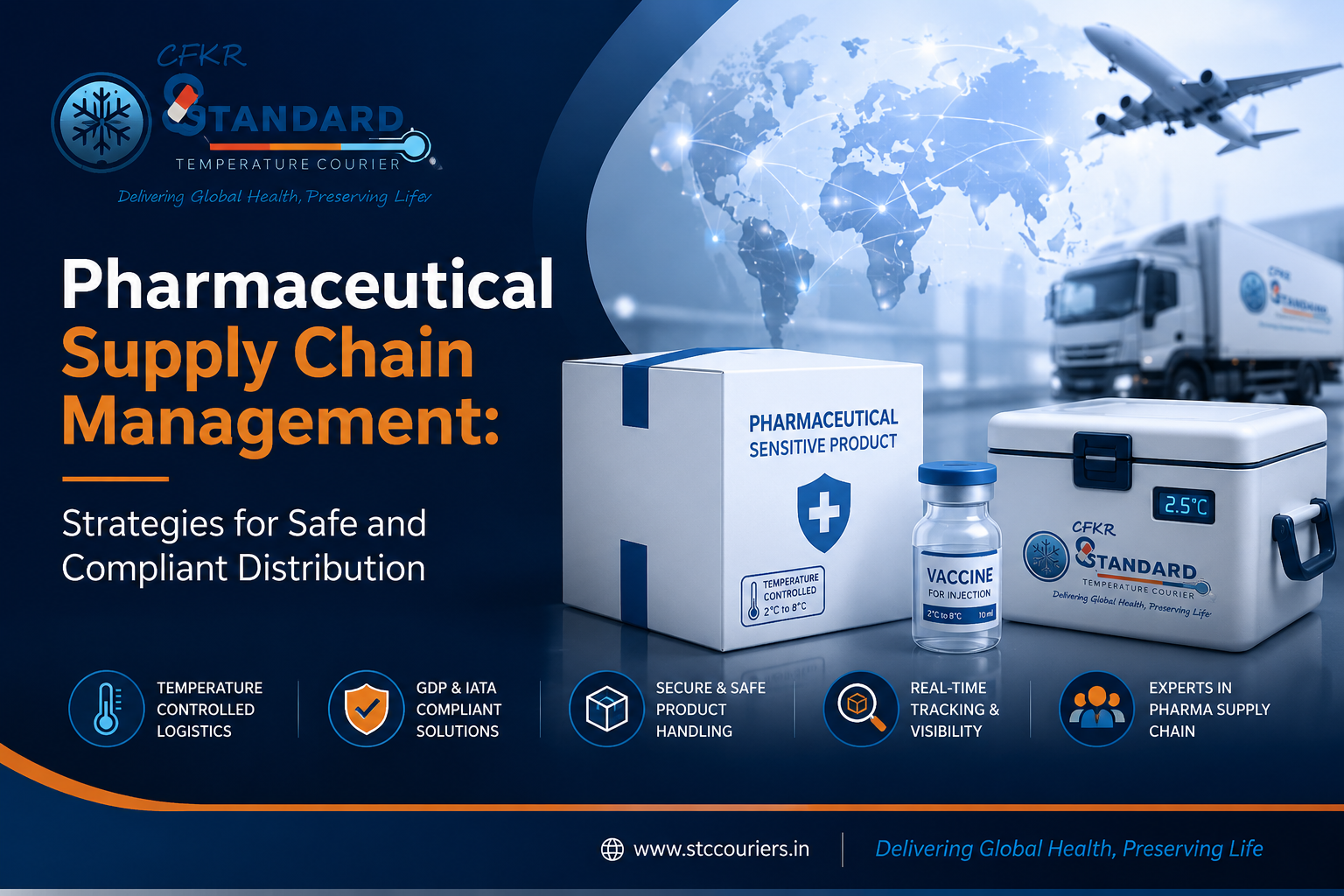
STC Couriers provides secure pharmaceutical supply chain management with temperature controlled logistics for safe and compliant deliveries.
Every medicine that reaches a hospital shelf or a patient’s hand has already traveled a long and carefully managed journey. That journey is what we call the pharmaceutical supply chain, and it covers everything from raw material sourcing and manufacturing to storage, transport, and final delivery. A single break in this chain, whether it is a temperature excursion, a delayed shipment, or a compliance gap, can turn a life saving drug into a wasted or even dangerous product. This is why supply chain management in the pharmaceutical industry has become one of the most closely watched areas of healthcare logistics today.
In this article, we will look at what pharmaceutical supply chain management actually involves, the biggest challenges companies face, and the strategies that keep distribution safe, compliant, and efficient. We will also compare different transport methods and approaches so you can see clearly where the risks lie and how they are managed.
What Is Pharmaceutical Supply Chain Management
Pharmaceutical supply chain management is the coordinated process of moving drugs, vaccines, biologics, and clinical trial materials from manufacturers to end users while protecting their quality, safety, and efficacy at every stage. Unlike ordinary retail logistics, this industry deals with products that are sensitive to temperature, light, humidity, and handling. A vaccine that sits outside its required temperature range for even a short time can lose its potency completely, and there is often no way to reverse that damage once it happens.
Because of this sensitivity, the pharmaceutical supply chain in India and globally is built around strict documentation, validated packaging, and continuous monitoring. Regulatory bodies expect full traceability, meaning every company involved should be able to show exactly where a shipment was, at what temperature, and for how long, at any point during transit.
Why Compliance Sits at the Center of Everything
Compliance is not a side requirement in pharma logistics, it is the foundation the entire system is built on. Regulators such as the World Health Organization set out Good Distribution Practice guidelines that describe how pharmaceutical products should be stored and transported to prevent contamination, counterfeiting, or degradation. You can read the WHO’s own guidance on this at their official site, which lays out the global standard that most national regulators build their own rules around.
In the United States, the FDA enforces similar requirements through its drug supply chain security regulations, while in India, the Central Drugs Standard Control Organisation, or CDSCO, sets the licensing and distribution rules that pharma companies and logistics partners must follow. A distributor working across borders needs to satisfy all of these frameworks at once, which is exactly why regulatory compliance has become a specialized skill within logistics rather than an afterthought. STC Couriers works directly within this framework through its dedicated approach to regulatory compliance, ensuring shipments meet GDP standards from pickup to final delivery.
The Real Challenges in Pharmaceutical Distribution
Anyone who has worked in this industry will tell you that the theory of compliance is one thing, but the day to day reality of moving temperature sensitive products across cities, countries, and continents is far harder. A few challenges come up again and again.
Temperature control remains the biggest concern, since many drugs and biologics need to stay within a narrow range, sometimes as tight as two to eight degrees Celsius, and any deviation can compromise the entire batch. Packaging failures are another common problem, where insulated boxes or gel packs are not validated properly for the specific route or duration of a shipment. Delays at customs or during transfers between transport modes also create risk, because every extra hour outside controlled conditions adds pressure on the product’s stability. Counterfeiting and diversion are ongoing threats too, particularly for high value biologics and vaccines, which is why serialization and track and trace systems have become standard practice. Finally, a shortage of skilled personnel who understand both pharmaceutical science and logistics operations continues to slow down the industry’s ability to scale reliable cold chain networks.
Comparing Transport Methods for Pharmaceutical Shipments
Not every pharmaceutical product needs the same type of transport. Choosing the wrong method is one of the most common and costly mistakes in this industry. The table below compares the three main categories used across the sector.
Transport Method | Typical Temperature Range | Common Products | Risk Level if Mismanaged |
Ambient Transport | 15°C to 25°C | Tablets, capsules, general OTC drugs | Low to moderate |
Cold Chain Logistics | 2°C to 8°C | Vaccines, insulin, most biologics | High |
Cryogenic Transportation | Below -150°C, often using liquid nitrogen | Cell and gene therapies, certain biologic samples | Very high |
Cryogenic transportation deserves special attention here because it deals with the most fragile and expensive products in the pharmaceutical world, including cell and gene therapies that are often irreplaceable once lost. STC Couriers has built a dedicated cryogenic transportation solution to handle exactly this category of shipment, using validated containers and continuous monitoring to keep ultra low temperatures stable across long distances. If your business ships biologics, cell therapies, or research samples that demand this level of precision, this is the kind of specialized service that separates a safe delivery from a costly loss.
Strategies for Building a Safer and More Compliant Supply Chain
Companies that consistently get pharmaceutical distribution right tend to follow a similar set of strategies, even if the details differ by product type or region.
The first strategy is investing in validated packaging and temperature-controlled logistics rather than treating packaging as a generic cost to minimize. Packaging that has been tested for the exact route, season, and duration of a shipment performs far better than a one size fits all solution. STC Couriers offers exactly this kind of tailored approach through its temperature controlled logistics services, which combine refrigerated transport with real time monitoring.
The second strategy is building end to end visibility through digital tracking. Real time temperature sensors, GPS tracking, and automated alerts allow logistics teams to catch a problem before it becomes a total loss, rather than discovering an excursion only after delivery. The Parenteral Drug Association, known as PDA, publishes extensive technical guidance on cold chain monitoring standards that many pharma companies and logistics providers reference when building these systems.
The third strategy is working with partners who understand both the science and the regulatory side of the industry, rather than treating pharma shipments the same as any other cargo. This is where pharmaceutical supply chain consulting becomes valuable, since consultants can help a company map its specific product risks, choose the right packaging and carrier combinations, and build documentation that satisfies regulators in every market it operates in.
The fourth strategy is planning for contingencies. Flight delays, customs holds, and equipment failures happen even with the best planning, so a resilient supply chain always has backup routes, spare packaging, and clear escalation procedures ready before they are needed.
The fifth strategy is training the people actually handling the product. Even the best packaging and technology fail if the person loading a truck does not understand why keeping a container upright or minimizing time on the tarmac actually matters. The International Air Transport Association, or IATA, runs specific training and certification programs for handling time and temperature sensitive pharmaceutical shipments by air, and many logistics providers now require this certification for their staff.
Traditional Versus Modern Approaches to Pharma Logistics
The pharmaceutical supply chain industry has changed significantly over the past decade, moving away from manual, paper based processes toward digital, data driven systems. The comparison below shows how the two approaches differ in practice.
Aspect | Traditional Approach | Modern Approach |
Temperature Monitoring | Manual checks at intervals | Continuous real-time sensors |
Documentation | Paper logs and manual entry | Digital records with automated alerts |
Route Planning | Fixed routes, limited flexibility | Dynamic routing based on live conditions |
Compliance Reporting | Reactive, after delivery | Proactive, tracked throughout transit |
Product Visibility | Limited to checkpoints | End-to-end tracking from pickup to delivery |
This shift is not just about convenience, it directly affects patient safety. A modern system that flags a temperature deviation within minutes gives a company the chance to intervene, reroute, or replace a shipment before it reaches a hospital, while a traditional system might only reveal the problem after the damage is already done.
The Role of Pharmaceutical Supply Chain Consulting
Not every pharmaceutical company, especially smaller manufacturers or clinical research organizations, has the internal expertise to design a fully compliant distribution network from scratch. This is where pharmaceutical supply chain consulting fills an important gap. Consultants typically start by auditing existing processes against regulatory requirements, identifying where packaging, documentation, or carrier selection falls short of what agencies like the FDA or CDSCO expect.
From there, consulting support usually extends into vendor selection, helping companies choose logistics partners with proven cold chain and cryogenic capabilities rather than general freight companies that lack pharma specific experience. Good consultants also help design contingency plans, train staff on handling procedures, and set up the kind of continuous monitoring systems that regulators increasingly expect to see as standard practice rather than an optional upgrade.
Why Cold Chain and Cryogenic Capability Matter More Than Ever
The pharmaceutical industry has shifted heavily toward biologics, cell and gene therapies, and mRNA based vaccines over the past several years, and all of these product categories are far more temperature sensitive than traditional small molecule drugs. The World Economic Forum has written about how this shift is putting pressure on cold chain infrastructure worldwide, particularly in regions where reliable refrigerated transport and storage are still being built out. You can read more about these global logistics trends on their website.
This growing complexity is exactly why specialized logistics providers matter so much in this space. A general courier service simply is not equipped to move a cell therapy shipment that must stay below minus one hundred and fifty degrees Celsius for the entire duration of transit. Providers who focus specifically on pharmaceutical and biotech logistics, like STC Couriers, build their entire operation, from packaging design to route planning to staff training, around meeting these exacting standards. This includes dedicated support for pharmaceutical supply chain shipments and clinical trial logistics, where a single missed deadline can delay an entire research study.
Practical Steps Companies Can Take Today
If you are responsible for pharmaceutical distribution, whether at a manufacturer, a research organization, or a distributor, there are a few practical steps worth prioritizing right away. Start by reviewing your current packaging validation data against the actual routes and seasons your products travel through, since packaging tested only in a lab may not hold up during a real world delay at customs. Next, check whether your logistics partners provide real time temperature data rather than post delivery reports, since the ability to intervene mid transit is what actually prevents losses. It is also worth reviewing your documentation processes to confirm they would hold up under a regulatory audit, not just a routine internal check. Finally, if your product portfolio includes biologics, cell therapies, or anything requiring cryogenic conditions, it is worth having a direct conversation with a logistics partner who specializes in that exact category rather than assuming a standard cold chain provider can handle it.
Conclusion:
Pharmaceutical supply chain management is not simply about moving boxes from one place to another. It is about protecting the integrity of products that patients depend on, often in situations where there is no room for error. The strategies that work, validated packaging, real time visibility, regulatory alignment, contingency planning, and trained personnel, all point toward the same conclusion, which is that specialized expertise matters more in this industry than in almost any other area of logistics.
Companies that treat compliance and temperature control as core parts of their operations, rather than boxes to check, consistently see fewer losses, fewer regulatory issues, and better outcomes for the patients who ultimately receive their products. If your organization is looking for a logistics partner who understands the full weight of these requirements, from standard cold chain shipments to the most demanding cryogenic transportation needs, STC Couriers has spent over thirty years building exactly that kind of expertise. You can learn more about their full range of services on their homepage.
Frequently Asked Questions
What is pharmaceutical supply chain management?
Pharmaceutical supply chain management is the process of planning, storing, and transporting drugs, vaccines, and biologics from manufacturers to end users while protecting their quality, safety, and compliance at every stage of the journey.
Why is temperature control so important in pharma logistics?
Most pharmaceutical products, especially vaccines and biologics, lose their potency or become unsafe if they move outside a specific temperature range, so temperature controlled logistics protects the product from the moment it leaves the manufacturer until it reaches the patient.
What is the difference between cold chain and cryogenic transportation?
Cold chain logistics typically keeps products between two and eight degrees Celsius, which suits vaccines and insulin, while cryogenic transportation involves much lower temperatures, often below minus one hundred and fifty degrees Celsius, used for cell and gene therapies and sensitive biological samples.
How does pharmaceutical supply chain consulting help a company?
Pharmaceutical supply chain consulting helps companies audit their current logistics setup, identify compliance gaps, choose the right packaging and carrier partners, and build monitoring systems that satisfy regulators such as the FDA and CDSCO.
What happens if a pharmaceutical shipment is not GDP compliant?
A shipment that fails to meet Good Distribution Practice standards can be delayed, rejected at customs, or destroyed by regulators, and in the worst cases it can put patient safety at risk if it enters the market despite quality issues.