
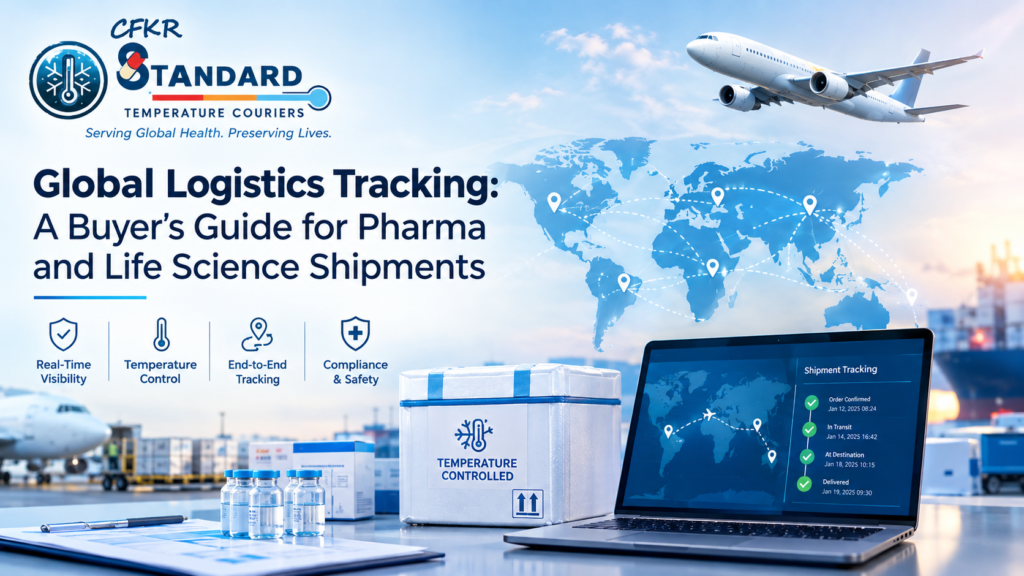
Global logistics tracking is the one thing most shippers only think hard about after something has gone wrong. A vaccine consignment sits at a customs bay for six hours with no temperature update. A biologic sample changes hands three times between two continents and nobody can say exactly where it is at 2 a.m. A finance team gets a claim for a spoiled shipment and has no event log to dispute it. If you are evaluating logistics partners right now, the quality of their tracking system is not a nice-to-have feature buried in a sales deck. It is the difference between a shipment you can defend to a regulator and one you cannot.
This guide is written for people who are close to making a decision: procurement leads, supply chain managers, and quality heads at pharmaceutical, biotech, and clinical research companies who need to pick a logistics partner and want to know exactly what separates a genuine tracking capability from a marketing claim.
What Global Logistics Tracking Actually Means for Regulated Shipments
Tracking, in the general courier world, usually means a barcode scan at a few checkpoints and a status update that says “in transit” for most of the journey. That is not sufficient for pharmaceutical, clinical trial, or biological cargo, and it is worth being precise about why.
A regulated shipment carries three layers of information that all need to be tracked together: location, condition, and custody. Location tells you where the package is. Condition tells you whether the temperature, humidity, or shock exposure stayed within validated limits. Custody tells you who touched the shipment, when, and under what documented authority. A courier tracking number only answers the first question. A logistics partner built for life sciences answers all three, continuously, and can produce that record on demand for an audit or a regulatory inquiry.
This is why the language changes once you move from parcel tracking to global logistics tracking for pharma and biotech freight. You are not just asking “where is my box.” You are asking “can I prove, six months from now, that this box never left its validated temperature range and that every handoff was authorized.” Those are very different systems to build.
Why Tracking Gaps Cost More in Life Sciences Than in Any Other Industry
In general cargo, a tracking blind spot means an annoyed customer and maybe a refund. In pharmaceutical logistics, a tracking gap during a customs hold or a transshipment point can mean an entire batch is quarantined, destroyed, or rejected by the receiving facility, even if the product was never actually compromised. Regulators do not accept “it was probably fine.” They want documented evidence, and undocumented gaps are treated as failures by default under Good Distribution Practice expectations set out by bodies such as the European Medicines Agency. A single missing data point in the chain of custody can force a company to write off a shipment worth far more than the freight cost itself.
The Real Cost of Poor Global Logistics Container Tracking
Container-level shipments deserve their own discussion because the failure points are different from air freight or last-mile parcels. A pharmaceutical container moving by ocean freight passes through port terminals, customs bonded areas, inland transport, and sometimes multiple carrier handoffs before it reaches a warehouse. Each of these transitions is a place where visibility commonly breaks down.
Weak global logistics container tracking usually shows up as long silent periods rather than dramatic failures. The container leaves the origin port and the next update does not arrive until it clears customs at the destination, sometimes days later. During that silent window, temperature excursions, rough handling, or delays caused by documentation errors go completely unnoticed until the container is opened. By then, there is nothing left to do except assess the damage.
A properly built tracking setup closes that window with milestone events at every transfer point: gate-in, vessel loading, departure, arrival, gate-out, customs clearance, and final delivery, each timestamped and, for cold chain cargo, paired with a temperature reading. When you are comparing quotes from logistics providers, ask specifically how many tracking checkpoints exist between origin and destination for container shipments, not just what the final delivery confirmation looks like.
Core Features to Demand From a Global Logistics Tracking Partner
Once you get past the sales language, most tracking claims reduce to a handful of concrete capabilities. Here is what each one actually needs to include before you treat it as a real feature rather than a promise.
Real-Time GPS and Temperature Data Together
Location data on its own tells you almost nothing useful for a temperature-sensitive shipment. The location feed needs to be paired with continuous condition monitoring from data loggers or connected sensors inside the packaging, and both streams need to be visible on the same interface. If a provider shows you a location map and a separate PDF temperature report that gets generated after delivery, that is not real-time monitoring. That is a reconciliation exercise, and reconciliation after the fact does not help you intervene during a temperature excursion.
Milestone and Event-Based Tracking, Not Just Status Labels
Ask what specific events trigger an update in the system. A mature tracking platform logs discrete events, such as pickup, customs submission, customs release, carrier handoff, and delivery, rather than a vague status like “in transit” that can mean anything from twenty minutes to three days. The air cargo industry has been standardizing this kind of event-level data sharing through frameworks such as IATA’s ONE Record standard, which creates a single, structured record of a shipment’s journey instead of fragmented updates across different systems. Similarly, GS1’s EPCIS standard gives supply chain partners a common way to capture and share the what, when, where, and why of a shipment as it moves. A logistics partner who can speak to how they capture and share this kind of event data is operating at a different level than one who can only describe a tracking portal.
Documentation and Customs Status Visibility
A large share of delays in international pharma shipments come from documentation issues at customs, not from the physical transport itself. Your tracking system should surface customs status as its own visible field, not bury it inside a generic delay notification. You want to know immediately if a shipment is held for missing paperwork, incorrect classification, or a licensing issue, because those are problems your team can often help resolve quickly if flagged in time.
Exception Alerts That Reach a Person, Not Just a Dashboard
A tracking dashboard that requires someone to log in and check it manually is only as good as the discipline of the person checking it. Exception-based alerting, where a deviation in temperature, an unexpected delay, or a failed handoff automatically triggers a notification to a named contact, is what actually prevents small problems from becoming spoiled shipments. When you evaluate a provider, ask them to walk through exactly what happens, step by step, from the moment a sensor reads outside the validated range to the moment a human on your team is notified.
How Global Logistics Tracking Is Evolving in India
If your supply chain runs through India, either as an origin, a destination, or a transit point, the tracking landscape has shifted meaningfully in the last few years and it is worth understanding the direction before you commit to a provider.
India moved up to 38th place out of 139 countries in the World Bank’s Logistics Performance Index 2023, a measurable improvement driven partly by digital reforms in how shipments are tracked across the country. The government’s Unified Logistics Interface Platform and the Logistics Data Bank initiative have digitized track and trace for containerized export-import cargo, a change the Ministry of Commerce and Industry has pointed to directly as part of the country’s improved standing on tracking and tracing as a specific LPI parameter, alongside the National Logistics Policy launched to reduce logistics costs and improve last-mile visibility, according to a press release from the Press Information Bureau of India.
What this means practically for a pharma or biotech shipper is that infrastructure-level tracking data is becoming more available across Indian ports and inland transit points than it was five years ago. But infrastructure-level data and shipment-level accountability are not the same thing. A national digital backbone can tell you where containers generally sit in the system. It does not replace a logistics partner’s own responsibility to monitor your specific shipment’s temperature, custody, and documentation status and to act on deviations in real time. When you evaluate providers operating in the Indian market, ask how they layer their own monitoring and alerting on top of these national systems, rather than assuming government digitization alone covers your compliance needs.
Comparing Tracking Capabilities: What Separates Good Providers From Great Ones
Most logistics companies can show you a tracking portal during a sales pitch. Fewer can explain what happens when that portal shows something wrong.
A good provider gives you visibility. A great provider gives you visibility plus a documented response protocol for every type of exception, plus a track record of catching problems before they become claims. When you are down to a shortlist of two or three vendors, the conversation should move past “can you track my shipment” and into “show me a redacted example of a real temperature excursion event and walk me through exactly what your team did, in what order, and how quickly.” Providers who have genuinely built this capability will have a specific, rehearsed answer. Providers who have not will describe generic escalation policies without concrete timelines.
It also matters whether the tracking system integrates with your own quality management processes. If your team has to manually re-enter data from a provider’s portal into your own deviation reports, you are adding a manual step that introduces error and delay into a process that regulators expect to be tight. Ask whether the provider can export structured data or integrate directly with your systems, rather than only offering a dashboard you have to check by hand.
Questions to Ask Before You Sign With a Global Logistics Tracking Provider
How many tracking checkpoints exist between pickup and final delivery for my specific lane?
Get a number and a list of what each checkpoint captures. A vague answer here is a warning sign.
What happens in the first fifteen minutes after a temperature excursion is detected?
This single question separates providers who have built a real exception protocol from those who have not thought past the sensor itself.
Can you provide tracking and temperature data as structured, exportable records for regulatory audits?
If the answer involves screenshots or PDFs generated manually after the fact, factor in the extra work your quality team will absorb.
How is tracking handled during customs holds specifically?
This is where visibility most commonly breaks down, and a provider with strong customs relationships and documentation practices will have a concrete answer rather than a shrug.
Who is my named point of contact if something goes wrong outside business hours?
Global shipments do not stop moving at 6 p.m. Your provider’s tracking and response capability should not either.
Why Pharma and Biotech Companies Choose STC Couriers for Global Logistics Tracking
CFKR STC Couriers has spent more than thirty years building cold chain logistics capability specifically for pharmaceutical and life sciences shippers, and tracking has been engineered into that experience rather than added as an afterthought. Every shipment placed through our global logistics network is assigned a unique reference number the moment it is booked, giving your team real-time visibility from pickup through final delivery, backed by regular progress updates rather than a static status page.
For shipments where regulatory documentation matters as much as the physical transport, our approach to regulatory compliance is built into the same tracking workflow, so customs status, temperature records, and chain-of-custody documentation live in one place instead of scattered across separate systems your team has to reconcile manually. We have also written in more detail about how this fits into the broader compliance picture in our breakdown of what pharmaceutical regulatory compliance in cold chain shipping actually requires, which is worth reading if your team is preparing for an audit or a new market entry.
If you are currently comparing providers and want to see exactly how our tracking and exception response works for a shipment profile like yours, including specific SLAs and named contact protocols, reach out to our team for a direct walkthrough rather than a generic brochure.
Frequently Asked Questions
What is global logistics tracking?
Global logistics tracking is the system a logistics provider uses to monitor a shipment’s location, condition, and chain of custody across international transport, from pickup at origin to final delivery. For pharmaceutical and biotech cargo, this typically includes GPS location, continuous temperature and humidity monitoring, and documented handoffs at every transfer point.
How is global logistics container tracking different from parcel tracking?
Container tracking follows freight through port terminals, vessel transit, customs clearance, and inland transport, with far fewer natural checkpoints than a parcel network. Because containers can sit unmonitored for long stretches between milestones, strong container tracking depends on capturing events at every gate transfer and customs stage rather than relying on a single origin and destination scan.
Why does temperature tracking matter as much as location tracking for pharma shipments?
Regulators evaluate pharmaceutical shipments based on whether the product stayed within its validated temperature range throughout transport, not just whether it arrived on time. A shipment that arrives on schedule but experienced an undocumented temperature excursion can still be rejected or quarantined, which is why condition data has to be tracked with the same rigor as location data.
Is India’s logistics tracking infrastructure reliable enough for pharma exports?
India has made measurable progress, including a six-place improvement in the World Bank’s Logistics Performance Index and the rollout of digital initiatives such as the Unified Logistics Interface Platform. That said, national infrastructure improvements do not replace the need for a logistics partner who actively monitors and responds to your specific shipment’s condition and documentation status in real time.
What should I ask a logistics provider before signing a contract for temperature-sensitive shipments?
Ask how many tracking checkpoints exist on your specific route, what the exception response protocol looks like in the first fifteen minutes after a deviation, whether tracking and temperature data can be exported for regulatory audits, and who your named contact is outside normal business hours.
How quickly should a logistics provider respond to a temperature excursion alert?
There is no universal number, but a credible provider should be able to describe a specific, rehearsed response sequence, including who gets notified, what immediate mitigation steps are taken, and how the incident is documented, rather than a vague commitment to “respond quickly.”