
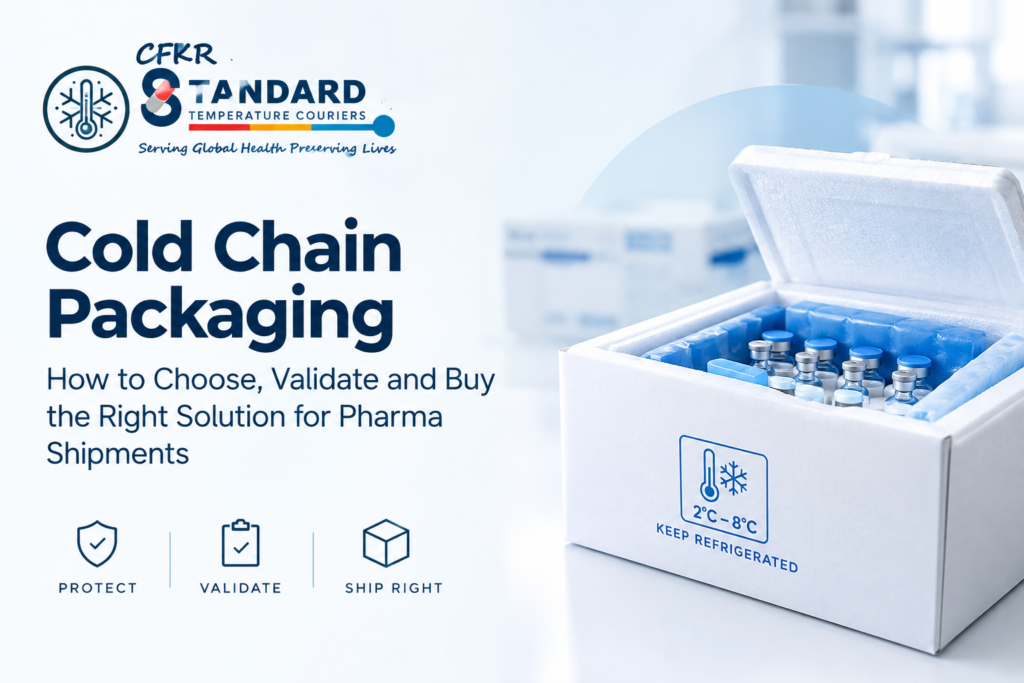
Cold chain packaging is the part of your logistics that decides whether a shipment arrives usable or gets rejected at the door. A refrigerated truck or a cargo hold with air conditioning is not what protects a vaccine, biologic or clinical sample for 72 hours across three handovers. The packaging system does that work, and it has to be designed, tested and documented for the exact route you plan to run.
This guide is written for people who are already past the “what is it” stage. If you are comparing vendors, preparing an RFQ, or trying to fix a shipment that keeps failing, the sections below cover what to specify, what proof to ask for, what drives price, and how to avoid the mistakes that cost the most money. You will also see how STC Couriers approaches packaging technology for pharma and life sciences customers, so you can judge whether it fits your requirements.
What Cold Chain Packaging Actually Includes
Many buyers think of a box and a few gel packs. A proper cold chain packaging system has four connected parts: the outer shipper, the insulation, the refrigerant and the monitoring device. Each one affects the others, and changing a single part without retesting the whole assembly invalidates the thermal performance you were promised.
The outer shipper protects the contents from impact, compression and moisture. The insulation slows heat transfer. It may be expanded polystyrene, polyurethane foam, or vacuum insulated panels, which offer far better performance per unit of thickness. The refrigerant provides the thermal mass that holds temperature. It could be water-based gel packs, phase change materials tuned to a specific temperature, or dry ice for frozen loads. The monitoring device records what actually happened inside the box, which is the evidence you need when a quality team asks whether the product can be released.
When people say cold packaging, they usually mean this entire assembly rather than any single component. When a vendor sells you cold chain packaging solutions, you should expect them to deliver the assembly as a tested configuration, with a written pack-out instruction that tells the person at your dispatch dock exactly how to load it.
Why Packaging Fails More Often Than Vehicles Do
Temperature excursions rarely happen on the highway. They happen at the points where a shipment sits still or changes hands: the airport ramp waiting for a flight, a customs inspection hall, a sorting hub over a weekend, or a doorstep when nobody is available to receive. Refrigerated vehicles cannot help during those gaps, because the product is outside the vehicle. Only the packaging protects it.
This is the reason regulators focus on the whole distribution chain. The European Commission’s guidelines on Good Distribution Practice for medicinal products require that products stay within labelled storage conditions during transport and that the distributor can demonstrate it. The World Health Organization’s model guidance on storage and transport of time and temperature sensitive pharmaceutical products makes the same point from a global perspective, with specific attention to packaging qualification and the handling of delays.
If your current process relies on “we always use a cooler with ice packs and it has been fine,” you are likely running on luck and mild weather. One hot week, one missed connection, or one new lane exposes the gap.
Match the Packaging to the Temperature Range of Your Product
The temperature requirement on your product label is the first filter. Everything else follows from it, and mixing up ranges is one of the most common and expensive errors.
Refrigerated Range: 2°C to 8°C
This is the most common requirement in pharma shipping. It covers most vaccines, insulin, many biologics, monoclonal antibodies and numerous diagnostic reagents. The difficulty is that the window is narrow at both ends. Freezing damages many of these products as seriously as overheating does, and some vaccines lose potency permanently after a single freeze event.
That makes direct contact between product and frozen gel packs a real risk. A properly designed 2°C to 8°C system uses conditioned refrigerants, meaning gel packs brought to a specified temperature before loading, or phase change materials that melt at around 5°C and so cannot push the load below freezing. The CDC’s vaccine storage and handling toolkit is a useful reference for the consequences of both freezing and heat exposure on vaccine potency.
For a detailed look at what a logistics partner must control on this range, read STC’s article on 2°C to 8°C pharmaceutical shipping.
Controlled Room Temperature: 15°C to 25°C
Many people assume room temperature products need no special packaging. In practice, a parcel sitting on a tarmac in an Indian summer or a European winter can leave this range quickly. Insulated shippers with phase change materials set around 20°C protect these products without the cost of a refrigerated system. This range is often ignored during vendor selection, then becomes a problem during the first monsoon or the first cold snap.
Frozen Range: -25°C to -15°C
Frozen biologics, certain plasma products and some clinical materials fall here. Packaging for this range usually uses frozen gel bricks or phase change materials designed for sub-zero melting points. Dry ice is an option but brings regulatory obligations discussed below.
Ultra-Cold Range: -80°C to -60°C
Some mRNA products and certain research materials need ultra-cold conditions. These shipments typically use dry ice in carefully sized shippers, with the quantity calculated for the planned transit time plus a safety margin for delay.
Cryogenic Range: Below -150°C
Cell and gene therapies, including CAR-T products, often travel in liquid nitrogen dry vapour shippers. These units hold a very low temperature for several days without liquid nitrogen pouring out, which matters for air transport safety. If your pipeline includes living cells, the packaging decision is tied to the entire chain of custody. STC covers this through its cryogenic transportation and cell and gene supply chain services.
Passive and Active Packaging: Which One Should You Buy
Once the range is clear, the next decision is whether to ship in a passive or an active system.
Passive packaging contains no power source. It depends on insulation and refrigerant mass, and it performs for a fixed duration. Most pharma parcel and air freight shipments use passive systems because they are lighter, cheaper per shipment, and easier to ship across borders. A well-designed passive shipper can hold 2°C to 8°C for 48, 72, 96 or even 120 hours depending on construction and outside conditions.
Active packaging uses a compressor, thermoelectric cooling or a powered container to maintain temperature. These are suited to high-value, long-duration or large-volume loads, such as pallet shipments where passive protection would be impractical. They cost more to rent or buy and add complexity around battery rules and returns, so they make sense when the shipment value or the route risk justifies them.
For most customers shipping boxes, cartons and small pallets, passive packaging offers the best balance. Choose active when the load is large, the transit is long, or the route includes unpredictable stops that a passive system cannot cover.
Single-Use Versus Reusable Cold Chain Packaging
The same decision appears in nearly every procurement meeting. Single-use shippers cost less up front, require no return logistics and carry no cleaning or requalification burden. They suit irregular shipments, one-way international lanes, and clinical trial sites that cannot be relied on to return empty containers.
Reusable shippers cost more per unit but spread that cost across many trips. They suit repeating lanes with a predictable return path, such as regular distribution between your own facilities or to a stable network of distributors. The hidden cost is the return process: collection, inspection, cleaning, refrigerant reconditioning and tracking. If your return rate drops, the economics collapse quickly.
A practical rule: if more than a handful of shipments per month run the same lane and you control both ends, evaluate reusable. If your destinations vary or you ship to external parties, single-use is usually cheaper once you count the real cost of getting boxes back.
What Validation Means and What Proof You Should Demand
This is where serious buyers separate themselves from casual ones. Any supplier can claim their box holds temperature for 72 hours. The question is whether they can show data proving it under conditions that match your route.
Qualification typically has stages. Design qualification confirms the packaging design is suitable for its intended purpose. Operational qualification tests the pack-out under controlled conditions in a thermal chamber, usually running summer and winter temperature profiles. Performance qualification confirms the system works on actual shipping lanes. Ask for each stage, and ask for the raw data, not only a summary certificate.
The International Safe Transit Association publishes test procedures that simulate the vibration, shock and compression of real distribution. ISTA standards are widely used to check that a package survives physical handling, and many thermal packaging suppliers test to them in addition to thermal qualification. A box that holds temperature in a chamber but cracks after a drop test will fail on the first rough sorting line.
When you review a supplier’s validation package, check these things in prose form rather than trusting a checklist from the vendor. First, does the tested payload match yours in size, mass and thermal behaviour? A box qualified with a half-empty load will behave differently with a full one. Second, do the temperature profiles reflect your lanes, including the hottest and coldest conditions you expect? Third, is the tested duration longer than your planned transit, with margin for delay? Fourth, is the pack-out procedure documented clearly enough that a different person on a different shift will assemble it the same way? Fifth, were the data loggers calibrated and traceable?
If a supplier hesitates on any of these, treat it as a warning about how they will behave when a shipment fails.
Dry Ice, Dangerous Goods and Air Transport Rules
Dry ice solves the problem of keeping products frozen or ultra-cold, but it creates regulatory requirements that surprise many first-time shippers. Dry ice is classified as a dangerous good for air transport under UN1845 because it releases carbon dioxide gas as it sublimates. Packaging must allow gas to escape, labelling must follow the rules, and the quantity per package must be declared.
The IATA Temperature Control Regulations set out the framework for transporting time and temperature sensitive healthcare products by air, including requirements for packaging, handling and documentation. Airlines can refuse a shipment that arrives with incorrect labelling, wrong dry ice declarations or damaged packaging, and the product sits on the ground while the clock runs.
If your shipment includes dry ice, liquid nitrogen shippers, lithium batteries in active containers, or infectious substances, make sure your logistics provider can handle dangerous goods documentation. STC lists dangerous goods as a specific service area, which matters because a single declaration error can ground a consignment.
Data Loggers and Real-Time Monitoring
Packaging performance is a claim until you can see the temperature trace. Data loggers placed inside the shipper record temperature at set intervals, and the file becomes part of your batch release evidence.
There are two main types. Standalone loggers record continuously and are read after delivery. They are inexpensive but give you information only after the fact. Real-time trackers transmit location and temperature while the shipment moves, which lets a control tower intervene before an excursion becomes a rejection. For high-value biologics, clinical trial material and cell therapies, real-time visibility often pays for itself the first time it prevents a loss.
Where you place the logger matters. A sensor taped to the inside wall will read very differently from one placed next to the product. Specify the position in the pack-out instruction, and make sure the logger’s calibration certificate travels with the file.
STC supports shipment visibility through STC Couriers Connect, which provides tracking so customers do not have to chase updates by phone.
Seasonal and Lane-Specific Design
A pack-out that works in October may fail in May. Cold chain packaging has to be designed for the extremes of the lane, not the average. Summer profiles in India can push ambient temperatures far above what many standard shippers were tested for. Winter shipments to northern destinations can threaten freezing of 2°C to 8°C products. Customs delays add hours that no schedule predicts.
Good suppliers offer seasonal pack-outs: a summer configuration with more refrigerant mass, and a winter configuration with protective layers or different conditioning to avoid freezing. If your supplier gives you one pack-out for the entire year, ask how they covered both extremes in qualification.
Duration is the other variable. Qualify for the planned transit time plus a buffer, usually 24 hours or more depending on lane risk. A 48-hour box on a 48-hour lane has no room for a missed flight. Many failures trace to this single mistake: a package qualified exactly to the schedule, with the schedule then slipping.
What Drives the Price of Cold Chain Packaging Solutions
Buyers often compare quotes on the packaging unit price and then discover the real cost sits elsewhere. When you evaluate cold chain packaging solutions, build the comparison around total cost per successful delivery.
The unit price of the shipper is the visible part. Insulation material has the biggest effect: vacuum insulated panels cost more than polystyrene but allow thinner walls, lower weight and sometimes cheaper freight. Refrigerant type and quantity add to the cost, and dry ice requires replenishment if the route is long.
Weight and volume affect freight charges, especially by air. A heavier or bulkier shipper can cost more to fly than the shipper itself costs to buy. This is why lightweight, high-performance insulation often wins on total cost even when its sticker price is higher.
Return logistics matter for reusable systems, as discussed earlier. Validation and requalification costs apply whenever you change product, route or packaging. Data loggers add per-shipment or per-unit cost. And the largest hidden cost is failure: a rejected shipment of a high-value biologic can cost many times the entire packaging budget for the year.
Ask each vendor to quote on the same assumptions: payload size, temperature range, duration, lanes, season, monitoring requirement and shipment volume. Quotes built on different assumptions cannot be compared fairly.
How to Evaluate a Cold Chain Packaging Provider
At the decision stage, the provider matters as much as the product. A good box from a weak operator still fails because of how it is loaded, handed over and tracked.
Start with regulatory credibility. The provider should operate to Good Distribution Practice principles and be able to explain how those apply to your shipments. Review the regulation and certification page of any candidate and ask for evidence beyond claims. For STC’s approach, see the regulatory compliance overview.
Next, test their experience with your product category. A provider that handles routine pharmaceuticals may not understand the handling needs of clinical trial samples, cell therapies or lab specimens. If you run trials, check whether they support clinical trial logistics, including site-level coordination, import permits and chain of custody. If your focus is the wider distribution network, look at their pharmaceutical supply chain capabilities.
Then examine how packaging connects to the rest of the service. The strongest offers combine packaging design, transport mode selection, documentation and tracking under one accountable party. When packaging comes from one vendor, transport from another and monitoring from a third, nobody owns the failure. A provider with an integrated cold chain service gives you a single point of responsibility.
Finally, look at response behaviour. Ask how they handle an excursion at 2 a.m. on a Saturday. Ask who you call, what authority that person has, and how quickly they can reroute, re-ice or replace a shipment. The answer tells you more than any brochure.
STC has also published a companion guide on how to choose a cold packaging provider you can trust, which pairs well with this one if you are building a vendor shortlist.
How STC Couriers Approaches Cold Chain Packaging
STC Couriers, operating as CFKR STC Couriers, has more than 30 years of experience in temperature-controlled pharmaceutical logistics. The company serves pharmaceutical, biotech, clinical trial and laboratory customers with air freight, ocean freight and express shipping, supported by validated packaging for biological samples and bulk drug shipments.
What this means in practice is that packaging is selected as part of the shipment plan rather than sold as an add-on. The process starts with your product’s temperature requirement, payload dimensions, origin, destination, transit mode and season. From there the team recommends a configuration, defines the pack-out instruction, and sets the monitoring approach. Pickup is scheduled, the shipment moves in controlled transit, and tracking updates keep you informed through delivery.
The coverage extends across the temperature spectrum and across product types, from standard 2°C to 8°C pharma shipments to cryogenic cell and gene therapy materials and regulated lab logistics. If you operate across several of these categories, working with one partner removes the need to manage separate vendors with different standards.
You can review the full packaging technology offering or contact the team directly to discuss a specific lane.
Common Mistakes That Lead to Failed Shipments
Most cold chain failures come from a small set of repeated errors. Knowing them helps you ask better questions during procurement.
The first is using a pack-out that was never tested for the actual route. A box qualified in a laboratory chamber at one profile may not hold on a lane with different extremes. The second is skipping conditioning. Gel packs loaded at the wrong temperature either freeze the product or fail to hold the range. Conditioning time and temperature must be written into the procedure and followed.
The third is inconsistent packing. When different staff assemble the same box differently, performance varies. Visual pack-out guides, photographs at each step and trained dispatch staff reduce this risk. The fourth is under-specifying duration. As noted earlier, a box qualified to the exact scheduled transit has no margin for delay.
The fifth is ignoring the destination. Delivery to a clinic that closes at noon on Friday, or to an address nobody monitors, leaves the shipment exposed regardless of how good the packaging is. Confirm receiving hours, contacts and storage readiness before dispatch. The sixth is poor documentation. Missing import permits, incorrect labelling or unclear dry ice declarations cause holds that burn through the thermal life of the shipper.
A Practical Process for Buying Cold Chain Packaging
If you are ready to move from research to action, a simple sequence keeps the process efficient and defensible.
Begin by writing a specification. Include the product name and category, the required temperature range, the dimensions and weight of the payload, the planned origin and destination, the transit mode, the expected duration, the season, the monitoring requirement, and your monthly shipment volume. Having this document ready speeds every vendor conversation and forces internal agreement before quotes arrive.
Request qualification evidence from each shortlisted provider and compare it against your specification. Run a pilot on your hardest lane rather than your easiest, because that is where weaknesses appear. Review the logger data from the pilot, check the pack-out instruction with the people who will actually do the work, and confirm how excursions are escalated.
Only then negotiate pricing, using total cost per successful delivery as the comparison. Include the cost of logger devices, requalification, return logistics and expected failure rates. A provider with a slightly higher unit price and a much lower failure rate is almost always the cheaper choice.
Finally, set a review cycle. Revisit packaging performance after each season and whenever your product, lanes or volumes change. Cold chain packaging is not a one-time purchase. It is an ongoing control that needs maintenance as conditions change.
Request a Validated Cold Chain Packaging Quote
If you ship temperature-sensitive pharmaceuticals, biologics, clinical samples or cell and gene therapy materials, the quickest way to find out whether a packaging solution fits is to test it against your actual lane. Share your product temperature range, payload size, route and timeline, and the STC Couriers team will recommend a validated configuration with a clear pack-out process and tracking.
Call +91 77991 03311 or contact STC Couriers to request a quote. You can also review the locations the company covers before you reach out.
Frequently Asked Questions About Cold Chain Packaging
What is cold chain packaging?
Cold chain packaging is a tested system of insulated containers, refrigerants and monitoring devices that keeps temperature-sensitive products within a defined range during storage and transport. It is designed and validated for a specific temperature range, payload and transit duration.
How long can cold chain packaging maintain 2°C to 8°C?
It depends on the design. Qualified passive shippers commonly hold the range for 48 to 120 hours under tested conditions. The real duration on your lane depends on ambient temperature, payload size, how the pack-out is assembled and how long the shipment sits outside controlled environments.
What is the difference between cold packaging and cold chain packaging solutions?
Cold packaging usually refers to the physical container and refrigerant. Cold chain packaging solutions describe the full offer: validated design, pack-out instructions, monitoring, documentation and logistics support. For regulated products, the full solution is what protects you.
Should I choose passive or active cold chain packaging?
Passive systems suit most parcel and air freight shipments because they are lighter and cheaper. Active systems suit large pallet loads, long transits or high-value shipments where powered temperature control is justified. Match the choice to load size, duration and route risk.
Is dry ice allowed on flights?
Yes, within limits. Dry ice is regulated as a dangerous good for air transport under UN1845, so packaging must vent gas, labels must be correct, and the quantity must be declared. Shipments that fail these requirements can be refused by the airline.
Do I need data loggers in every shipment?
For pharmaceutical products, temperature records are normally needed to support release decisions and regulatory expectations. Standalone loggers give you a record after delivery. Real-time trackers add live visibility, which is valuable for high-value or time-critical shipments.
How do I know if packaging has been properly validated?
Ask for design, operational and performance qualification data, including the temperature profiles tested, the payload used, the duration and the logger calibration records. Confirm the testing matches your product, lane and season, and that physical transit testing, such as ISTA procedures, was also performed.
Are reusable shippers cheaper than single-use shippers?
Only on stable, repeating lanes where you can reliably get the containers back. If return rates are low or destinations vary, single-use packaging is often cheaper once you include collection, cleaning and reconditioning costs.
Can STC Couriers support cell and gene therapy shipments?
Yes. STC offers cryogenic transportation and a dedicated cell and gene supply chain service for products that require very low temperature and strict chain of custody control.
How do I get a quote for cold chain packaging from STC Couriers?
Share your product temperature range, payload dimensions, origin, destination, transit time and expected volume. You can call +91 77991 03311 or use the contact page to start the conversation.