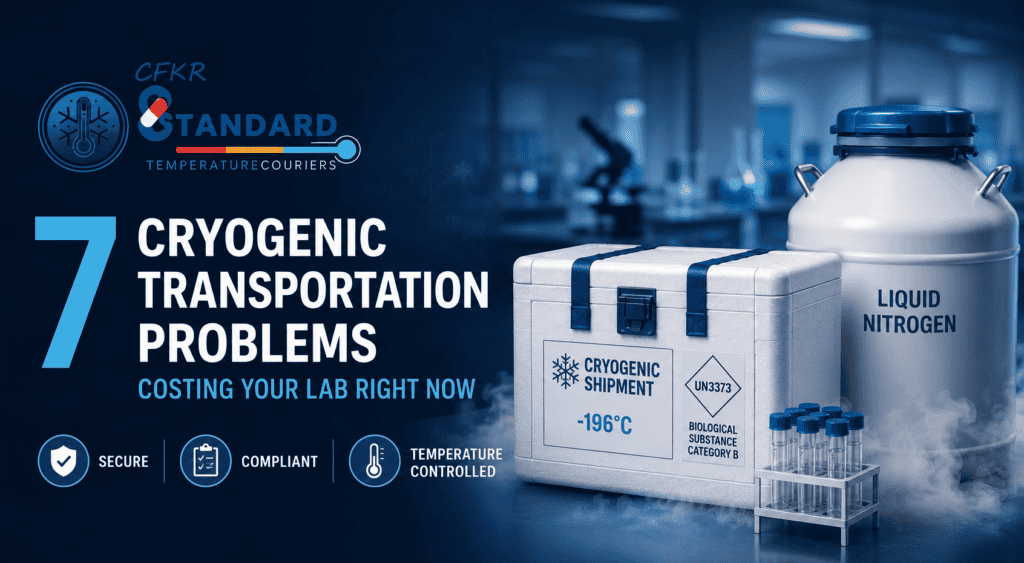
7 Cryogenic Transportation Problems That Are Costing Your Lab Right Now (And How to Solve Them)
You did not get into laboratory work to spend your time worrying about couriers. But here you are, double-checking tracking links, calling drivers who do not pick up, and holding your breath every time a cryogenic shipment leaves your facility. Something is wrong with that picture. The truth is that most labs, hospitals, and research facilities are quietly absorbing losses they should never have to deal with. Compromised samples. Delayed deliveries. Missing paperwork. Failed audits. All because the courier they are using was never built for this kind of work. This blog is not a general overview of cryogenic logistics. It is a direct answer to the specific problems that come up again and again when temperature-sensitive materials are trusted to the wrong hands. If any of these sound familiar, STC Couriers has already solved them. Problem 1: Your Samples Are Arriving Compromised and You Do Not Know Why This is the most painful problem in cryogenic transportation and also the most common. The sample leaves your facility in perfect condition. It arrives at the destination degraded, partially thawed, or completely unusable. And when you ask the courier what happened, they have no answer because they were not monitoring anything. The cause is almost always one of three things. The packaging was not validated for the duration of the journey. The driver left the container in a warm vehicle for too long during a stop. Or the dry ice or liquid nitrogen was not sufficient for the route. None of these things are detectable after the fact unless someone was recording temperature continuously throughout the transit. Without a data logger inside the shipment, you are flying blind. You have no way of knowing when the excursion happened, how long it lasted, or whether it is likely to happen again. The fix: Every STC Couriers cryogenic shipment includes a calibrated temperature data logger that records continuously from collection to delivery. When your sample arrives, you receive a full temperature report alongside your delivery confirmation. If there was an excursion, you know exactly when it happened and for how long. If everything held, you have the documentation to prove it. Either way, you are no longer guessing. Problem 2: You Cannot Pass Your Compliance Audit Because Your Transport Documentation Is a Mess If your facility is subject to CQC inspection, MHRA oversight, HTA licensing, or research governance audits, you already know that transport documentation is not optional. Auditors want to see a documented chain of custody from collection to delivery, temperature records for every cryogenic shipment, evidence that your courier is compliant with the relevant regulations, and confirmation that your packaging meets the required standard. Most standard couriers give you a delivery signature. That is it. No temperature data. No chain of custody record. No compliance documentation. When the auditor asks for evidence, you have nothing to show them. According to the UK Health Security Agency guidance on transport of biological specimens, shippers are responsible for ensuring that biological materials are transported in a compliant manner. That responsibility does not transfer to the courier. It sits with you. So if your courier is not giving you the documentation you need, your facility is exposed. The fix: STC Couriers provides complete chain of custody documentation as standard on every shipment. This includes collection time and name, temperature at point of collection, continuous temperature record throughout transit, delivery time, and recipient signature. Everything is stored and available for audit on request. When your auditor asks for transport records, you can produce them immediately. Problem 3: Your Courier Has No Idea What They Are Carrying This one is uncomfortable to think about but important to face. If you handed a liquid nitrogen dewar to your current courier driver and asked them to explain what it is, what the risks are, and what to do if it starts venting, could they answer? In most cases, no. General courier drivers are not trained in cryogenic materials. They do not know that liquid nitrogen can displace oxygen in a confined space and become a serious safety hazard. They do not know how to handle dry ice safely or what the regulations say about transporting UN1845. They are treating your irreplaceable biological samples the same way they treat a box of shoes. Beyond the safety risk to the driver and others, this creates a direct risk to your samples. Improper handling during transit, incorrect positioning of dewars, exposure to heat sources, all of these things happen when the person carrying your materials does not understand what they are. The IATA Dangerous Goods Regulations require that anyone handling biological substances and cryogenic materials in transit holds current training certification. That certification needs to be renewed every two years. If your courier cannot produce training certificates, they are not compliant, and neither is your shipment. The fix: Every STC Couriers driver and handler who works with cryogenic and biological materials holds current IATA Dangerous Goods certification. They know what they are carrying, how to handle it safely, and what to do in the event of an incident. You are not handing your samples to someone who is guessing. You are handing them to someone who has been trained specifically for this. Problem 4: You Have No Idea What to Do When Something Goes Wrong in Transit Picture this. A temperature alarm fires on a shipment halfway through a six-hour journey. The sample is at risk. Every minute matters. What happens next? If your current courier has no monitoring system, the answer is nothing happens. No one knows there is a problem until the driver opens the box at the destination. By then it is too late. Even if you do have some monitoring in place, what is the escalation process? Who gets called? What decisions can be made in transit to protect the sample? Is there a protocol, or is the driver just going to keep driving and hope for the best? The absence of a clear incident protocol is